Two-dimensional Triblock Peptide assemblies for the stabilization of Pickering emulsions with pH responsiveness
Huang, Zhiwei ; Calicchia, Eleonora ; Jurewicz, Izabela ; Muñoz, Edgar ; Garriga, Rosa (Universidad de Zaragoza) ; Portale, Giuseppe ; Howlin, Brendan J. ; Keddie, Joseph L.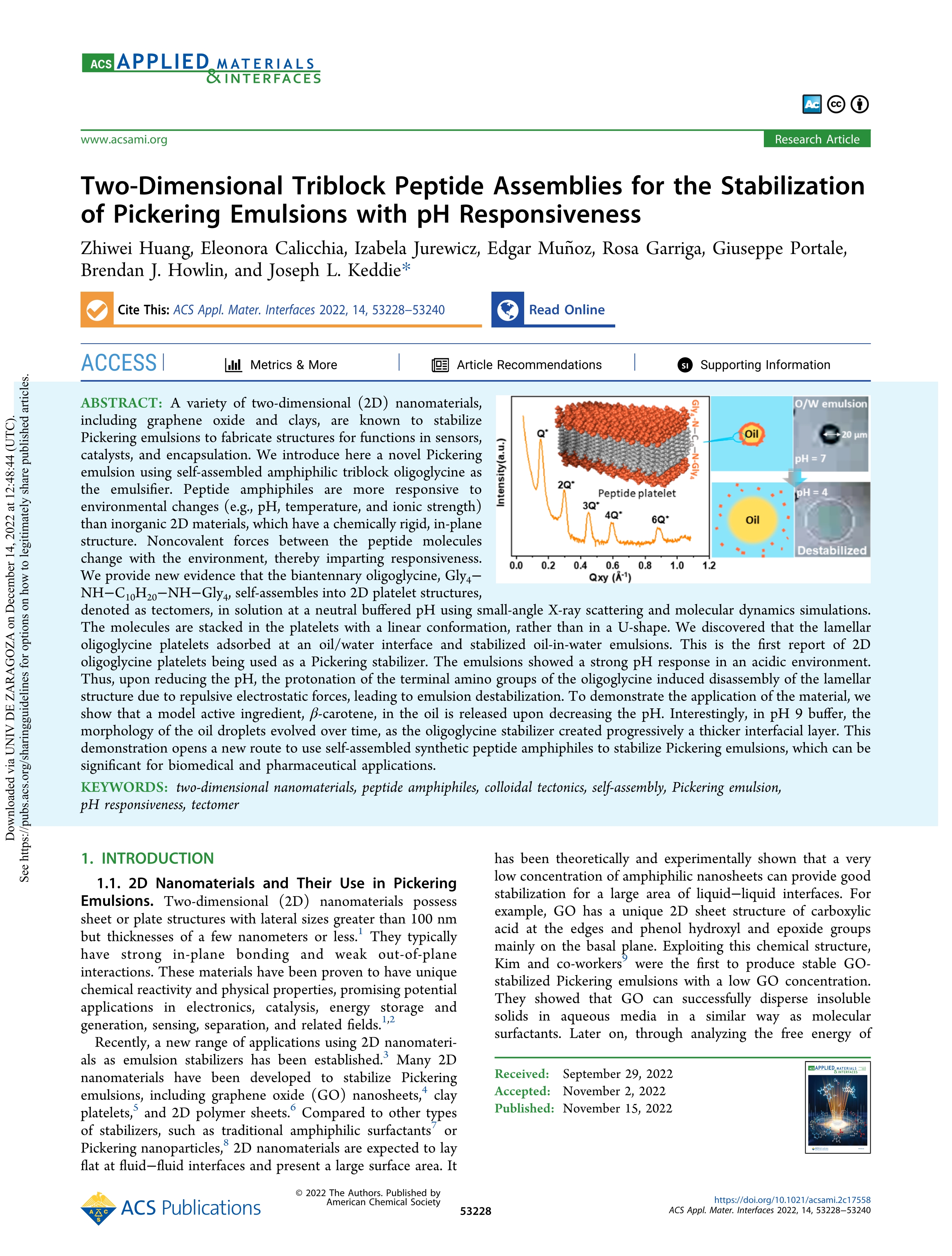
Resumen: A variety of two-dimensional (2D) nanomaterials, including graphene oxide and clays, are known to stabilize Pickering emulsions to fabricate structures for functions in sensors, catalysts, and encapsulation. We introduce here a novel Pickering emulsion using self-assembled amphiphilic triblock oligoglycine as the emulsifier. Peptide amphiphiles are more responsive to environmental changes (e.g., pH, temperature, and ionic strength) than inorganic 2D materials, which have a chemically rigid, in-plane structure. Noncovalent forces between the peptide molecules change with the environment, thereby imparting responsiveness. We provide new evidence that the biantennary oligoglycine, Gly4–NH–C10H20–NH–Gly4, self-assembles into 2D platelet structures, denoted as tectomers, in solution at a neutral buffered pH using small-angle X-ray scattering and molecular dynamics simulations. The molecules are stacked in the platelets with a linear conformation, rather than in a U-shape. We discovered that the lamellar oligoglycine platelets adsorbed at an oil/water interface and stabilized oil-in-water emulsions. This is the first report of 2D oligoglycine platelets being used as a Pickering stabilizer. The emulsions showed a strong pH response in an acidic environment. Thus, upon reducing the pH, the protonation of the terminal amino groups of the oligoglycine induced disassembly of the lamellar structure due to repulsive electrostatic forces, leading to emulsion destabilization. To demonstrate the application of the material, we show that a model active ingredient, β-carotene, in the oil is released upon decreasing the pH. Interestingly, in pH 9 buffer, the morphology of the oil droplets evolved over time, as the oligoglycine stabilizer created progressively a thicker interfacial layer. This demonstration opens a new route to use self-assembled synthetic peptide amphiphiles to stabilize Pickering emulsions, which can be significant for biomedical and pharmaceutical applications.
Idioma: Inglés
DOI: 10.1021/acsami.2c17558
Año: 2022
Publicado en: ACS applied materials & interfaces 14, 47 (2022), 53228-53240
ISSN: 1944-8244
Factor impacto JCR: 9.5 (2022)
Categ. JCR: NANOSCIENCE & NANOTECHNOLOGY rank: 27 / 107 = 0.252 (2022) - Q2 - T1
Categ. JCR: MATERIALS SCIENCE, MULTIDISCIPLINARY rank: 55 / 343 = 0.16 (2022) - Q1 - T1
Factor impacto CITESCORE: 15.7 - Materials Science (Q1)
Factor impacto SCIMAGO: 2.178 - Materials Science (miscellaneous) (Q1) - Nanoscience and Nanotechnology (Q1) - Medicine (miscellaneous) (Q1)
Financiación: info:eu-repo/grantAgreement/ES/DGA/E25-20R
Tipo y forma: Artículo (Versión definitiva)
Área (Departamento): Área Química Física (Dpto. Química Física)
 Debe reconocer adecuadamente la autoría, proporcionar un enlace a la licencia e indicar si se han realizado cambios. Puede hacerlo de cualquier manera razonable, pero no de una manera que sugiera que tiene el apoyo del licenciador o lo recibe por el uso que hace.
Exportado de SIDERAL (2024-03-18-14:34:22)
Visitas y descargas
Idioma: Inglés
DOI: 10.1021/acsami.2c17558
Año: 2022
Publicado en: ACS applied materials & interfaces 14, 47 (2022), 53228-53240
ISSN: 1944-8244
Factor impacto JCR: 9.5 (2022)
Categ. JCR: NANOSCIENCE & NANOTECHNOLOGY rank: 27 / 107 = 0.252 (2022) - Q2 - T1
Categ. JCR: MATERIALS SCIENCE, MULTIDISCIPLINARY rank: 55 / 343 = 0.16 (2022) - Q1 - T1
Factor impacto CITESCORE: 15.7 - Materials Science (Q1)
Factor impacto SCIMAGO: 2.178 - Materials Science (miscellaneous) (Q1) - Nanoscience and Nanotechnology (Q1) - Medicine (miscellaneous) (Q1)
Financiación: info:eu-repo/grantAgreement/ES/DGA/E25-20R
Tipo y forma: Artículo (Versión definitiva)
Área (Departamento): Área Química Física (Dpto. Química Física)
Debe reconocer adecuadamente la autoría, proporcionar un enlace a la licencia e indicar si se han realizado cambios. Puede hacerlo de cualquier manera razonable, pero no de una manera que sugiera que tiene el apoyo del licenciador o lo recibe por el uso que hace. Exportado de SIDERAL (2024-03-18-14:34:22)
Enlace permanente:
Visitas y descargas
Este artículo se encuentra en las siguientes colecciones:
Artículos > Artículos por área > Química Física
Registro creado el 2022-12-21, última modificación el 2024-03-19