Implicating genes, pleiotropy, and sexual dimorphism at blood lipid loci through multi-ancestry meta-analysis
Kanoni, S. ; Graham, S. E. ; Wang, Y. ; Surakka, I. ; Ramdas, S. ; Zhu, X. ; Clarke, S. L. ; Bhatti, K. F. ; Vedantam, S. ; Winkler, T. W. ; Locke, A. E. ; Marouli, E. ; Zajac, G. J. M. ; Wu, K.H. H. ; Ntalla, I. ; Hui, Q. ; Klarin, D. ; Hiliard, A.T. ; Wang, Z. ; Xue, Ch. ; Thorleidson, G. ; Helgadottir, A. ; Gudbjartsson, D. F. ; Holm, H. ; Olafsson, I. ; Hwang, M. Y.: Han, S. ; Akiyama, M. ; Sakue, S. ; Terao, S. ; Kanai, M. ; Zhou, W. ; Brumpton, B. M. ; Rasheed, H. ; Havulinna, A. S. ; Veturi, Y. ; Ramírez, J. (Universidad de Zaragoza)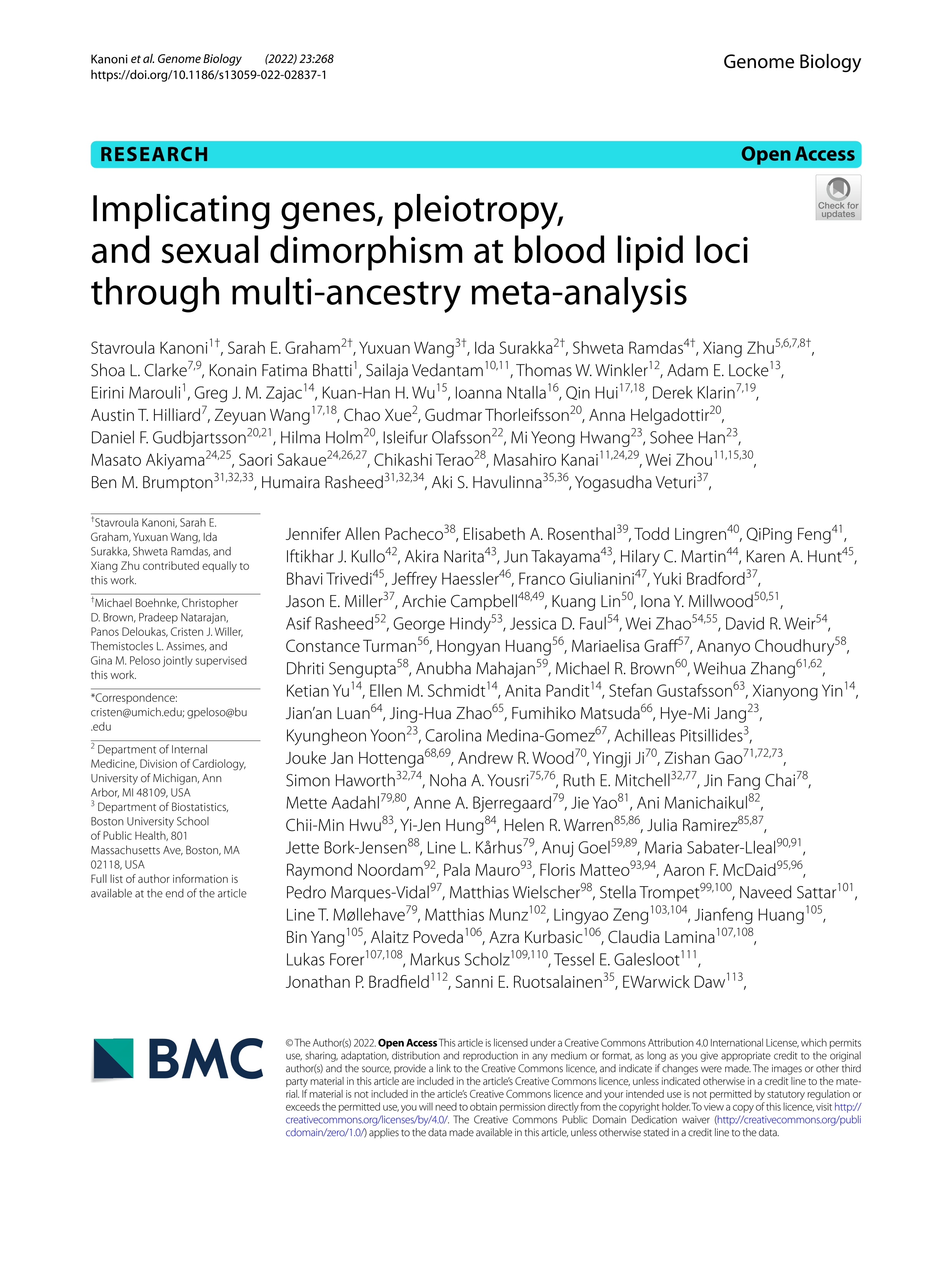
Resumen: Background: Genetic variants within nearly 1000 loci are known to contribute to modulation of blood lipid levels. However, the biological pathways underlying these associations are frequently unknown, limiting understanding of these findings and hindering downstream translational efforts such as drug target discovery. Results: To expand our understanding of the underlying biological pathways and mechanisms controlling blood lipid levels, we leverage a large multi-ancestry meta-analysis (N = 1,654,960) of blood lipids to prioritize putative causal genes for 2286 lipid associations using six gene prediction approaches. Using phenome-wide association (PheWAS) scans, we identify relationships of genetically predicted lipid levels to other diseases and conditions. We confirm known pleiotropic associations with cardiovascular phenotypes and determine novel associations, notably with cholelithiasis risk. We perform sex-stratified GWAS meta-analysis of lipid levels and show that 3-5% of autosomal lipid-associated loci demonstrate sex-biased effects. Finally, we report 21 novel lipid loci identified on the X chromosome. Many of the sex-biased autosomal and X chromosome lipid loci show pleiotropic associations with sex hormones, emphasizing the role of hormone regulation in lipid metabolism. Conclusions: Taken together, our findings provide insights into the biological mechanisms through which associated variants lead to altered lipid levels and potentially cardiovascular disease risk.
Idioma: Inglés
DOI: 10.1186/s13059-022-02837-1
Año: 2022
Publicado en: Genome biology 23 (2022), 268[42 pp.]
ISSN: 1474-7596
Factor impacto JCR: 12.3 (2022)
Categ. JCR: GENETICS & HEREDITY rank: 5 / 171 = 0.029 (2022) - Q1 - T1
Categ. JCR: BIOTECHNOLOGY & APPLIED MICROBIOLOGY rank: 9 / 158 = 0.057 (2022) - Q1 - T1
Factor impacto CITESCORE: 25.5 - Biochemistry, Genetics and Molecular Biology (Q1) - Agricultural and Biological Sciences (Q1)
Factor impacto SCIMAGO: 9.249 - Cell Biology (Q1) - Genetics (Q1) - Ecology, Evolution, Behavior and Systematics (Q1)
Financiación: info:eu-repo/grantAgreement/EC/FP7/608765/EU/WILLIAM HARVEY INTERNATIONAL TRANSLATIONAL RESEARCH ACADEMY/WHRI-ACADEMY
Financiación: info:eu-repo/grantAgreement/EC/H2020/786833/EU/GENetics and the Electrocardiogram for predicting Scd rISk/GENESIS
Financiación: info:eu-repo/grantAgreement/ES/ISCIII/PI17-00142
Tipo y forma: Artículo (Versión definitiva)
Área (Departamento): Área Teoría Señal y Comunicac. (Dpto. Ingeniería Electrón.Com.)
 Debe reconocer adecuadamente la autoría, proporcionar un enlace a la licencia e indicar si se han realizado cambios. Puede hacerlo de cualquier manera razonable, pero no de una manera que sugiera que tiene el apoyo del licenciador o lo recibe por el uso que hace.
Exportado de SIDERAL (2024-03-18-16:57:10)
Visitas y descargas
Idioma: Inglés
DOI: 10.1186/s13059-022-02837-1
Año: 2022
Publicado en: Genome biology 23 (2022), 268[42 pp.]
ISSN: 1474-7596
Factor impacto JCR: 12.3 (2022)
Categ. JCR: GENETICS & HEREDITY rank: 5 / 171 = 0.029 (2022) - Q1 - T1
Categ. JCR: BIOTECHNOLOGY & APPLIED MICROBIOLOGY rank: 9 / 158 = 0.057 (2022) - Q1 - T1
Factor impacto CITESCORE: 25.5 - Biochemistry, Genetics and Molecular Biology (Q1) - Agricultural and Biological Sciences (Q1)
Factor impacto SCIMAGO: 9.249 - Cell Biology (Q1) - Genetics (Q1) - Ecology, Evolution, Behavior and Systematics (Q1)
Financiación: info:eu-repo/grantAgreement/EC/FP7/608765/EU/WILLIAM HARVEY INTERNATIONAL TRANSLATIONAL RESEARCH ACADEMY/WHRI-ACADEMY
Financiación: info:eu-repo/grantAgreement/EC/H2020/786833/EU/GENetics and the Electrocardiogram for predicting Scd rISk/GENESIS
Financiación: info:eu-repo/grantAgreement/ES/ISCIII/PI17-00142
Tipo y forma: Artículo (Versión definitiva)
Área (Departamento): Área Teoría Señal y Comunicac. (Dpto. Ingeniería Electrón.Com.)
Debe reconocer adecuadamente la autoría, proporcionar un enlace a la licencia e indicar si se han realizado cambios. Puede hacerlo de cualquier manera razonable, pero no de una manera que sugiera que tiene el apoyo del licenciador o lo recibe por el uso que hace. Exportado de SIDERAL (2024-03-18-16:57:10)
Enlace permanente:
Visitas y descargas
Este artículo se encuentra en las siguientes colecciones:
Artículos > Artículos por área > Teoría de la Señal y Comunicaciones
Registro creado el 2023-02-24, última modificación el 2024-03-19