Development of a six-month prognostic index in patients with advanced chronic medical conditions: The PALIAR score
Bernabeu-Wittel, M. ; Murcia-Zaragoza, J. ; Hernández-Quiles, C. ; Escolano-Fernández, B. ; Jarava-Rol, G. ; Oliver, M. ; Díez-Manglano, Jesús (Universidad de Zaragoza) ; Ruiz-Cantero, A. ; Ollero-Baturone, M.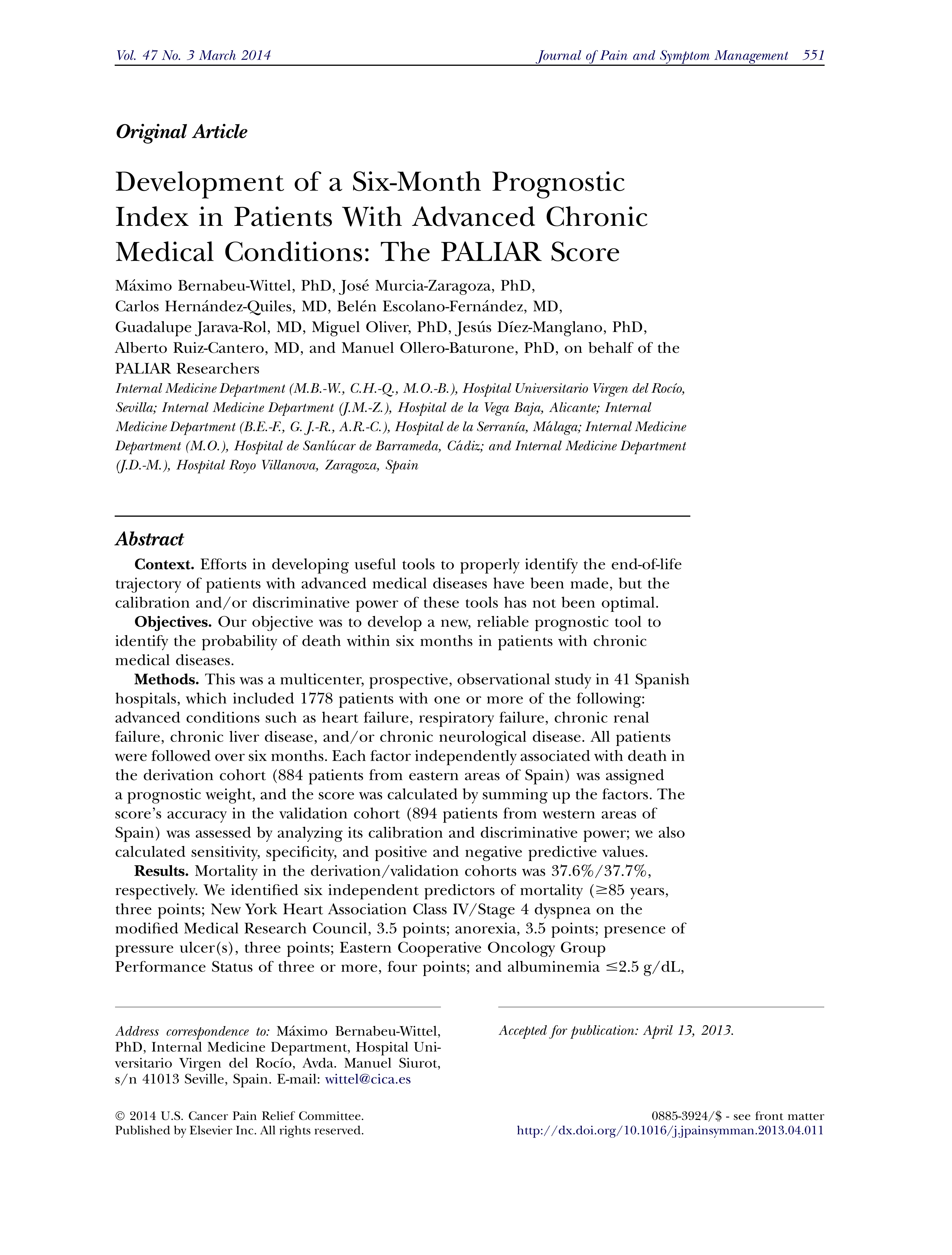
Resumen: Context
Efforts in developing useful tools to properly identify the end-of-life trajectory of patients with advanced medical diseases have been made, but the calibration and/or discriminative power of these tools has not been optimal.
Objectives
Our objective was to develop a new, reliable prognostic tool to identify the probability of death within six months in patients with chronic medical diseases.
Methods
This was a multicenter, prospective, observational study in 41 Spanish hospitals, which included 1778 patients with one or more of the following: advanced conditions such as heart failure, respiratory failure, chronic renal failure, chronic liver disease, and/or chronic neurological disease. All patients were followed over six months. Each factor independently associated with death in the derivation cohort (884 patients from eastern areas of Spain) was assigned a prognostic weight, and the score was calculated by summing up the factors. The score's accuracy in the validation cohort (894 patients from western areas of Spain) was assessed by analyzing its calibration and discriminative power; we also calculated sensitivity, specificity, and positive and negative predictive values.
Results
Mortality in the derivation/validation cohorts was 37.6%/37.7%, respectively. We identified six independent predictors of mortality (≥85 years, three points; New York Heart Association Class IV/Stage 4 dyspnea on the modified Medical Research Council, 3.5 points; anorexia, 3.5 points; presence of pressure ulcer(s), three points; Eastern Cooperative Oncology Group Performance Status of three or more, four points; and albuminemia ≤2.5 g/dL, four points). Mortality in the derivation/validation cohorts according to risk group was 20%/21.5% for patients with zero points; 33%/30.5% for those with 3–3.5 points; 46.3%/43% for those with four to seven points; and 67%/61% for those who reached 7.5 or more points, respectively. The calibration was good (Hosmer-Lemeshow test, P = 0.39), as was the discriminative power (area under the receiver operating characteristic curve of 0.69 [0.66–0.72]). The sensitivity (85%), specificity (86%), positive and negative predictive values (64% and 80%, respectively) at 180 days were high.
Conclusion
The PALIAR score is a precise and reliable tool for identifying the end-of-life trajectory in patients with advanced medical diseases.
Idioma: Inglés
DOI: 10.1016/j.jpainsymman.2013.04.011
Año: 2014
Publicado en: JOURNAL OF PAIN AND SYMPTOM MANAGEMENT 47, 3 (2014), 551-565
ISSN: 0885-3924
Factor impacto JCR: 2.795 (2014)
Categ. JCR: HEALTH CARE SCIENCES & SERVICES rank: 19 / 87 = 0.218 (2014) - Q1 - T1
Categ. JCR: MEDICINE, GENERAL & INTERNAL rank: 28 / 154 = 0.182 (2014) - Q1 - T1
Categ. JCR: CLINICAL NEUROLOGY rank: 70 / 191 = 0.366 (2014) - Q2 - T2
Tipo y forma: Artículo (Versión definitiva)
Área (Departamento): Area Medicina (Dpto. Medicina, Psiqu. y Derm.)
 Debe reconocer adecuadamente la autoría, proporcionar un enlace a la licencia e indicar si se han realizado cambios. Puede hacerlo de cualquier manera razonable, pero no de una manera que sugiera que tiene el apoyo del licenciador o lo recibe por el uso que hace. No puede utilizar el material para una finalidad comercial. Si remezcla, transforma o crea a partir del material, no puede difundir el material modificado.
Exportado de SIDERAL (2024-01-31-19:24:54)
Visitas y descargas
Efforts in developing useful tools to properly identify the end-of-life trajectory of patients with advanced medical diseases have been made, but the calibration and/or discriminative power of these tools has not been optimal.
Objectives
Our objective was to develop a new, reliable prognostic tool to identify the probability of death within six months in patients with chronic medical diseases.
Methods
This was a multicenter, prospective, observational study in 41 Spanish hospitals, which included 1778 patients with one or more of the following: advanced conditions such as heart failure, respiratory failure, chronic renal failure, chronic liver disease, and/or chronic neurological disease. All patients were followed over six months. Each factor independently associated with death in the derivation cohort (884 patients from eastern areas of Spain) was assigned a prognostic weight, and the score was calculated by summing up the factors. The score's accuracy in the validation cohort (894 patients from western areas of Spain) was assessed by analyzing its calibration and discriminative power; we also calculated sensitivity, specificity, and positive and negative predictive values.
Results
Mortality in the derivation/validation cohorts was 37.6%/37.7%, respectively. We identified six independent predictors of mortality (≥85 years, three points; New York Heart Association Class IV/Stage 4 dyspnea on the modified Medical Research Council, 3.5 points; anorexia, 3.5 points; presence of pressure ulcer(s), three points; Eastern Cooperative Oncology Group Performance Status of three or more, four points; and albuminemia ≤2.5 g/dL, four points). Mortality in the derivation/validation cohorts according to risk group was 20%/21.5% for patients with zero points; 33%/30.5% for those with 3–3.5 points; 46.3%/43% for those with four to seven points; and 67%/61% for those who reached 7.5 or more points, respectively. The calibration was good (Hosmer-Lemeshow test, P = 0.39), as was the discriminative power (area under the receiver operating characteristic curve of 0.69 [0.66–0.72]). The sensitivity (85%), specificity (86%), positive and negative predictive values (64% and 80%, respectively) at 180 days were high.
Conclusion
The PALIAR score is a precise and reliable tool for identifying the end-of-life trajectory in patients with advanced medical diseases.
Idioma: Inglés
DOI: 10.1016/j.jpainsymman.2013.04.011
Año: 2014
Publicado en: JOURNAL OF PAIN AND SYMPTOM MANAGEMENT 47, 3 (2014), 551-565
ISSN: 0885-3924
Factor impacto JCR: 2.795 (2014)
Categ. JCR: HEALTH CARE SCIENCES & SERVICES rank: 19 / 87 = 0.218 (2014) - Q1 - T1
Categ. JCR: MEDICINE, GENERAL & INTERNAL rank: 28 / 154 = 0.182 (2014) - Q1 - T1
Categ. JCR: CLINICAL NEUROLOGY rank: 70 / 191 = 0.366 (2014) - Q2 - T2
Tipo y forma: Artículo (Versión definitiva)
Área (Departamento): Area Medicina (Dpto. Medicina, Psiqu. y Derm.)
Debe reconocer adecuadamente la autoría, proporcionar un enlace a la licencia e indicar si se han realizado cambios. Puede hacerlo de cualquier manera razonable, pero no de una manera que sugiera que tiene el apoyo del licenciador o lo recibe por el uso que hace. No puede utilizar el material para una finalidad comercial. Si remezcla, transforma o crea a partir del material, no puede difundir el material modificado.Exportado de SIDERAL (2024-01-31-19:24:54)
Enlace permanente:
Visitas y descargas
Este artículo se encuentra en las siguientes colecciones:
Artículos > Artículos por área > Medicina
Registro creado el 2024-01-31, última modificación el 2024-01-31