Association Between Pain Coping and Symptoms of Anxiety and Depression, and work absenteeism in people with upper limb musculoskeletal disorders: a systematic review and meta-analysis
Núñez-Cortés, Rodrigo ; Espin, Ander ; Pérez-Alenda, Sofía ; López-Bueno, Rubén (Universidad de Zaragoza) ; Cruz-Montecinos, Carlos ; Vincents-Seeberg, Karina Glies ; Püschel, Thomas A. ; Calatayud, Joaquín ; Andersen, Lars Louis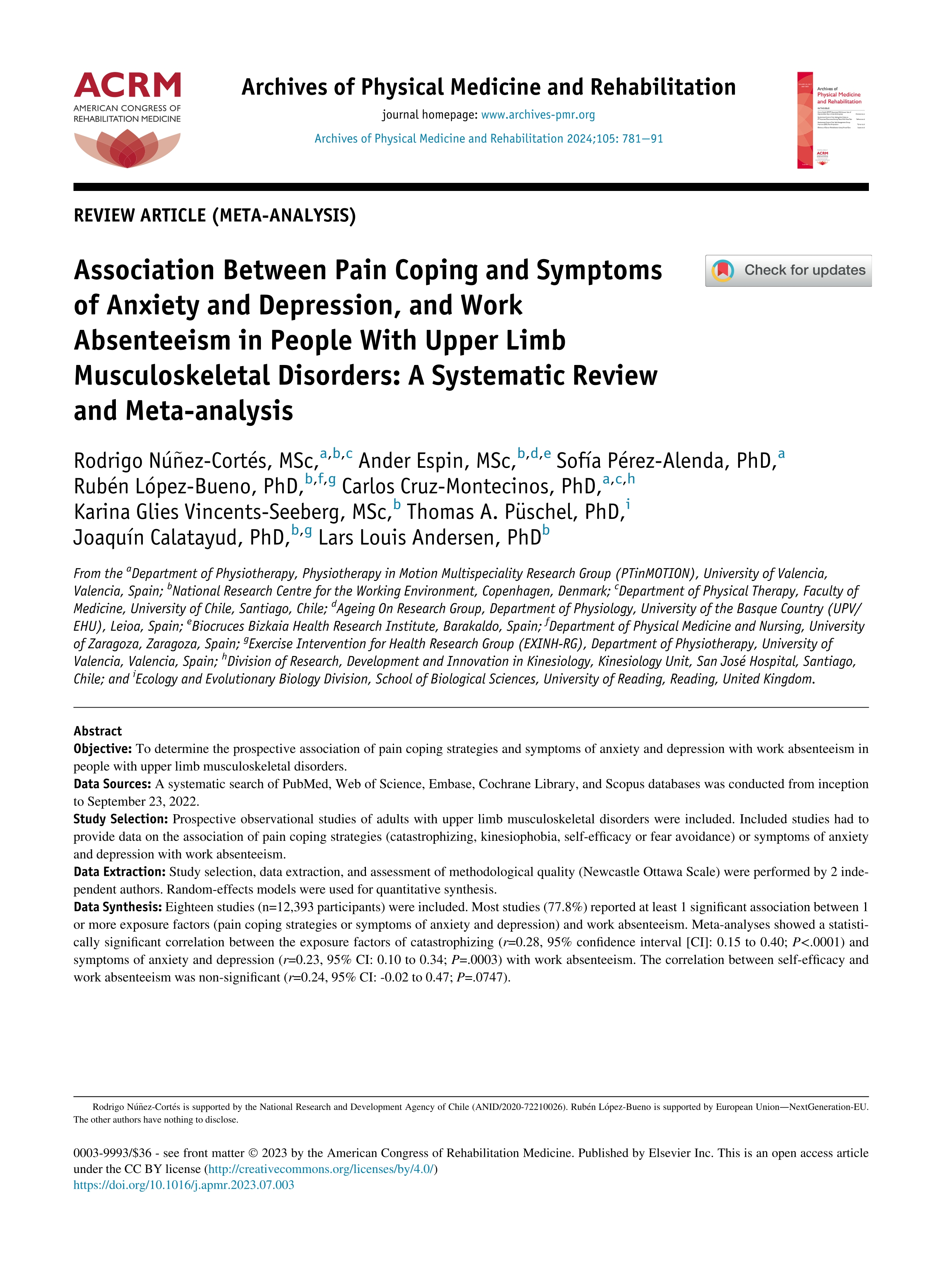
Resumen: Objective:
To determine the prospective association of pain coping strategies and symptoms of anxiety and depression with work absenteeism in people with upper limb musculoskeletal disorders.
Data Sources:
A systematic search of PubMed, Web of Science, Embase, Cochrane Library, and Scopus databases was conducted from inception to September 23, 2022.
Study Selection:
Prospective observational studies of adults with upper limb musculoskeletal disorders were included. Included studies had to provide data on the association of pain coping strategies (catastrophizing, kinesiophobia, self-efficacy or fear avoidance) or symptoms of anxiety and depression with work absenteeism.
Data Extraction:
Study selection, data extraction, and assessment of methodological quality (Newcastle Ottawa Scale) were performed by 2 independent authors. Random-effects models were used for quantitative synthesis.
Data Synthesis:
Eighteen studies (n=12,393 participants) were included. Most studies (77.8%) reported at least 1 significant association between 1 or more exposure factors (pain coping strategies or symptoms of anxiety and depression) and work absenteeism. Meta-analyses showed a statistically significant correlation between the exposure factors of catastrophizing (r=0.28, 95% confidence interval [CI]: 0.15 to 0.40; P<.0001) and symptoms of anxiety and depression (r=0.23, 95% CI: 0.10 to 0.34; P=.0003) with work absenteeism. The correlation between self-efficacy and work absenteeism was non-significant (r=0.24, 95% CI: -0.02 to 0.47; P=.0747).
Conclusions:
Rehabilitation teams should consider assessing catastrophizing and symptoms of anxiety and depression to identify patients at risk for work absenteeism. Addressing these variables may also be considered in return-to-work programs for individuals with upper limb disorders.
Idioma: Inglés
DOI: 10.1016/j.apmr.2023.07.003
Año: 2024
Publicado en: ARCHIVES OF PHYSICAL MEDICINE AND REHABILITATION 105, 4 (2024), 781-791
ISSN: 0003-9993
Factor impacto JCR: 3.7 (2024)
Categ. JCR: SPORT SCIENCES rank: 16 / 133 = 0.12 (2024) - Q1 - T1
Categ. JCR: REHABILITATION rank: 9 / 173 = 0.052 (2024) - Q1 - T1
Factor impacto SCIMAGO: 1.136 - Physical Therapy, Sports Therapy and Rehabilitation (Q1) - Rehabilitation (Q1) - Sports Science (Q2)
Tipo y forma: Artículo (Versión definitiva)
Área (Departamento): Área Didáctica Expres.Corporal (Dpto. Expres.Music.Plást.Corp.)
 Debe reconocer adecuadamente la autoría, proporcionar un enlace a la licencia e indicar si se han realizado cambios. Puede hacerlo de cualquier manera razonable, pero no de una manera que sugiera que tiene el apoyo del licenciador o lo recibe por el uso que hace.
Exportado de SIDERAL (2025-09-22-14:35:06)
Visitas y descargas
To determine the prospective association of pain coping strategies and symptoms of anxiety and depression with work absenteeism in people with upper limb musculoskeletal disorders.
Data Sources:
A systematic search of PubMed, Web of Science, Embase, Cochrane Library, and Scopus databases was conducted from inception to September 23, 2022.
Study Selection:
Prospective observational studies of adults with upper limb musculoskeletal disorders were included. Included studies had to provide data on the association of pain coping strategies (catastrophizing, kinesiophobia, self-efficacy or fear avoidance) or symptoms of anxiety and depression with work absenteeism.
Data Extraction:
Study selection, data extraction, and assessment of methodological quality (Newcastle Ottawa Scale) were performed by 2 independent authors. Random-effects models were used for quantitative synthesis.
Data Synthesis:
Eighteen studies (n=12,393 participants) were included. Most studies (77.8%) reported at least 1 significant association between 1 or more exposure factors (pain coping strategies or symptoms of anxiety and depression) and work absenteeism. Meta-analyses showed a statistically significant correlation between the exposure factors of catastrophizing (r=0.28, 95% confidence interval [CI]: 0.15 to 0.40; P<.0001) and symptoms of anxiety and depression (r=0.23, 95% CI: 0.10 to 0.34; P=.0003) with work absenteeism. The correlation between self-efficacy and work absenteeism was non-significant (r=0.24, 95% CI: -0.02 to 0.47; P=.0747).
Conclusions:
Rehabilitation teams should consider assessing catastrophizing and symptoms of anxiety and depression to identify patients at risk for work absenteeism. Addressing these variables may also be considered in return-to-work programs for individuals with upper limb disorders.
Idioma: Inglés
DOI: 10.1016/j.apmr.2023.07.003
Año: 2024
Publicado en: ARCHIVES OF PHYSICAL MEDICINE AND REHABILITATION 105, 4 (2024), 781-791
ISSN: 0003-9993
Factor impacto JCR: 3.7 (2024)
Categ. JCR: SPORT SCIENCES rank: 16 / 133 = 0.12 (2024) - Q1 - T1
Categ. JCR: REHABILITATION rank: 9 / 173 = 0.052 (2024) - Q1 - T1
Factor impacto SCIMAGO: 1.136 - Physical Therapy, Sports Therapy and Rehabilitation (Q1) - Rehabilitation (Q1) - Sports Science (Q2)
Tipo y forma: Artículo (Versión definitiva)
Área (Departamento): Área Didáctica Expres.Corporal (Dpto. Expres.Music.Plást.Corp.)
Debe reconocer adecuadamente la autoría, proporcionar un enlace a la licencia e indicar si se han realizado cambios. Puede hacerlo de cualquier manera razonable, pero no de una manera que sugiera que tiene el apoyo del licenciador o lo recibe por el uso que hace. Exportado de SIDERAL (2025-09-22-14:35:06)
Enlace permanente:
Visitas y descargas
Este artículo se encuentra en las siguientes colecciones:
Artículos > Artículos por área > Didáctica de la Expresión Corporal
Registro creado el 2024-04-24, última modificación el 2025-09-23