Can immunocrit be used as a monitoring tool for swine vaccination and infection studies?
Sagrera, Mònica ; Sibila, Marina ; Martínez-Boixaderas, Núria ; Llorens, Anna Maria ; Espigares, David ; Pastor, Josep ; Garza-Moreno, Laura (Universidad de Zaragoza) ; Segalés, Joaquim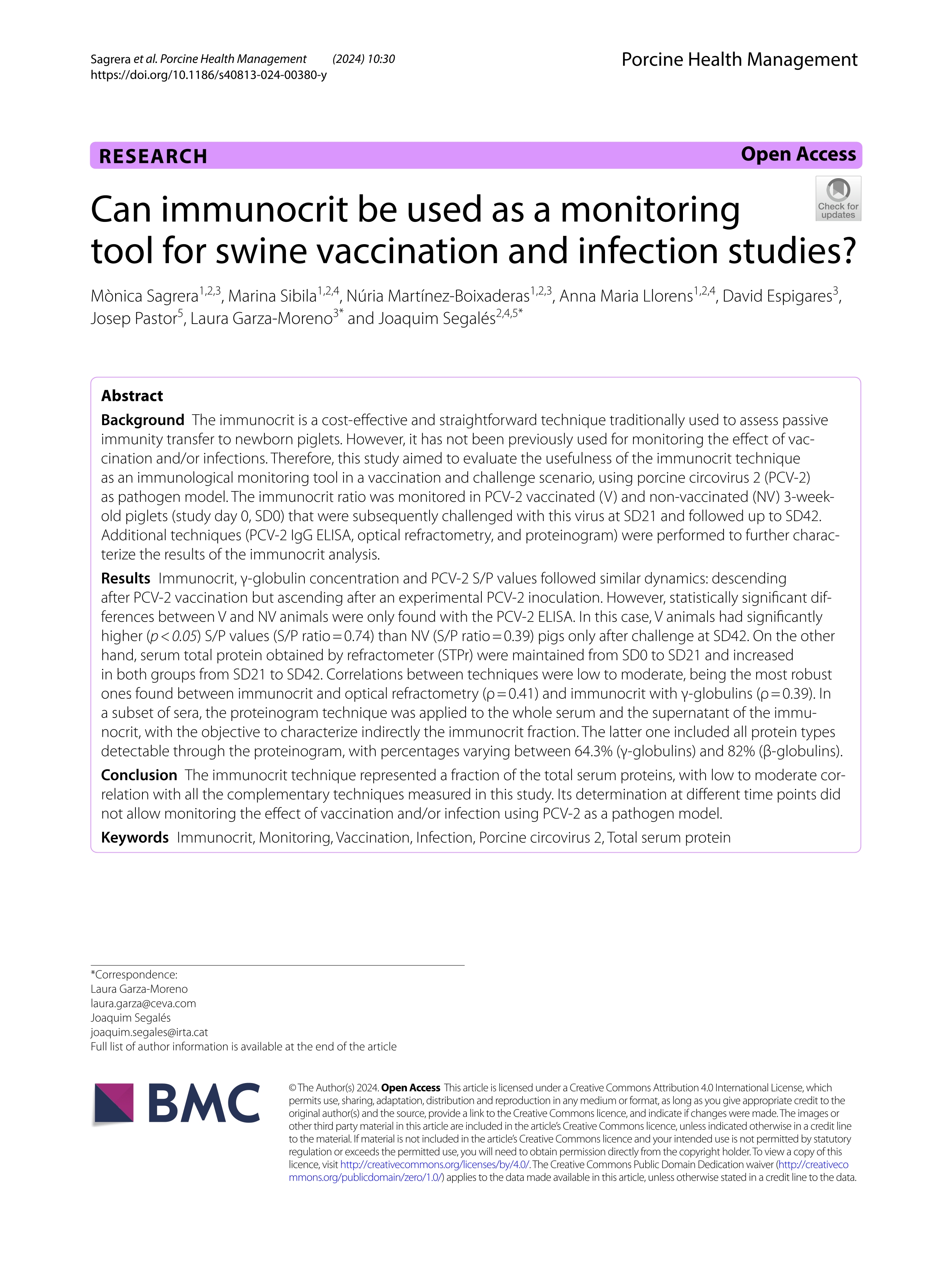
Resumen: The immunocrit is a cost-effective and straightforward technique traditionally used to assess passive immunity transfer to newborn piglets. However, it has not been previously used for monitoring the effect of vaccination and/or infections. Therefore, this study aimed to evaluate the usefulness of the immunocrit technique as an immunological monitoring tool in a vaccination and challenge scenario, using porcine circovirus 2 (PCV-2) as pathogen model. The immunocrit ratio was monitored in PCV-2 vaccinated (V) and non-vaccinated (NV) 3-week-old piglets (study day 0, SD0) that were subsequently challenged with this virus at SD21 and followed up to SD42. Additional techniques (PCV-2 IgG ELISA, optical refractometry, and proteinogram) were performed to further characterize the results of the immunocrit analysis.
Results
Immunocrit, γ-globulin concentration and PCV-2 S/P values followed similar dynamics: descending after PCV-2 vaccination but ascending after an experimental PCV-2 inoculation. However, statistically significant differences between V and NV animals were only found with the PCV-2 ELISA. In this case, V animals had significantly higher (p < 0.05) S/P values (S/P ratio = 0.74) than NV (S/P ratio = 0.39) pigs only after challenge at SD42. On the other hand, serum total protein obtained by refractometer (STPr) were maintained from SD0 to SD21 and increased in both groups from SD21 to SD42. Correlations between techniques were low to moderate, being the most robust ones found between immunocrit and optical refractometry (ρ = 0.41) and immunocrit with γ-globulins (ρ = 0.39). In a subset of sera, the proteinogram technique was applied to the whole serum and the supernatant of the immunocrit, with the objective to characterize indirectly the immunocrit fraction. The latter one included all protein types detectable through the proteinogram, with percentages varying between 64.3% (γ-globulins) and 82% (β-globulins).
Conclusion
The immunocrit technique represented a fraction of the total serum proteins, with low to moderate correlation with all the complementary techniques measured in this study. Its determination at different time points did not allow monitoring the effect of vaccination and/or infection using PCV-2 as a pathogen model.
Idioma: Inglés
DOI: 10.1186/s40813-024-00380-y
Año: 2024
Publicado en: Porcine Health Management 10, 30 (2024), 9 pp.
ISSN: 2055-5660
Factor impacto JCR: 3.1 (2024)
Categ. JCR: VETERINARY SCIENCES rank: 14 / 170 = 0.082 (2024) - Q1 - T1
Factor impacto CITESCORE: 5.7 - Food Animals (Q1) - Animal Science and Zoology (Q1)
Factor impacto SCIMAGO: 0.776 - Animal Science and Zoology (Q1) - Small Animals (Q1) - Food Animals (Q1)
Tipo y forma: Artículo (Versión definitiva)
Área (Departamento): Área Sanidad Animal (Dpto. Patología Animal)
 Debe reconocer adecuadamente la autoría, proporcionar un enlace a la licencia e indicar si se han realizado cambios. Puede hacerlo de cualquier manera razonable, pero no de una manera que sugiera que tiene el apoyo del licenciador o lo recibe por el uso que hace.
Exportado de SIDERAL (2026-01-12-12:36:35)
Visitas y descargas
Results
Immunocrit, γ-globulin concentration and PCV-2 S/P values followed similar dynamics: descending after PCV-2 vaccination but ascending after an experimental PCV-2 inoculation. However, statistically significant differences between V and NV animals were only found with the PCV-2 ELISA. In this case, V animals had significantly higher (p < 0.05) S/P values (S/P ratio = 0.74) than NV (S/P ratio = 0.39) pigs only after challenge at SD42. On the other hand, serum total protein obtained by refractometer (STPr) were maintained from SD0 to SD21 and increased in both groups from SD21 to SD42. Correlations between techniques were low to moderate, being the most robust ones found between immunocrit and optical refractometry (ρ = 0.41) and immunocrit with γ-globulins (ρ = 0.39). In a subset of sera, the proteinogram technique was applied to the whole serum and the supernatant of the immunocrit, with the objective to characterize indirectly the immunocrit fraction. The latter one included all protein types detectable through the proteinogram, with percentages varying between 64.3% (γ-globulins) and 82% (β-globulins).
Conclusion
The immunocrit technique represented a fraction of the total serum proteins, with low to moderate correlation with all the complementary techniques measured in this study. Its determination at different time points did not allow monitoring the effect of vaccination and/or infection using PCV-2 as a pathogen model.
Idioma: Inglés
DOI: 10.1186/s40813-024-00380-y
Año: 2024
Publicado en: Porcine Health Management 10, 30 (2024), 9 pp.
ISSN: 2055-5660
Factor impacto JCR: 3.1 (2024)
Categ. JCR: VETERINARY SCIENCES rank: 14 / 170 = 0.082 (2024) - Q1 - T1
Factor impacto CITESCORE: 5.7 - Food Animals (Q1) - Animal Science and Zoology (Q1)
Factor impacto SCIMAGO: 0.776 - Animal Science and Zoology (Q1) - Small Animals (Q1) - Food Animals (Q1)
Tipo y forma: Artículo (Versión definitiva)
Área (Departamento): Área Sanidad Animal (Dpto. Patología Animal)
Debe reconocer adecuadamente la autoría, proporcionar un enlace a la licencia e indicar si se han realizado cambios. Puede hacerlo de cualquier manera razonable, pero no de una manera que sugiera que tiene el apoyo del licenciador o lo recibe por el uso que hace. Exportado de SIDERAL (2026-01-12-12:36:35)
Enlace permanente:
Visitas y descargas
Este artículo se encuentra en las siguientes colecciones:
Artículos > Artículos por área > Sanidad Animal
Registro creado el 2025-01-21, última modificación el 2026-01-12