Is energy expenditure or physical activity considered when energy intake is measured? A scoping review 1975–2015
González-Gross M. ; Aparicio-Ugarriza R. ; Calonge-Pascual S. ; Gómez-Martínez S. ; García-Carro A. ; Zaragoza-Martí A. ; Sanz-Valero J. ; Wanden-Berghe C. ; Martínez J.A. ; Gil Á. ; Marcos A. ; Moreno L.A. (Universidad de Zaragoza)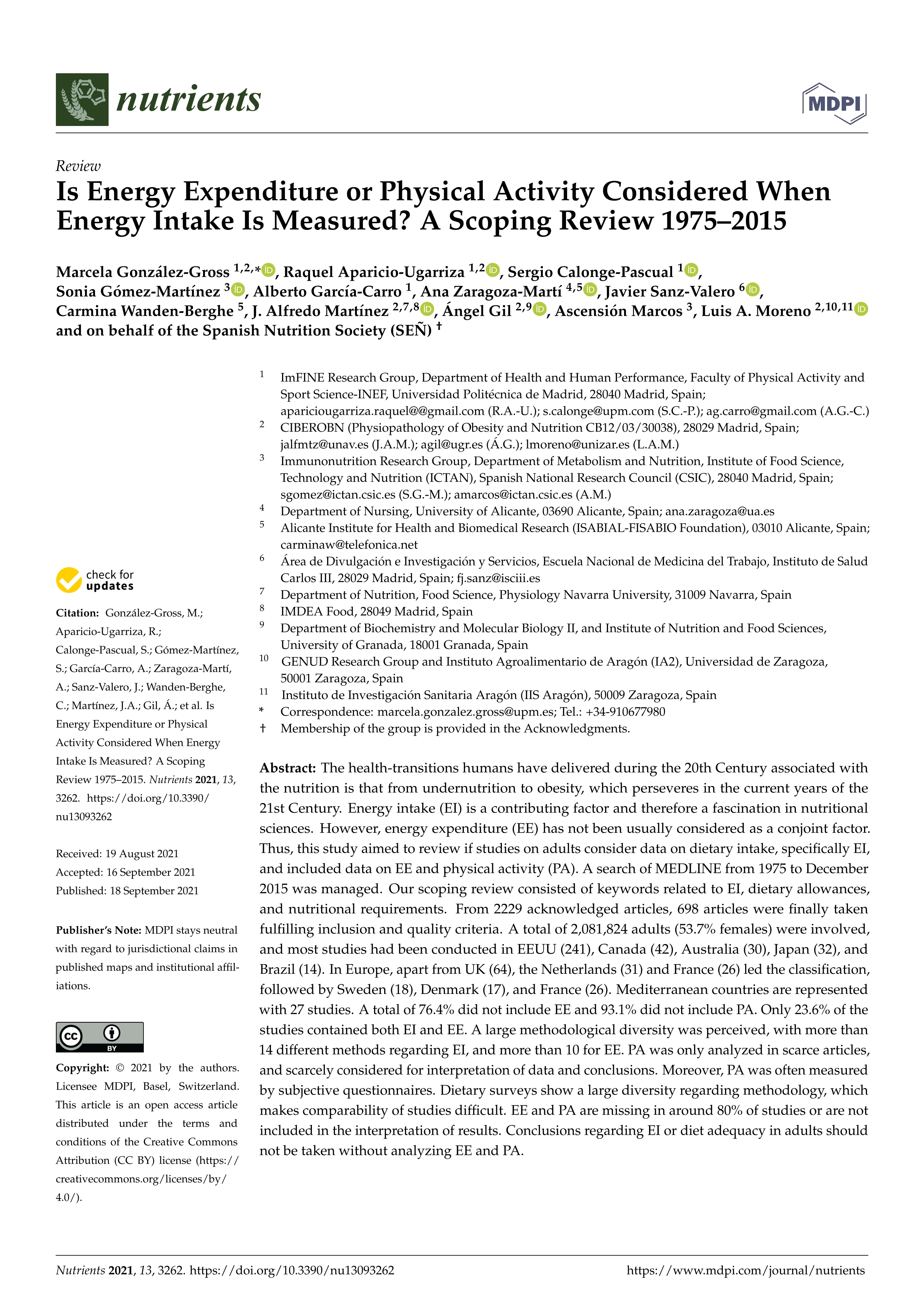
Resumen: The health-transitions humans have delivered during the 20th Century associated with the nutrition is that from undernutrition to obesity, which perseveres in the current years of the 21st Century. Energy intake (EI) is a contributing factor and therefore a fascination in nutritional sciences. However, energy expenditure (EE) has not been usually considered as a conjoint factor. Thus, this study aimed to review if studies on adults consider data on dietary intake, specifically EI, and included data on EE and physical activity (PA). A search of MEDLINE from 1975 to December 2015 was managed. Our scoping review consisted of keywords related to EI, dietary allowances, and nutritional requirements. From 2229 acknowledged articles, 698 articles were finally taken fulfilling inclusion and quality criteria. A total of 2, 081, 824 adults (53.7% females) were involved, and most studies had been conducted in EEUU (241), Canada (42), Australia (30), Japan (32), and Brazil (14). In Europe, apart from UK (64), the Netherlands (31) and France (26) led the classification, followed by Sweden (18), Denmark (17), and France (26). Mediterranean countries are represented with 27 studies. A total of 76.4% did not include EE and 93.1% did not include PA. Only 23.6% of the studies contained both EI and EE. A large methodological diversity was perceived, with more than 14 different methods regarding EI, and more than 10 for EE. PA was only analyzed in scarce articles, and scarcely considered for interpretation of data and conclusions. Moreover, PA was often measured by subjective questionnaires. Dietary surveys show a large diversity regarding methodology, which makes comparability of studies difficult. EE and PA are missing in around 80% of studies or are not included in the interpretation of results. Conclusions regarding EI or diet adequacy in adults should not be taken without analyzing EE and PA. © 2021 by the authors. Licensee MDPI, Basel, Switzerland.
Idioma: Inglés
DOI: 10.3390/nu13093262
Año: 2021
Publicado en: Nutrients 13, 9 (2021), 3262[10 pp.]
ISSN: 2072-6643
Factor impacto JCR: 6.706 (2021)
Categ. JCR: NUTRITION & DIETETICS rank: 15 / 90 = 0.167 (2021) - Q1 - T1
Factor impacto CITESCORE: 7.9 - Nursing (Q1) - Agricultural and Biological Sciences (Q1)
Factor impacto SCIMAGO: 1.287 - Nutrition and Dietetics (Q1) - Food Science (Q1)
Tipo y forma: Artículo (Versión definitiva)
Área (Departamento): Área Enfermería (Dpto. Fisiatría y Enfermería)
 Debe reconocer adecuadamente la autoría, proporcionar un enlace a la licencia e indicar si se han realizado cambios. Puede hacerlo de cualquier manera razonable, pero no de una manera que sugiera que tiene el apoyo del licenciador o lo recibe por el uso que hace.
Exportado de SIDERAL (2025-10-17-14:16:29)
Visitas y descargas
Idioma: Inglés
DOI: 10.3390/nu13093262
Año: 2021
Publicado en: Nutrients 13, 9 (2021), 3262[10 pp.]
ISSN: 2072-6643
Factor impacto JCR: 6.706 (2021)
Categ. JCR: NUTRITION & DIETETICS rank: 15 / 90 = 0.167 (2021) - Q1 - T1
Factor impacto CITESCORE: 7.9 - Nursing (Q1) - Agricultural and Biological Sciences (Q1)
Factor impacto SCIMAGO: 1.287 - Nutrition and Dietetics (Q1) - Food Science (Q1)
Tipo y forma: Artículo (Versión definitiva)
Área (Departamento): Área Enfermería (Dpto. Fisiatría y Enfermería)
Debe reconocer adecuadamente la autoría, proporcionar un enlace a la licencia e indicar si se han realizado cambios. Puede hacerlo de cualquier manera razonable, pero no de una manera que sugiera que tiene el apoyo del licenciador o lo recibe por el uso que hace. Exportado de SIDERAL (2025-10-17-14:16:29)
Enlace permanente:
Visitas y descargas
Este artículo se encuentra en las siguientes colecciones:
Artículos > Artículos por área > Enfermería
Registro creado el 2025-02-27, última modificación el 2025-10-17