CAPI-Detect: machine learning in capillaroscopy reveals new variables influencing diagnosis
Lledó-Ibáñez, Gema M. ; Sáez Comet, Luis (Universidad de Zaragoza) ; Freire Dapena, Mayka ; Mesa Navas, Miguel ; Martín Cascón, Miguel ; Guillén del Castillo, Alfredo ; Simeon, Carmen Pilar ; Martínez Robles, Elena ; Todolí Parra, José ; Varela, Diana Cristina ; Maldonado, Génesis ; Marín, Adela (Universidad de Zaragoza) ; Pérez Abad, Laura ; Aramburu, Jimena ; Vela, Laura ; Ramos Ibáñez, Eduardo ; Gracia Tello, Borja del Carmelo (Universidad de Zaragoza)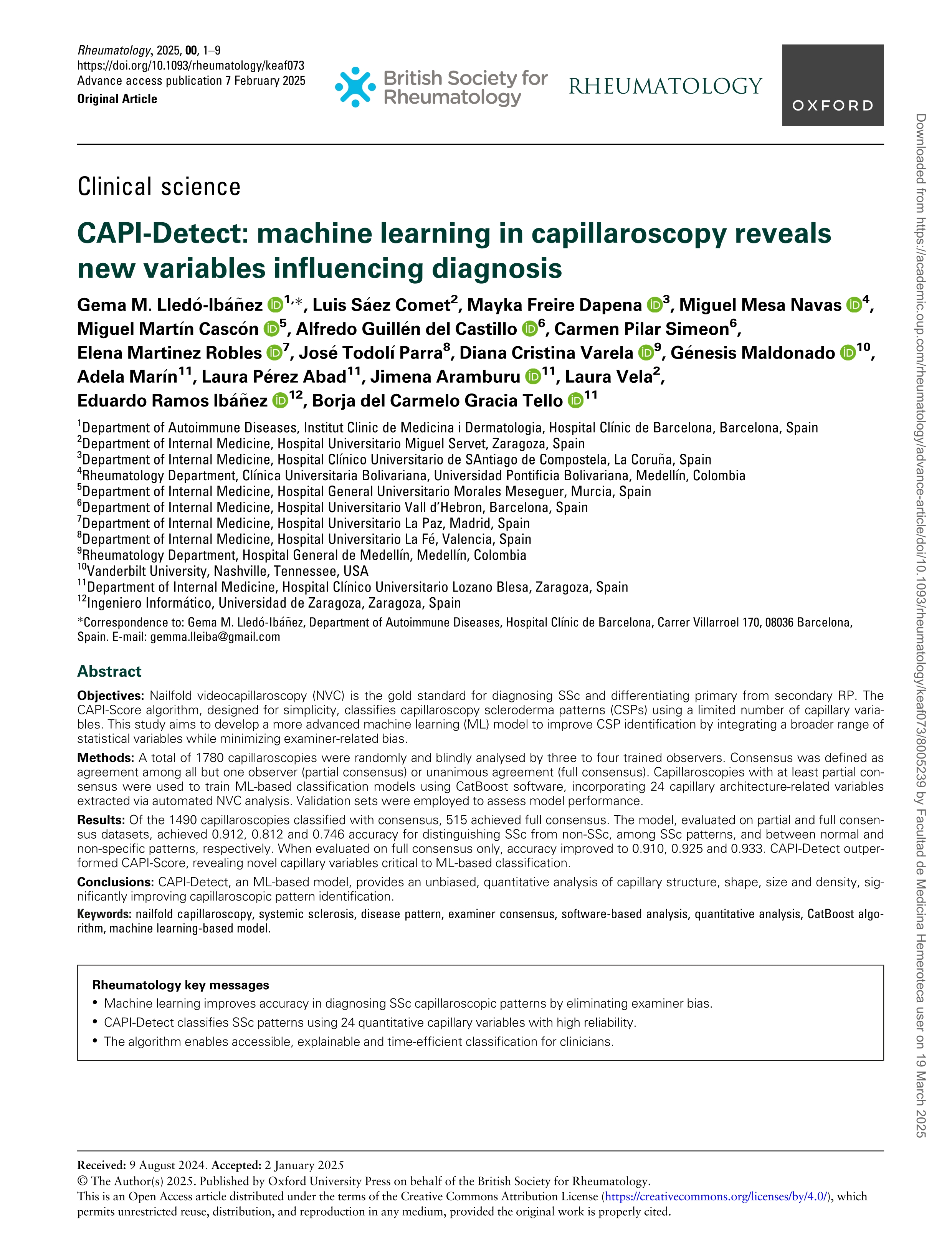
Resumen: Objectives
Nailfold videocapillaroscopy (NVC) is the gold standard for diagnosing SSc and differentiating primary from secondary RP. The CAPI-Score algorithm, designed for simplicity, classifies capillaroscopy scleroderma patterns (CSPs) using a limited number of capillary variables. This study aims to develop a more advanced machine learning (ML) model to improve CSP identification by integrating a broader range of statistical variables while minimizing examiner-related bias.
Methods
A total of 1780 capillaroscopies were randomly and blindly analysed by three to four trained observers. Consensus was defined as agreement among all but one observer (partial consensus) or unanimous agreement (full consensus). Capillaroscopies with at least partial consensus were used to train ML-based classification models using CatBoost software, incorporating 24 capillary architecture-related variables extracted via automated NVC analysis. Validation sets were employed to assess model performance.
Results
Of the 1490 capillaroscopies classified with consensus, 515 achieved full consensus. The model, evaluated on partial and full consensus datasets, achieved 0.912, 0.812 and 0.746 accuracy for distinguishing SSc from non-SSc, among SSc patterns, and between normal and non-specific patterns, respectively. When evaluated on full consensus only, accuracy improved to 0.910, 0.925 and 0.933. CAPI-Detect outperformed CAPI-Score, revealing novel capillary variables critical to ML-based classification.
CAPI-Detect, an ML-based model, provides an unbiased, quantitative analysis of capillary structure, shape, size and density, significantly improving capillaroscopic pattern identification.
Idioma: Inglés
DOI: 10.1093/rheumatology/keaf073
Año: 2025
Publicado en: Rheumatology (Oxford) (2025), keaf073 [9 pp.]
ISSN: 1462-0324
Tipo y forma: Artículo (Versión definitiva)
Área (Departamento): Area Medicina (Dpto. Medicina, Psiqu. y Derm.)
 Debe reconocer adecuadamente la autoría, proporcionar un enlace a la licencia e indicar si se han realizado cambios. Puede hacerlo de cualquier manera razonable, pero no de una manera que sugiera que tiene el apoyo del licenciador o lo recibe por el uso que hace.
Exportado de SIDERAL (2025-10-17-14:16:00)
Visitas y descargas
Nailfold videocapillaroscopy (NVC) is the gold standard for diagnosing SSc and differentiating primary from secondary RP. The CAPI-Score algorithm, designed for simplicity, classifies capillaroscopy scleroderma patterns (CSPs) using a limited number of capillary variables. This study aims to develop a more advanced machine learning (ML) model to improve CSP identification by integrating a broader range of statistical variables while minimizing examiner-related bias.
Methods
A total of 1780 capillaroscopies were randomly and blindly analysed by three to four trained observers. Consensus was defined as agreement among all but one observer (partial consensus) or unanimous agreement (full consensus). Capillaroscopies with at least partial consensus were used to train ML-based classification models using CatBoost software, incorporating 24 capillary architecture-related variables extracted via automated NVC analysis. Validation sets were employed to assess model performance.
Results
Of the 1490 capillaroscopies classified with consensus, 515 achieved full consensus. The model, evaluated on partial and full consensus datasets, achieved 0.912, 0.812 and 0.746 accuracy for distinguishing SSc from non-SSc, among SSc patterns, and between normal and non-specific patterns, respectively. When evaluated on full consensus only, accuracy improved to 0.910, 0.925 and 0.933. CAPI-Detect outperformed CAPI-Score, revealing novel capillary variables critical to ML-based classification.
CAPI-Detect, an ML-based model, provides an unbiased, quantitative analysis of capillary structure, shape, size and density, significantly improving capillaroscopic pattern identification.
Idioma: Inglés
DOI: 10.1093/rheumatology/keaf073
Año: 2025
Publicado en: Rheumatology (Oxford) (2025), keaf073 [9 pp.]
ISSN: 1462-0324
Tipo y forma: Artículo (Versión definitiva)
Área (Departamento): Area Medicina (Dpto. Medicina, Psiqu. y Derm.)
Debe reconocer adecuadamente la autoría, proporcionar un enlace a la licencia e indicar si se han realizado cambios. Puede hacerlo de cualquier manera razonable, pero no de una manera que sugiera que tiene el apoyo del licenciador o lo recibe por el uso que hace. Exportado de SIDERAL (2025-10-17-14:16:00)
Enlace permanente:
Visitas y descargas
Este artículo se encuentra en las siguientes colecciones:
Artículos > Artículos por área > Medicina
Registro creado el 2025-03-19, última modificación el 2025-10-17