Addressing causal complexity in the drivers of teachers’ innovative behavior: a configurational qualitative comparative approach
Sánchez-Pérez, Miguel ; Revuelto-Taboada, Lorenzo ; Mas-Tur, Alicia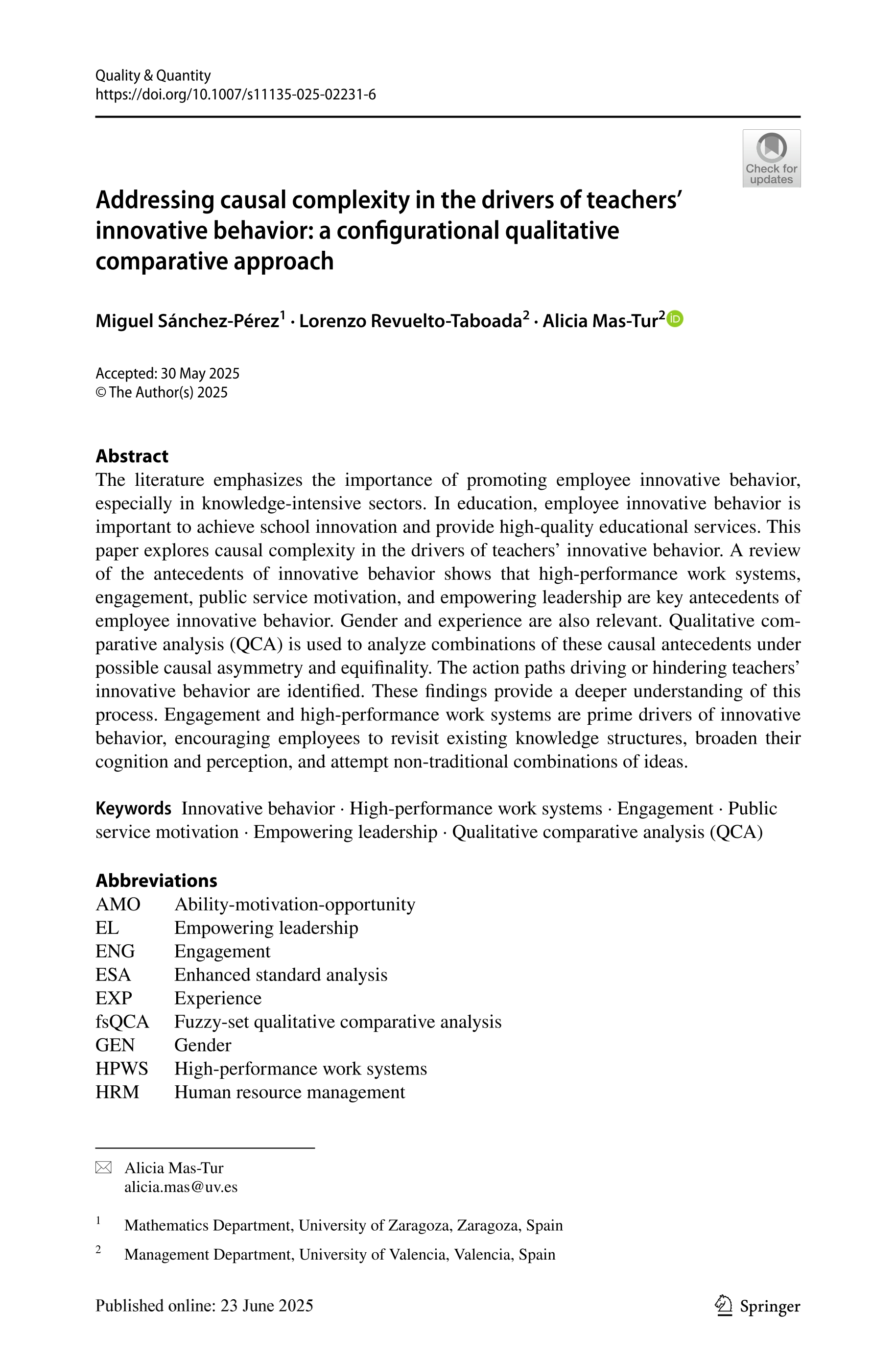
Resumen: The literature emphasizes the importance of promoting employee innovative behavior, especially in knowledge-intensive sectors. In education, employee innovative behavior is important to achieve school innovation and provide high-quality educational services. This paper explores causal complexity in the drivers of teachers’ innovative behavior. A review of the antecedents of innovative behavior shows that high-performance work systems, engagement, public service motivation, and empowering leadership are key antecedents of employee innovative behavior. Gender and experience are also relevant. Qualitative comparative analysis (QCA) is used to analyze combinations of these causal antecedents under possible causal asymmetry and equifinality. The action paths driving or hindering teachers’ innovative behavior are identified. These findings provide a deeper understanding of this process. Engagement and high-performance work systems are prime drivers of innovative behavior, encouraging employees to revisit existing knowledge structures, broaden their cognition and perception, and attempt non-traditional combinations of ideas.
Idioma: Inglés
DOI: 10.1007/s11135-025-02231-6
Año: 2025
Publicado en: QUALITY & QUANTITY (2025), [22 pp.]
ISSN: 0033-5177
Tipo y forma: Artículo (Versión definitiva)
 Debe reconocer adecuadamente la autoría, proporcionar un enlace a la licencia e indicar si se han realizado cambios. Puede hacerlo de cualquier manera razonable, pero no de una manera que sugiera que tiene el apoyo del licenciador o lo recibe por el uso que hace.
Exportado de SIDERAL (2025-10-17-14:19:29)
Visitas y descargas
Idioma: Inglés
DOI: 10.1007/s11135-025-02231-6
Año: 2025
Publicado en: QUALITY & QUANTITY (2025), [22 pp.]
ISSN: 0033-5177
Tipo y forma: Artículo (Versión definitiva)
Debe reconocer adecuadamente la autoría, proporcionar un enlace a la licencia e indicar si se han realizado cambios. Puede hacerlo de cualquier manera razonable, pero no de una manera que sugiera que tiene el apoyo del licenciador o lo recibe por el uso que hace. Exportado de SIDERAL (2025-10-17-14:19:29)
Enlace permanente:
Visitas y descargas
Este artículo se encuentra en las siguientes colecciones:
Artículos
Registro creado el 2025-07-02, última modificación el 2025-10-17