Carbon dots as an emergent class of sustainable antifungal agents
Ghirardello, Mattia (Universidad de Zaragoza) ; Ramos-Soriano, Javier ; Galán, M. Carmen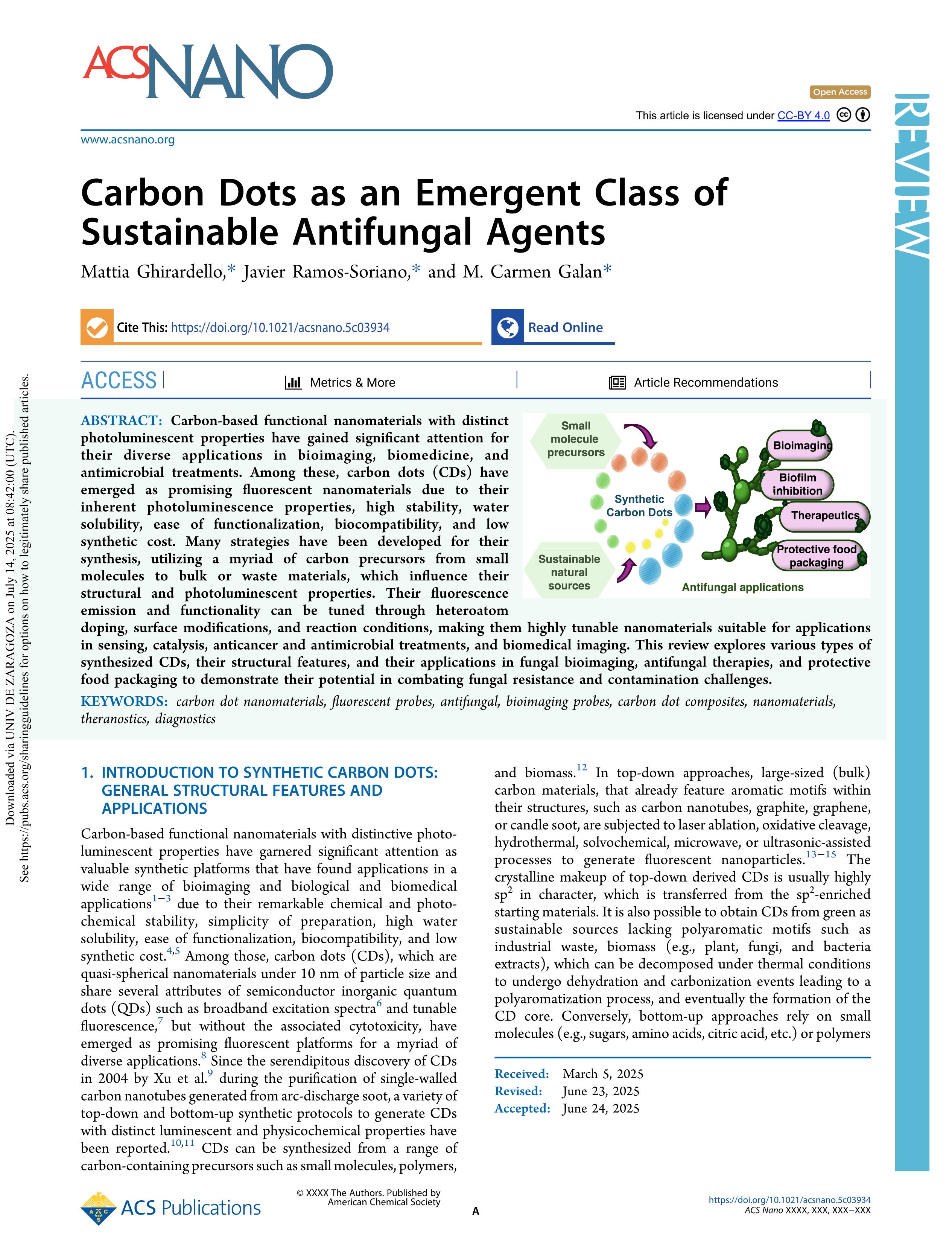

Resumen: Carbon-based functional nanomaterials with distinct photoluminescent properties have gained significant attention for their diverse applications in bioimaging, biomedicine, and antimicrobial treatments. Among these, carbon dots (CDs) have emerged as promising fluorescent nanomaterials due to their inherent photoluminescence properties, high stability, water solubility, ease of functionalization, biocompatibility, and low synthetic cost. Many strategies have been developed for their synthesis, utilizing a myriad of carbon precursors from small molecules to bulk or waste materials, which influence their structural and photoluminescent properties. Their fluorescence emission and functionality can be tuned through heteroatom doping, surface modifications, and reaction conditions, making them highly tunable nanomaterials suitable for applications in sensing, catalysis, anticancer and antimicrobial treatments, and biomedical imaging. This review explores various types of synthesized CDs, their structural features, and their applications in fungal bioimaging, antifungal therapies, and protective food packaging to demonstrate their potential in combating fungal resistance and contamination challenges.
Idioma: Inglés
DOI: 10.1021/acsnano.5c03934
Año: 2025
Publicado en: ACS NANO 19, 27 (2025), 24377-24403
ISSN: 1936-0851
Financiación: info:eu-repo/grantAgreement/ES/AEI/RYC2022-037742-I
Financiación: info:eu-repo/grantAgreement/EC/H2020/101034288/EU/International Fellowship Programme for Talent Attraction to the Campus of International Excellence Campus Iberus/IberusExperience
Tipo y forma: Artículo (Versión definitiva)
Área (Departamento): Área Química Orgánica (Dpto. Química Orgánica)
 Debe reconocer adecuadamente la autoría, proporcionar un enlace a la licencia e indicar si se han realizado cambios. Puede hacerlo de cualquier manera razonable, pero no de una manera que sugiera que tiene el apoyo del licenciador o lo recibe por el uso que hace.
Exportado de SIDERAL (2026-04-30-14:05:36)
Visitas y descargas
Idioma: Inglés
DOI: 10.1021/acsnano.5c03934
Año: 2025
Publicado en: ACS NANO 19, 27 (2025), 24377-24403
ISSN: 1936-0851
Financiación: info:eu-repo/grantAgreement/ES/AEI/RYC2022-037742-I
Financiación: info:eu-repo/grantAgreement/EC/H2020/101034288/EU/International Fellowship Programme for Talent Attraction to the Campus of International Excellence Campus Iberus/IberusExperience
Tipo y forma: Artículo (Versión definitiva)
Área (Departamento): Área Química Orgánica (Dpto. Química Orgánica)
Debe reconocer adecuadamente la autoría, proporcionar un enlace a la licencia e indicar si se han realizado cambios. Puede hacerlo de cualquier manera razonable, pero no de una manera que sugiera que tiene el apoyo del licenciador o lo recibe por el uso que hace. Exportado de SIDERAL (2026-04-30-14:05:36)
Enlace permanente:
Visitas y descargas
Este artículo se encuentra en las siguientes colecciones:
Artículos > Artículos por área > Química Orgánica
Registro creado el 2025-07-17, última modificación el 2026-04-30