Biophysical and socioeconomic state and links of deltaic areas vulnerable to climate change: Volta (Ghana), Mahanadi (India) and Ganges-Brahmaputra-Meghna (India and Bangladesh)
Cazcarro, I. ; Arto, I. ; Hazra, S. ; Bhattacharya, R.N. ; Adjei, P.O.-W. ; Ofori-Danson, P.K. ; Asenso, J.K. ; Amponsah, S.K. ; Khondker, B. ; Raihan, S. ; Hossen, Z.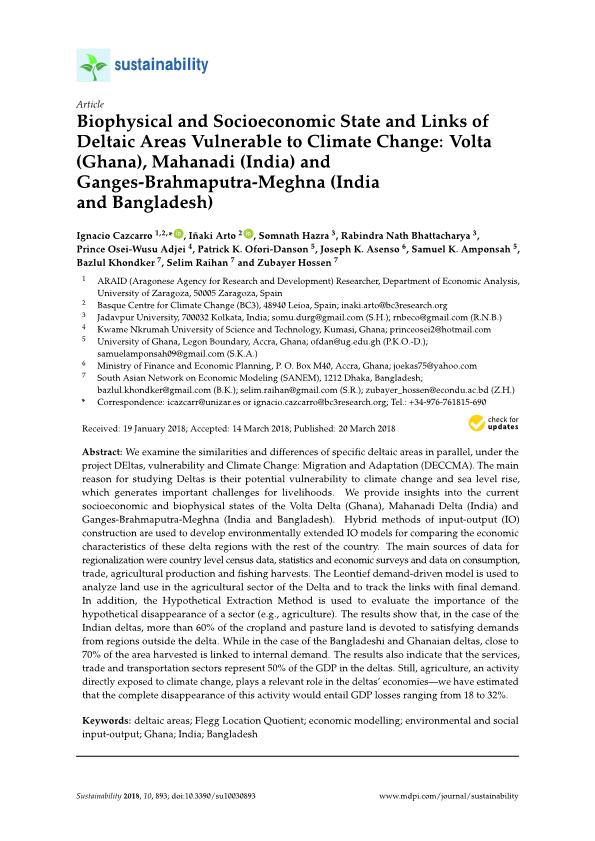
Resumen: We examine the similarities and differences of specific deltaic areas in parallel, under the project DEltas, vulnerability and Climate Change: Migration and Adaptation (DECCMA). The main reason for studying Deltas is their potential vulnerability to climate change and sea level rise, which generates important challenges for livelihoods. We provide insights into the current socioeconomic and biophysical states of the Volta Delta (Ghana), Mahanadi Delta (India) and Ganges-Brahmaputra-Meghna (India and Bangladesh). Hybrid methods of input-output (IO) construction are used to develop environmentally extended IO models for comparing the economic characteristics of these delta regions with the rest of the country. The main sources of data for regionalization were country level census data, statistics and economic surveys and data on consumption, trade, agricultural production and fishing harvests. The Leontief demand-driven model is used to analyze land use in the agricultural sector of the Delta and to track the links with final demand. In addition, the Hypothetical Extraction Method is used to evaluate the importance of the hypothetical disappearance of a sector (e.g., agriculture). The results show that, in the case of the Indian deltas, more than 60% of the cropland and pasture land is devoted to satisfying demands from regions outside the delta. While in the case of the Bangladeshi and Ghanaian deltas, close to 70% of the area harvested is linked to internal demand. The results also indicate that the services, trade and transportation sectors represent 50% of the GDP in the deltas. Still, agriculture, an activity directly exposed to climate change, plays a relevant role in the deltas'' economies-we have estimated that the complete disappearance of this activity would entail GDP losses ranging from 18 to 32%.
Idioma: Inglés
DOI: 10.3390/su10030893
Año: 2018
Publicado en: Sustainability (Switzerland) 10, 3 (2018), 893 [22 pp]
ISSN: 2071-1050
Factor impacto JCR: 2.592 (2018)
Categ. JCR: ENVIRONMENTAL SCIENCES rank: 105 / 250 = 0.42 (2018) - Q2 - T2
Categ. JCR: GREEN & SUSTAINABLE SCIENCE & TECHNOLOGY rank: 3 / 6 = 0.5 (2018) - Q2 - T2
Categ. JCR: ENVIRONMENTAL STUDIES rank: 44 / 116 = 0.379 (2018) - Q2 - T2
Categ. JCR: GREEN & SUSTAINABLE SCIENCE & TECHNOLOGY rank: 20 / 35 = 0.571 (2018) - Q3 - T2
Factor impacto SCIMAGO: 0.549 - Geography, Planning and Development (Q2) - Renewable Energy, Sustainability and the Environment (Q2) - Management, Monitoring, Policy and Law (Q2)
Tipo y forma: Artículo (Versión definitiva)
 Debe reconocer adecuadamente la autoría, proporcionar un enlace a la licencia e indicar si se han realizado cambios. Puede hacerlo de cualquier manera razonable, pero no de una manera que sugiera que tiene el apoyo del licenciador o lo recibe por el uso que hace.
Exportado de SIDERAL (2020-01-13-14:54:15)
Visitas y descargas
Idioma: Inglés
DOI: 10.3390/su10030893
Año: 2018
Publicado en: Sustainability (Switzerland) 10, 3 (2018), 893 [22 pp]
ISSN: 2071-1050
Factor impacto JCR: 2.592 (2018)
Categ. JCR: ENVIRONMENTAL SCIENCES rank: 105 / 250 = 0.42 (2018) - Q2 - T2
Categ. JCR: GREEN & SUSTAINABLE SCIENCE & TECHNOLOGY rank: 3 / 6 = 0.5 (2018) - Q2 - T2
Categ. JCR: ENVIRONMENTAL STUDIES rank: 44 / 116 = 0.379 (2018) - Q2 - T2
Categ. JCR: GREEN & SUSTAINABLE SCIENCE & TECHNOLOGY rank: 20 / 35 = 0.571 (2018) - Q3 - T2
Factor impacto SCIMAGO: 0.549 - Geography, Planning and Development (Q2) - Renewable Energy, Sustainability and the Environment (Q2) - Management, Monitoring, Policy and Law (Q2)
Tipo y forma: Artículo (Versión definitiva)
Debe reconocer adecuadamente la autoría, proporcionar un enlace a la licencia e indicar si se han realizado cambios. Puede hacerlo de cualquier manera razonable, pero no de una manera que sugiera que tiene el apoyo del licenciador o lo recibe por el uso que hace. Exportado de SIDERAL (2020-01-13-14:54:15)
Enlace permanente:
Visitas y descargas
Este artículo se encuentra en las siguientes colecciones:
Artículos
Registro creado el 2018-06-19, última modificación el 2020-01-13