Sonochemical edge functionalisation of molybdenum disulfide
Graf, Aline Amorim ; Large, Matthew J. ; Ogilvie, Sean P. ; Rong, Yuanyang ; Lynch, Peter J. ; Fratta, Giuseppe ; Ray, Santanu ; Shmeliov, Aleksey ; Nicolosi, Valeria ; Arenal, Raul (Universidad de Zaragoza) ; King, Alice A. K. ; Dalton, Alan B.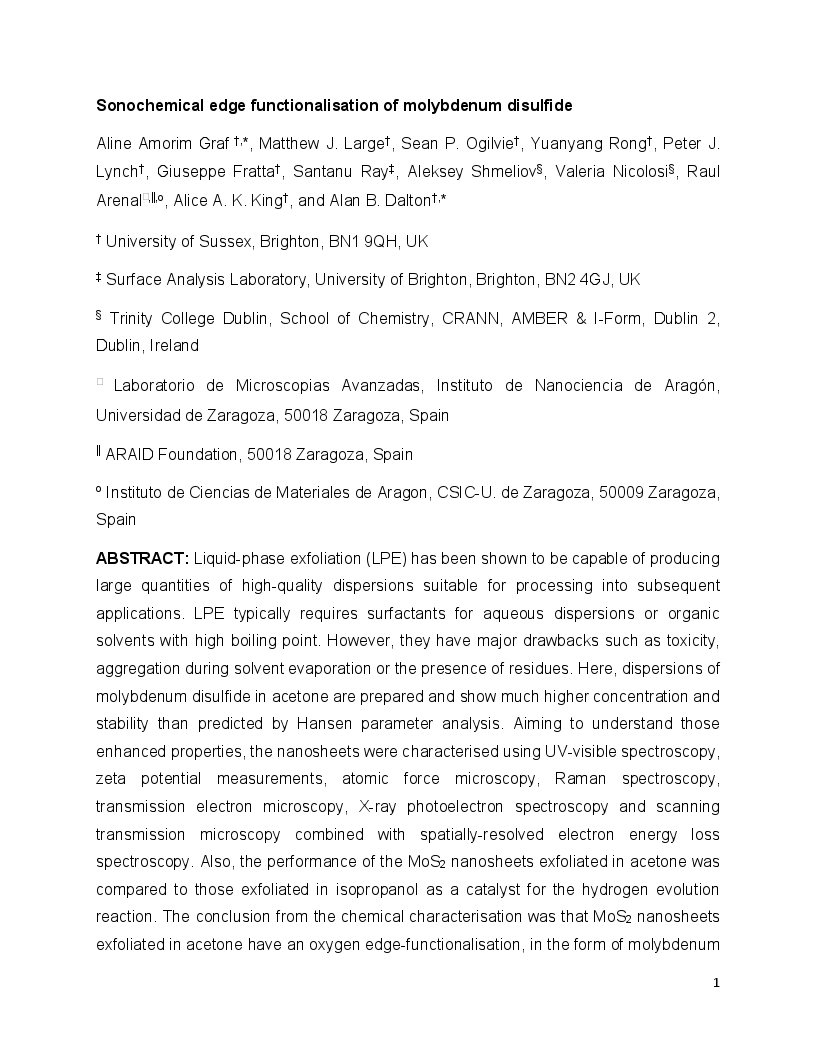
Resumen: Liquid-phase exfoliation (LPE) has been shown to be capable of producing large quantities of high-quality dispersions suitable for processing into subsequent applications. LPE typically requires surfactants for aqueous dispersions or organic solvents with high boiling point. However, they have major drawbacks such as toxicity, aggregation during solvent evaporation or the presence of residues. Here, dispersions of molybdenum disulfide in acetone are prepared and show much higher concentration and stability than predicted by Hansen parameter analysis. Aiming to understand these enhanced properties, the nanosheets were characterised using UV-visible spectroscopy, zeta potential measurements, atomic force microscopy, Raman spectroscopy, transmission electron microscopy, X-ray photoelectron spectroscopy and scanning transmission microscopy combined with spatially-resolved electron energy loss spectroscopy. Also, the performance of the MoS2 nanosheets exfoliated in acetone was compared to that of those exfoliated in isopropanol as a catalyst for the hydrogen evolution reaction. The conclusion from the chemical characterisation was that MoS2 nanosheets exfoliated in acetone have an oxygen edge functionalisation, in the form of molybdenum oxides, changing its interaction with solvents and explaining the observed high-quality and stability of the resulting dispersion in a low boiling point solvent. Exfoliation in acetone could potentially be applied as a pretreatment to modify the solubility of MoS2 by edge functionalisation.
Idioma: Inglés
DOI: 10.1039/c9nr04974f
Año: 2019
Publicado en: Nanoscale 11, 33 (2019), 15550-15560
ISSN: 2040-3372
Factor impacto JCR: 6.895 (2019)
Categ. JCR: MATERIALS SCIENCE, MULTIDISCIPLINARY rank: 50 / 314 = 0.159 (2019) - Q1 - T1
Categ. JCR: NANOSCIENCE & NANOTECHNOLOGY rank: 25 / 103 = 0.243 (2019) - Q1 - T1
Categ. JCR: CHEMISTRY, MULTIDISCIPLINARY rank: 28 / 177 = 0.158 (2019) - Q1 - T1
Categ. JCR: PHYSICS, APPLIED rank: 23 / 154 = 0.149 (2019) - Q1 - T1
Factor impacto SCIMAGO: 2.18 - Nanoscience and Nanotechnology (Q1) - Materials Science (miscellaneous) (Q1)
Financiación: info:eu-repo/grantAgreement/ES/DGA/E13-17R
Financiación: info:eu-repo/grantAgreement/EC/H2020/785219/EU/Graphene Flagship Core Project 2/GrapheneCore2
Financiación: info:eu-repo/grantAgreement/ES/MINECO/MAT2016-79776-P
Tipo y forma: Artículo (PostPrint)
Área (Departamento): Área Física Materia Condensada (Dpto. Física Materia Condensa.)
 Derechos reservados por el editor de la revista
Exportado de SIDERAL (2020-07-16-09:45:41)
Visitas y descargas
Idioma: Inglés
DOI: 10.1039/c9nr04974f
Año: 2019
Publicado en: Nanoscale 11, 33 (2019), 15550-15560
ISSN: 2040-3372
Factor impacto JCR: 6.895 (2019)
Categ. JCR: MATERIALS SCIENCE, MULTIDISCIPLINARY rank: 50 / 314 = 0.159 (2019) - Q1 - T1
Categ. JCR: NANOSCIENCE & NANOTECHNOLOGY rank: 25 / 103 = 0.243 (2019) - Q1 - T1
Categ. JCR: CHEMISTRY, MULTIDISCIPLINARY rank: 28 / 177 = 0.158 (2019) - Q1 - T1
Categ. JCR: PHYSICS, APPLIED rank: 23 / 154 = 0.149 (2019) - Q1 - T1
Factor impacto SCIMAGO: 2.18 - Nanoscience and Nanotechnology (Q1) - Materials Science (miscellaneous) (Q1)
Financiación: info:eu-repo/grantAgreement/ES/DGA/E13-17R
Financiación: info:eu-repo/grantAgreement/EC/H2020/785219/EU/Graphene Flagship Core Project 2/GrapheneCore2
Financiación: info:eu-repo/grantAgreement/ES/MINECO/MAT2016-79776-P
Tipo y forma: Artículo (PostPrint)
Área (Departamento): Área Física Materia Condensada (Dpto. Física Materia Condensa.)
Derechos reservados por el editor de la revistaExportado de SIDERAL (2020-07-16-09:45:41)
Enlace permanente:
Visitas y descargas
Este artículo se encuentra en las siguientes colecciones:
Artículos > Artículos por área > Física de la Materia Condensada
Registro creado el 2020-02-18, última modificación el 2020-07-16