Low-Temperature Catalytic NO Reduction with CO by Subnanometric Pt Clusters
Fernández E. ; Liu L. ; Boronat M. ; Arenal R. (Universidad de Zaragoza) ; Concepcion P. ; Corma A.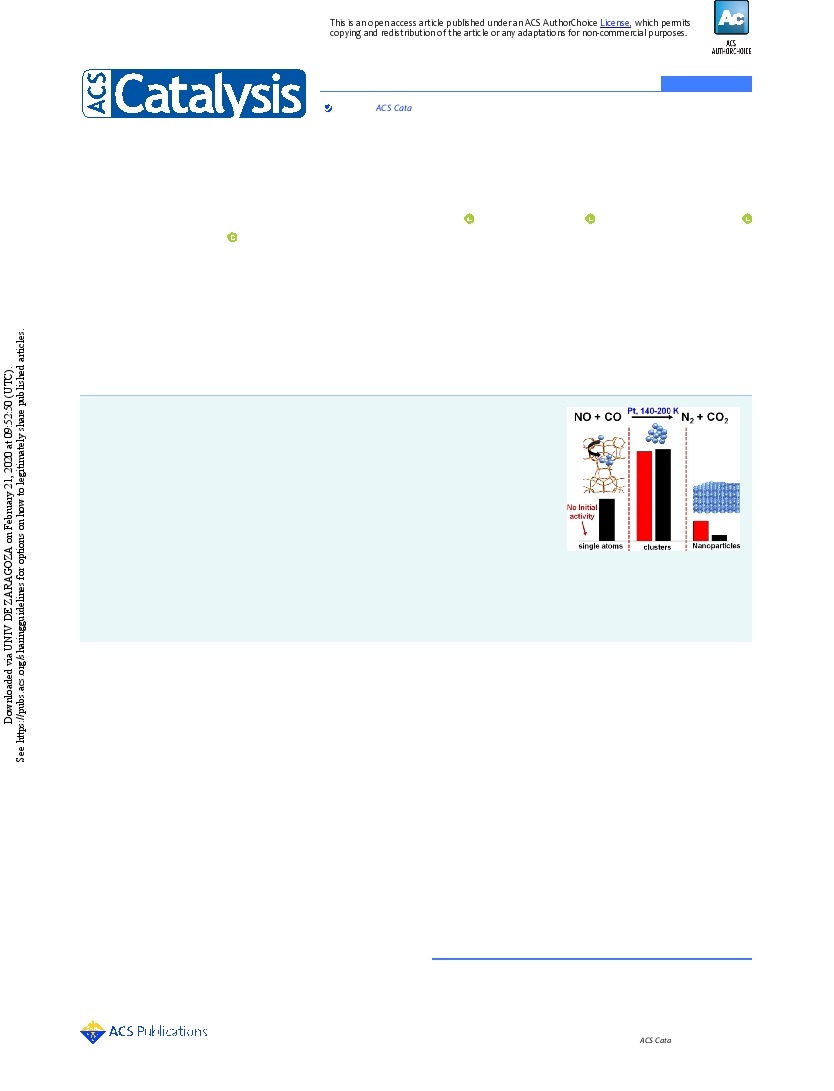

Resumen: The catalytic subnanometric metal clusters with a few atoms can be regarded as an intermediate state between single atoms and metal nanoparticles (>1 nm). Their molecule-like electronic structures and flexible geometric structures bring rich chemistry and also a different catalytic behavior, in comparison with the single-atom or nanoparticulate counterparts. In this work, by combination of operando IR spectroscopy techniques and electronic structure calculations, we will show a comparative study on Pt catalysts for CO + NO reaction at a very low temperature range (140-200 K). It has been found that single Pt atoms immobilized on MCM-22 zeolite are not stable under reaction conditions and agglomerate into Pt nanoclusters and particles, which are the working active sites for CO + NO reaction. In the case of the catalyst containing Pt nanoparticles (~2 nm), the oxidation of CO to CO2 occurs in a much lower extension, and Pt nanoparticles become poisoned under reaction conditions because of a strong interaction with CO and NO. Therefore, only subnanometric Pt clusters allow NO dissociation at a low temperature and CO oxidation to occur well on the surface, while CO interaction is weak enough to avoid catalyst poisoning, resulting in a good balance to achieve enhanced catalytic performance.
Idioma: Inglés
DOI: 10.1021/acscatal.9b03207
Año: 2019
Publicado en: ACS CATALYSIS 9, 12 (2019), 11530-11541
ISSN: 2155-5435
Factor impacto JCR: 12.35 (2019)
Categ. JCR: CHEMISTRY, PHYSICAL rank: 12 / 159 = 0.075 (2019) - Q1 - T1
Factor impacto SCIMAGO: 4.633 - Chemistry (miscellaneous) (Q1) - Catalysis (Q1)
Financiación: info:eu-repo/grantAgreement/ES/DGA/E13-17R
Financiación: info:eu-repo/grantAgreement/EC/H2020/823717/EU/Enabling Science and Technology through European Electron Microscopy/ESTEEM3
Financiación: info:eu-repo/grantAgreement/ES/MINECO-AEI-FEDER/MAT2016-79776-P
Tipo y forma: Artículo (Versión definitiva)
Área (Departamento): Área Física Materia Condensada (Dpto. Física Materia Condensa.)
 Debe reconocer adecuadamente la autoría, proporcionar un enlace a la licencia e indicar si se han realizado cambios. Puede hacerlo de cualquier manera razonable, pero no de una manera que sugiera que tiene el apoyo del licenciador o lo recibe por el uso que hace. No puede utilizar el material para una finalidad comercial.
Exportado de SIDERAL (2020-10-22-13:50:40)
Visitas y descargas
Idioma: Inglés
DOI: 10.1021/acscatal.9b03207
Año: 2019
Publicado en: ACS CATALYSIS 9, 12 (2019), 11530-11541
ISSN: 2155-5435
Factor impacto JCR: 12.35 (2019)
Categ. JCR: CHEMISTRY, PHYSICAL rank: 12 / 159 = 0.075 (2019) - Q1 - T1
Factor impacto SCIMAGO: 4.633 - Chemistry (miscellaneous) (Q1) - Catalysis (Q1)
Financiación: info:eu-repo/grantAgreement/ES/DGA/E13-17R
Financiación: info:eu-repo/grantAgreement/EC/H2020/823717/EU/Enabling Science and Technology through European Electron Microscopy/ESTEEM3
Financiación: info:eu-repo/grantAgreement/ES/MINECO-AEI-FEDER/MAT2016-79776-P
Tipo y forma: Artículo (Versión definitiva)
Área (Departamento): Área Física Materia Condensada (Dpto. Física Materia Condensa.)
Debe reconocer adecuadamente la autoría, proporcionar un enlace a la licencia e indicar si se han realizado cambios. Puede hacerlo de cualquier manera razonable, pero no de una manera que sugiera que tiene el apoyo del licenciador o lo recibe por el uso que hace. No puede utilizar el material para una finalidad comercial.Exportado de SIDERAL (2020-10-22-13:50:40)
Enlace permanente:
Visitas y descargas
Este artículo se encuentra en las siguientes colecciones:
Artículos > Artículos por área > Física de la Materia Condensada
Registro creado el 2020-02-21, última modificación el 2020-10-22