Mindfulness Training Improves Quality of Life and Reduces Depression and Anxiety Symptoms Among Police Officers: Results From the POLICE Study—A Multicenter Randomized Controlled Trial
Trombka, M. ; Demarzo, M. ; Campos, D. (Universidad de Zaragoza) ; Antonio, S.B. ; Cicuto, K. ; Walcher, A.L. ; García-Campayo, J. (Universidad de Zaragoza) ; Schuman-Olivier, Z. ; Rocha, N.S.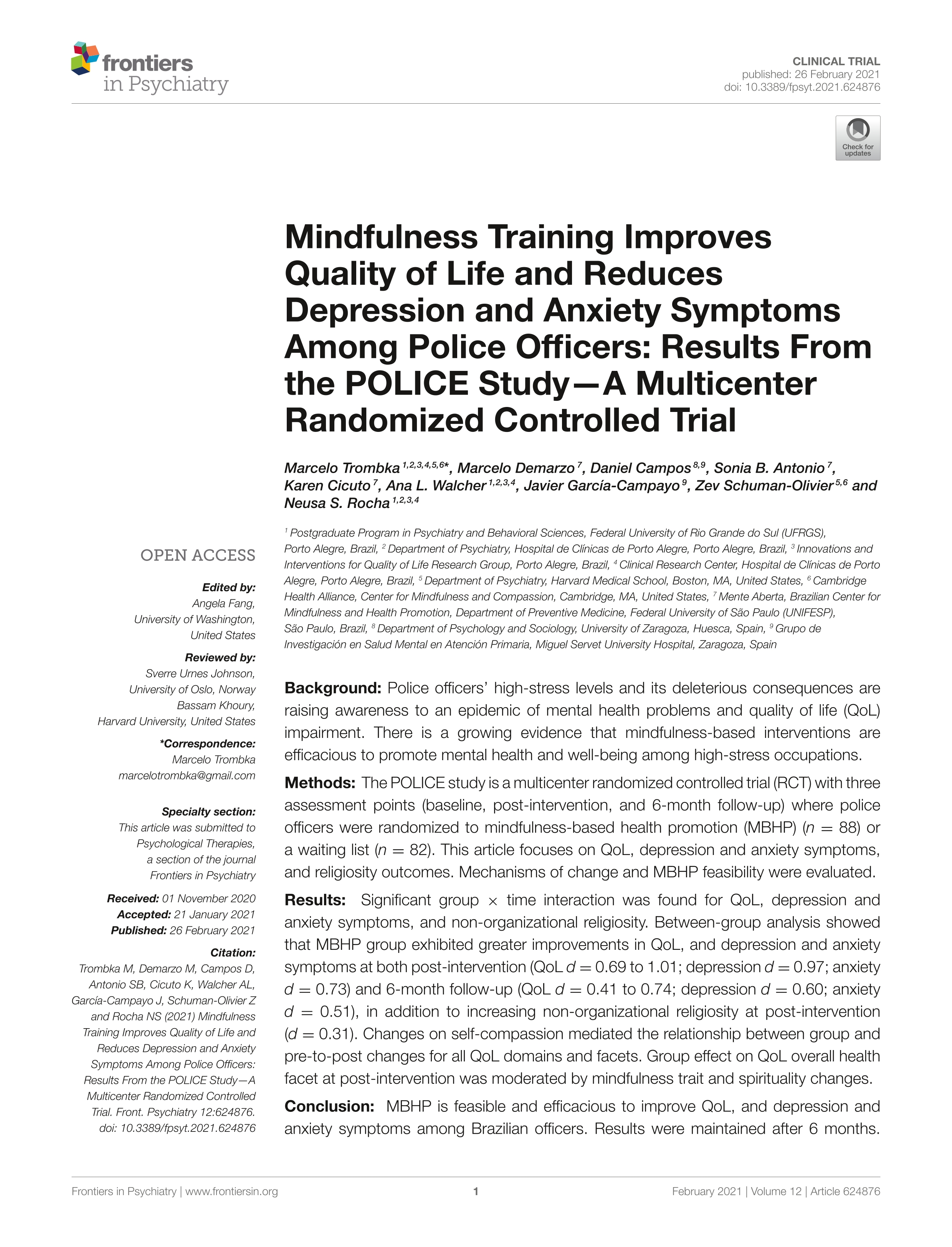
Resumen: Background: Police officers'' high-stress levels and its deleterious consequences are raising awareness to an epidemic of mental health problems and quality of life (QoL) impairment. There is a growing evidence that mindfulness-based interventions are efficacious to promote mental health and well-being among high-stress occupations. Methods: The POLICE study is a multicenter randomized controlled trial (RCT) with three assessment points (baseline, post-intervention, and 6-month follow-up) where police officers were randomized to mindfulness-based health promotion (MBHP) (n = 88) or a waiting list (n = 82). This article focuses on QoL, depression and anxiety symptoms, and religiosity outcomes. Mechanisms of change and MBHP feasibility were evaluated. Results: Significant group × time interaction was found for QoL, depression and anxiety symptoms, and non-organizational religiosity. Between-group analysis showed that MBHP group exhibited greater improvements in QoL, and depression and anxiety symptoms at both post-intervention (QoL d = 0.69 to 1.01; depression d = 0.97; anxiety d = 0.73) and 6-month follow-up (QoL d = 0.41 to 0.74; depression d = 0.60; anxiety d = 0.51), in addition to increasing non-organizational religiosity at post-intervention (d = 0.31). Changes on self-compassion mediated the relationship between group and pre-to-post changes for all QoL domains and facets. Group effect on QoL overall health facet at post-intervention was moderated by mindfulness trait and spirituality changes. Conclusion: MBHP is feasible and efficacious to improve QoL, and depression and anxiety symptoms among Brazilian officers. Results were maintained after 6 months. MBHP increased non-organizational religiosity, although the effect was not sustained 6 months later. To our knowledge, this is the first mindfulness-based intervention RCT to empirically demonstrate these effects among police officers. Self-compassion, mindfulness trait, and spirituality mechanisms of change are examined. Clinical Trial Registration: www.ClinicalTrials.gov. identifier: NCT03114605. ©
Idioma: Inglés
DOI: 10.3389/fpsyt.2021.624876
Año: 2021
Publicado en: Frontiers in Psychiatry 12 (2021), [16 pp]
ISSN: 1664-0640
Factor impacto JCR: 5.435 (2021)
Categ. JCR: PSYCHIATRY rank: 38 / 143 = 0.266 (2021) - Q2 - T1
Categ. JCR: PSYCHIATRY rank: 48 / 155 = 0.31 (2021) - Q2 - T1
Factor impacto CITESCORE: 4.6 - Medicine (Q2)
Factor impacto SCIMAGO: 1.279 - Psychiatry and Mental Health (Q1)
Tipo y forma: Artículo (Versión definitiva)
Área (Departamento): Area Psiquiatría (Dpto. Medicina, Psiqu. y Derm.)
Área (Departamento): Área Psicolog.Evolut.Educac (Dpto. Psicología y Sociología)
 Debe reconocer adecuadamente la autoría, proporcionar un enlace a la licencia e indicar si se han realizado cambios. Puede hacerlo de cualquier manera razonable, pero no de una manera que sugiera que tiene el apoyo del licenciador o lo recibe por el uso que hace.
Exportado de SIDERAL (2023-11-08-20:14:06)
Visitas y descargas
Idioma: Inglés
DOI: 10.3389/fpsyt.2021.624876
Año: 2021
Publicado en: Frontiers in Psychiatry 12 (2021), [16 pp]
ISSN: 1664-0640
Factor impacto JCR: 5.435 (2021)
Categ. JCR: PSYCHIATRY rank: 38 / 143 = 0.266 (2021) - Q2 - T1
Categ. JCR: PSYCHIATRY rank: 48 / 155 = 0.31 (2021) - Q2 - T1
Factor impacto CITESCORE: 4.6 - Medicine (Q2)
Factor impacto SCIMAGO: 1.279 - Psychiatry and Mental Health (Q1)
Tipo y forma: Artículo (Versión definitiva)
Área (Departamento): Area Psiquiatría (Dpto. Medicina, Psiqu. y Derm.)
Área (Departamento): Área Psicolog.Evolut.Educac (Dpto. Psicología y Sociología)
Debe reconocer adecuadamente la autoría, proporcionar un enlace a la licencia e indicar si se han realizado cambios. Puede hacerlo de cualquier manera razonable, pero no de una manera que sugiera que tiene el apoyo del licenciador o lo recibe por el uso que hace. Exportado de SIDERAL (2023-11-08-20:14:06)
Enlace permanente:
Visitas y descargas
Este artículo se encuentra en las siguientes colecciones:
Artículos > Artículos por área > Psicología Evolutiva y de la Educación
Artículos > Artículos por área > Psiquiatría
Registro creado el 2021-05-25, última modificación el 2023-11-08