On the use of laser-scanning vibrometry for mechanical performance evaluation of 3D printed specimens
Medel F. (Universidad de Zaragoza) ; Esteban V. ; Abad J. (Universidad de Zaragoza)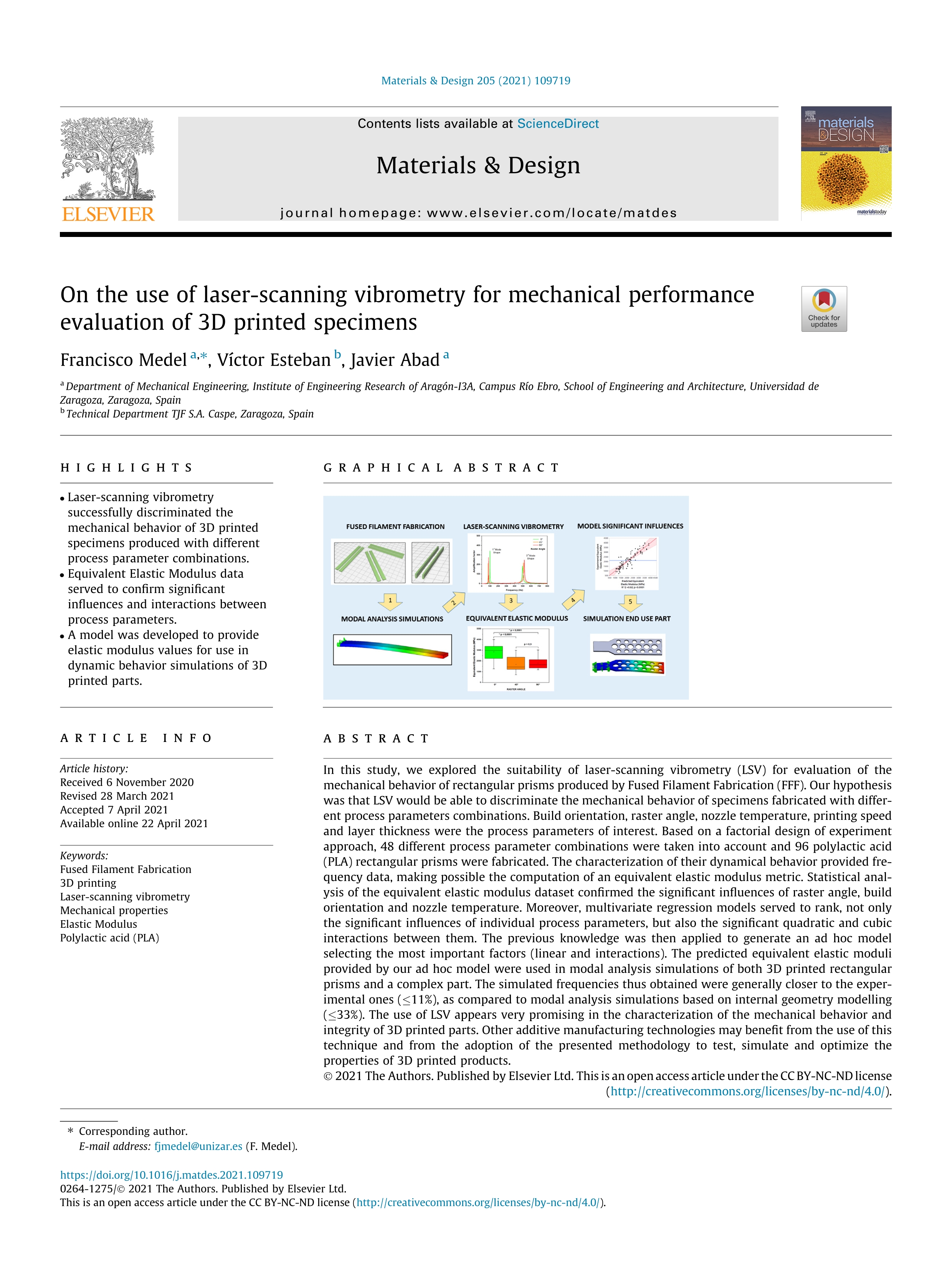
Resumen: In this study, we explored the suitability of laser-scanning vibrometry (LSV) for evaluation of the mechanical behavior of rectangular prisms produced by Fused Filament Fabrication (FFF). Our hypothesis was that LSV would be able to discriminate the mechanical behavior of specimens fabricated with different process parameters combinations. Build orientation, raster angle, nozzle temperature, printing speed and layer thickness were the process parameters of interest. Based on a factorial design of experiment approach, 48 different process parameter combinations were taken into account and 96 polylactic acid (PLA) rectangular prisms were fabricated. The characterization of their dynamical behavior provided frequency data, making possible the computation of an equivalent elastic modulus metric. Statistical analysis of the equivalent elastic modulus dataset confirmed the significant influences of raster angle, build orientation and nozzle temperature. Moreover, multivariate regression models served to rank, not only the significant influences of individual process parameters, but also the significant quadratic and cubic interactions between them. The previous knowledge was then applied to generate an ad hoc model selecting the most important factors (linear and interactions). The predicted equivalent elastic moduli provided by our ad hoc model were used in modal analysis simulations of both 3D printed rectangular prisms and a complex part. The simulated frequencies thus obtained were generally closer to the experimental ones (=11%), as compared to modal analysis simulations based on internal geometry modelling (=33%). The use of LSV appears very promising in the characterization of the mechanical behavior and integrity of 3D printed parts. Other additive manufacturing technologies may benefit from the use of this technique and from the adoption of the presented methodology to test, simulate and optimize the properties of 3D printed products. © 2021 The Authors
Idioma: Inglés
DOI: 10.1016/j.matdes.2021.109719
Año: 2021
Publicado en: MATERIALS & DESIGN 205 (2021), 109719 [14 pp]
ISSN: 0264-1275
Factor impacto JCR: 9.417 (2021)
Categ. JCR: MATERIALS SCIENCE, MULTIDISCIPLINARY rank: 58 / 345 = 0.168 (2021) - Q1 - T1
Factor impacto CITESCORE: 13.2 - Materials Science (Q1) - Engineering (Q1)
Factor impacto SCIMAGO: 1.802 - Mechanical Engineering (Q1) - Materials Science (miscellaneous) (Q1)
Financiación: info:eu-repo/grantAgreement/ES/DGA/T19-20R
Financiación: info:eu-repo/grantAgreement/ES/DGA/T48-20R
Tipo y forma: Artículo (Versión definitiva)
Área (Departamento): Área Ingeniería Mecánica (Dpto. Ingeniería Mecánica)
 Debe reconocer adecuadamente la autoría, proporcionar un enlace a la licencia e indicar si se han realizado cambios. Puede hacerlo de cualquier manera razonable, pero no de una manera que sugiera que tiene el apoyo del licenciador o lo recibe por el uso que hace. No puede utilizar el material para una finalidad comercial. Si remezcla, transforma o crea a partir del material, no puede difundir el material modificado.
Exportado de SIDERAL (2023-05-18-15:48:11)
Visitas y descargas
Idioma: Inglés
DOI: 10.1016/j.matdes.2021.109719
Año: 2021
Publicado en: MATERIALS & DESIGN 205 (2021), 109719 [14 pp]
ISSN: 0264-1275
Factor impacto JCR: 9.417 (2021)
Categ. JCR: MATERIALS SCIENCE, MULTIDISCIPLINARY rank: 58 / 345 = 0.168 (2021) - Q1 - T1
Factor impacto CITESCORE: 13.2 - Materials Science (Q1) - Engineering (Q1)
Factor impacto SCIMAGO: 1.802 - Mechanical Engineering (Q1) - Materials Science (miscellaneous) (Q1)
Financiación: info:eu-repo/grantAgreement/ES/DGA/T19-20R
Financiación: info:eu-repo/grantAgreement/ES/DGA/T48-20R
Tipo y forma: Artículo (Versión definitiva)
Área (Departamento): Área Ingeniería Mecánica (Dpto. Ingeniería Mecánica)
Debe reconocer adecuadamente la autoría, proporcionar un enlace a la licencia e indicar si se han realizado cambios. Puede hacerlo de cualquier manera razonable, pero no de una manera que sugiera que tiene el apoyo del licenciador o lo recibe por el uso que hace. No puede utilizar el material para una finalidad comercial. Si remezcla, transforma o crea a partir del material, no puede difundir el material modificado.Exportado de SIDERAL (2023-05-18-15:48:11)
Enlace permanente:
Visitas y descargas
Este artículo se encuentra en las siguientes colecciones:
Artículos > Artículos por área > Ingeniería Mecánica
Registro creado el 2022-04-05, última modificación el 2023-05-19