Azolium Control of the Osmium-Promoted Aromatic C-H Bond Activation in 1, 3-Disubstituted Substrates
Cancela, Lara (Universidad de Zaragoza) ; Esteruelas, Miguel A. ; Olivan, Montserrat ; Oñate, Enrique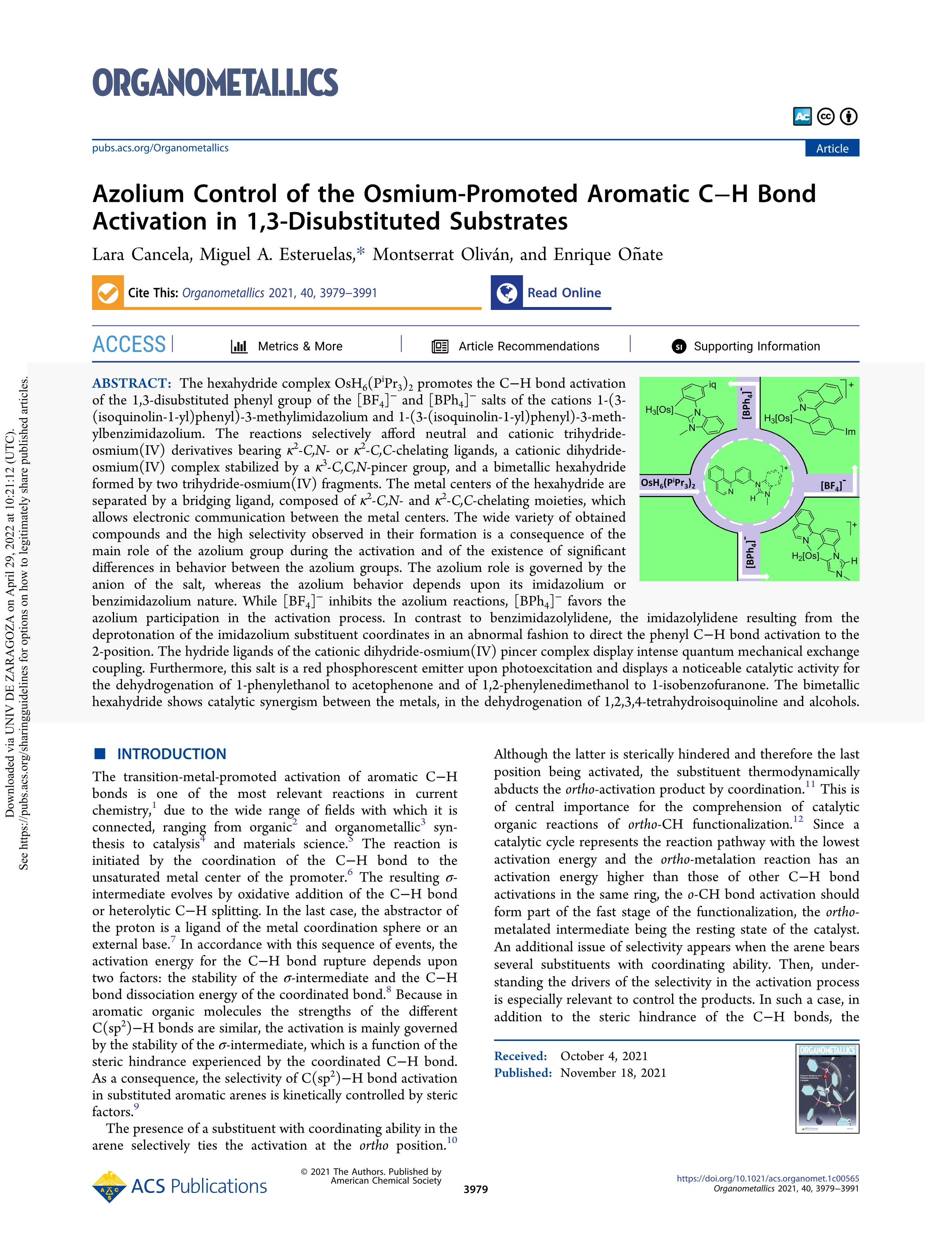
Resumen: The hexahydride complex OsH6((PPr3)-Pr-i)(2) promotes the C-H bond activation of the 1, 3-disubstituted phenyl group of the [BF4](-) and [BPh4](-) salts of the cations 1-(3-(isoquinolin-1-yl)phenyl)-3-methylimidazolium and 1-(3-(isoquinolin-1-yl)phenyl)-3-meth-ylbenzimidazolium. The reactions selectively afford neutral and cationic trihydride-osmium(IV) derivatives bearing kappa(2)-C, N- or kappa(2)-C, C-chelating ligands, a cationic dihydride-osmium(IV) complex stabilized by a kappa(3)-C, C, N-pincer group, and a bimetallic hexahydride formed by two trihydride-osmium(IV) fragments. The metal centers of the hexahydride are separated by a bridging ligand, composed of kappa(2)-C, N- and kappa(2)-C, C-chelating moieties, which allows electronic communication between the metal centers. The wide variety of obtained compounds and the high selectivity observed in their formation is a consequence of the main role of the azolium group during the activation and of the existence of significant differences in behavior between the azolium groups. The azolium role is governed by the anion of the salt, whereas the azolium behavior depends upon its imidazolium or benzimidazolium nature. While [BF4](-) inhibits the azolium reactions, [BPh4](-) favors the azolium participation in the activation process. In contrast to benzimidazolylidene, the imidazolylidene resulting from the deprotonation of the imidazolium substituent coordinates in an abnormal fashion to direct the phenyl C-H bond activation to the 2-position. The hydride ligands of the cationic dihydride-osmium(IV) pincer complex display intense quantum mechanical exchange coupling. Furthermore, this salt is a red phosphorescent emitter upon photoexcitation and displays a noticeable catalytic activity for the dehydrogenation of 1-phenylethanol to acetophenone and of 1, 2-phenylenedimethanol to 1-isobenzofuranone. The bimetallic hexahydride shows catalytic synergism between the metals, in the dehydrogenation of 1, 2, 3, 4-tetrahydroisoquinoline and alcohols.
Idioma: Inglés
DOI: 10.1021/acs.organomet.1c00565
Año: 2021
Publicado en: Organometallics 40, 23 (2021), 3979-3991
ISSN: 0276-7333
Factor impacto JCR: 3.837 (2021)
Categ. JCR: CHEMISTRY, ORGANIC rank: 15 / 57 = 0.263 (2021) - Q2 - T1
Categ. JCR: CHEMISTRY, INORGANIC & NUCLEAR rank: 12 / 46 = 0.261 (2021) - Q2 - T1
Factor impacto SCIMAGO: 0.994 - Organic Chemistry (Q1) - Inorganic Chemistry (Q1)
Financiación: info:eu-repo/grantAgreement/ES/DGA/E06-20R
Financiación: info:eu-repo/grantAgreement/ES/MICINN/PID2020-115286GB-I00/AEI/10.13039/501100011033
Financiación: info:eu-repo/grantAgreement/ES/MINECO-AEI-FEDER/RED2018-102387-T
Tipo y forma: Article (Published version)
Área (Departamento): Área Química Inorgánica (Dpto. Química Inorgánica)
Exportado de SIDERAL (2023-05-18-14:41:58)
Visitas y descargas
Idioma: Inglés
DOI: 10.1021/acs.organomet.1c00565
Año: 2021
Publicado en: Organometallics 40, 23 (2021), 3979-3991
ISSN: 0276-7333
Factor impacto JCR: 3.837 (2021)
Categ. JCR: CHEMISTRY, ORGANIC rank: 15 / 57 = 0.263 (2021) - Q2 - T1
Categ. JCR: CHEMISTRY, INORGANIC & NUCLEAR rank: 12 / 46 = 0.261 (2021) - Q2 - T1
Factor impacto SCIMAGO: 0.994 - Organic Chemistry (Q1) - Inorganic Chemistry (Q1)
Financiación: info:eu-repo/grantAgreement/ES/DGA/E06-20R
Financiación: info:eu-repo/grantAgreement/ES/MICINN/PID2020-115286GB-I00/AEI/10.13039/501100011033
Financiación: info:eu-repo/grantAgreement/ES/MINECO-AEI-FEDER/RED2018-102387-T
Tipo y forma: Article (Published version)
Área (Departamento): Área Química Inorgánica (Dpto. Química Inorgánica)
Exportado de SIDERAL (2023-05-18-14:41:58)
Permalink:
Visitas y descargas
Este artículo se encuentra en las siguientes colecciones:
articulos > articulos-por-area > quimica_inorganica
Notice créée le 2022-05-03, modifiée le 2023-05-19