Profiles and risk factors for teen dating violence in Spain
Valdivia-Salas, Sonsoles (Universidad de Zaragoza) ; Lombas, A. Sebastian (Universidad de Zaragoza) ; Jiménez, Teresa I. (Universidad de Zaragoza) ; Lucas-Alba, Antonio (Universidad de Zaragoza) ; Villanueva-Blasco, Víctor J.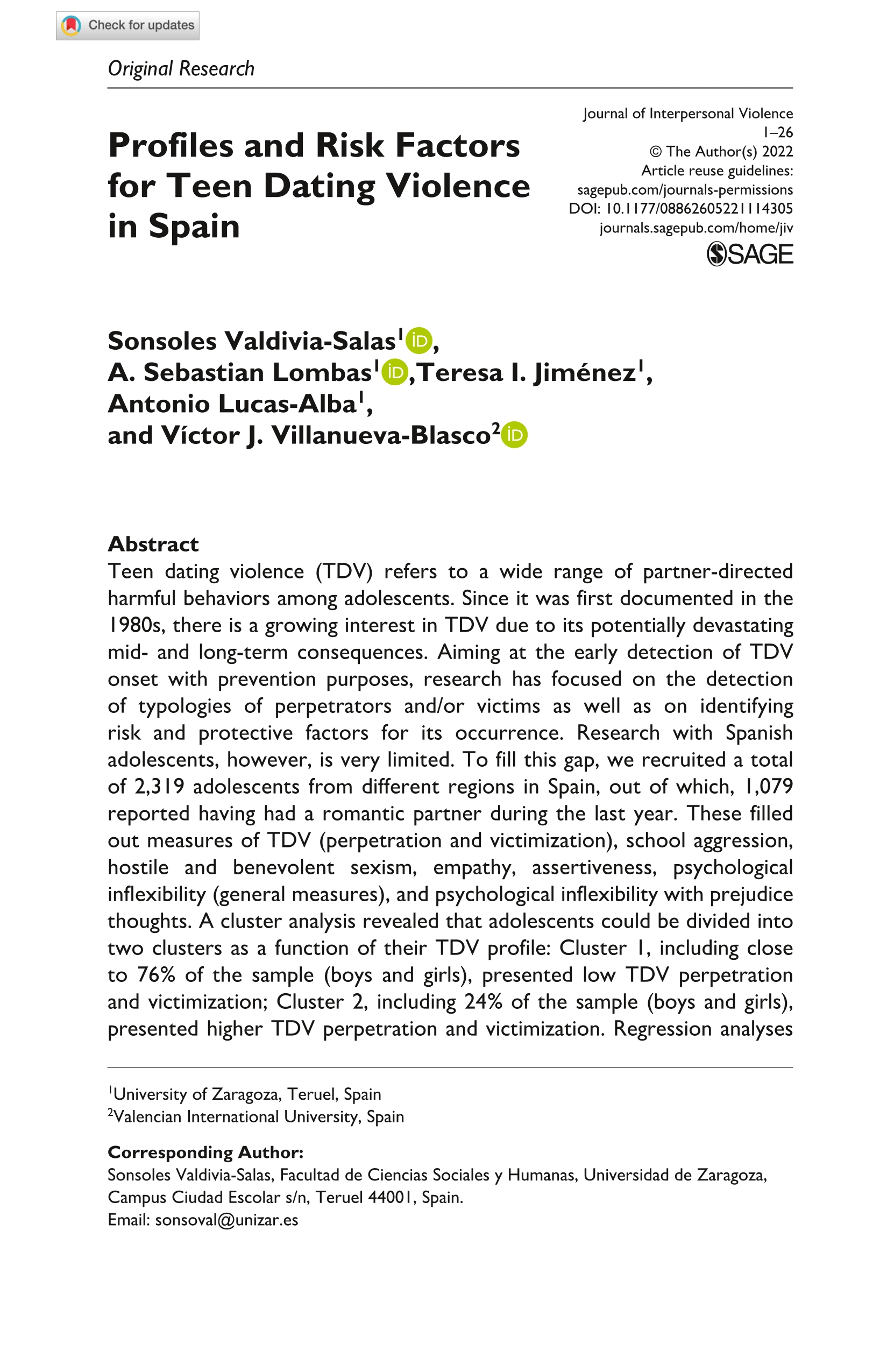
Resumen: Teen dating violence (TDV) refers to a wide range of partner-directed harmful behaviors among adolescents. Since it was first documented in the 1980s, there is a growing interest in TDV due to its potentially devastating mid- and long-term consequences. Aiming at the early detection of TDV onset with prevention purposes, research has focused on the detection of typologies of perpetrators and/or victims as well as on identifying risk and protective factors for its occurrence. Research with Spanish adolescents, however, is very limited. To fill this gap, we recruited a total of 2,319 adolescents from different regions in Spain, out of which, 1,079 reported having had a romantic partner during the last year. These filled out measures of TDV (perpetration and victimization), school aggression, hostile and benevolent sexism, empathy, assertiveness, psychological inflexibility (general measures), and psychological inflexibility with prejudice thoughts. A cluster analysis revealed that adolescents could be divided into two clusters as a function of their TDV profile: Cluster 1, including close to 76% of the sample (boys and girls), presented low TDV perpetration and victimization; Cluster 2, including 24% of the sample (boys and girls), presented higher TDV perpetration and victimization. Regression analyses revealed that, as compared to those in Cluster 1, adolescents in Cluster 2 were more likely to be older boys who scored high in benevolent sexism, overt and relational school aggression, and personal distress, and low in behavior regulation skills, perspective taking, and practical personal ability. We discuss the implications of these findings for the design of evidence-based TDV prevention campaigns.
Idioma: Inglés
DOI: 10.1177/08862605221114305
Año: 2023
Publicado en: Journal of Interpersonal Violence 38, 3-4 (2023), 4267-4292
ISSN: 0886-2605
Factor impacto JCR: 2.6 (2023)
Categ. JCR: CRIMINOLOGY & PENOLOGY rank: 12 / 113 = 0.106 (2023) - Q1 - T1
Categ. JCR: FAMILY STUDIES rank: 11 / 66 = 0.167 (2023) - Q1 - T1
Categ. JCR: PSYCHOLOGY, APPLIED rank: 48 / 113 = 0.425 (2023) - Q2 - T2
Factor impacto CITESCORE: 6.2 - Clinical Psychology (Q1) - Applied Psychology (Q2)
Factor impacto SCIMAGO: 1.169 - Clinical Psychology (Q1) - Applied Psychology (Q1)
Financiación: info:eu-repo/grantAgreement/ES/DGA-FEDER/LMP40-18
Financiación: info:eu-repo/grantAgreement/ES/DGA-FEDER/S62-20R
Financiación: info:eu-repo/grantAgreement/ES/UZ/JIUZ-2016-SOC-04
Tipo y forma: Artículo (Versión definitiva)
Área (Departamento): Área Metod.Ciencias Comportam. (Dpto. Psicología y Sociología)
Área (Departamento): Área Psicología Básica (Dpto. Psicología y Sociología)
Área (Departamento): Área Psicolog.Evolut.Educac (Dpto. Psicología y Sociología)
Área (Departamento): Área Person.Eval.Trat.Psicoló. (Dpto. Psicología y Sociología)
 Derechos reservados por el editor de la revista
Exportado de SIDERAL (2024-11-22-11:56:54)
Visitas y descargas
Idioma: Inglés
DOI: 10.1177/08862605221114305
Año: 2023
Publicado en: Journal of Interpersonal Violence 38, 3-4 (2023), 4267-4292
ISSN: 0886-2605
Factor impacto JCR: 2.6 (2023)
Categ. JCR: CRIMINOLOGY & PENOLOGY rank: 12 / 113 = 0.106 (2023) - Q1 - T1
Categ. JCR: FAMILY STUDIES rank: 11 / 66 = 0.167 (2023) - Q1 - T1
Categ. JCR: PSYCHOLOGY, APPLIED rank: 48 / 113 = 0.425 (2023) - Q2 - T2
Factor impacto CITESCORE: 6.2 - Clinical Psychology (Q1) - Applied Psychology (Q2)
Factor impacto SCIMAGO: 1.169 - Clinical Psychology (Q1) - Applied Psychology (Q1)
Financiación: info:eu-repo/grantAgreement/ES/DGA-FEDER/LMP40-18
Financiación: info:eu-repo/grantAgreement/ES/DGA-FEDER/S62-20R
Financiación: info:eu-repo/grantAgreement/ES/UZ/JIUZ-2016-SOC-04
Tipo y forma: Artículo (Versión definitiva)
Área (Departamento): Área Metod.Ciencias Comportam. (Dpto. Psicología y Sociología)
Área (Departamento): Área Psicología Básica (Dpto. Psicología y Sociología)
Área (Departamento): Área Psicolog.Evolut.Educac (Dpto. Psicología y Sociología)
Área (Departamento): Área Person.Eval.Trat.Psicoló. (Dpto. Psicología y Sociología)
Derechos reservados por el editor de la revistaExportado de SIDERAL (2024-11-22-11:56:54)
Enlace permanente:
Visitas y descargas
Este artículo se encuentra en las siguientes colecciones:
Artículos > Artículos por área > Personalidad,Evaluación y Tratamiento Psicológicos
Artículos > Artículos por área > Metod. de las Ciencias del Comportamiento
Artículos > Artículos por área > Psicología Evolutiva y de la Educación
Artículos > Artículos por área > Psicología Básica
Registro creado el 2022-10-20, última modificación el 2024-11-25