Topology and excited state multiplicity as controlling factors in the carbazole-photosensitized CPD formation and repair
Rodríguez-Muñiz, G. M. ; Gomez-Mendoza, M. ; Miro, P. ; García-Orduña, P. ; Sastre, G. ; Miranda, M. A. ; Marin, M. L.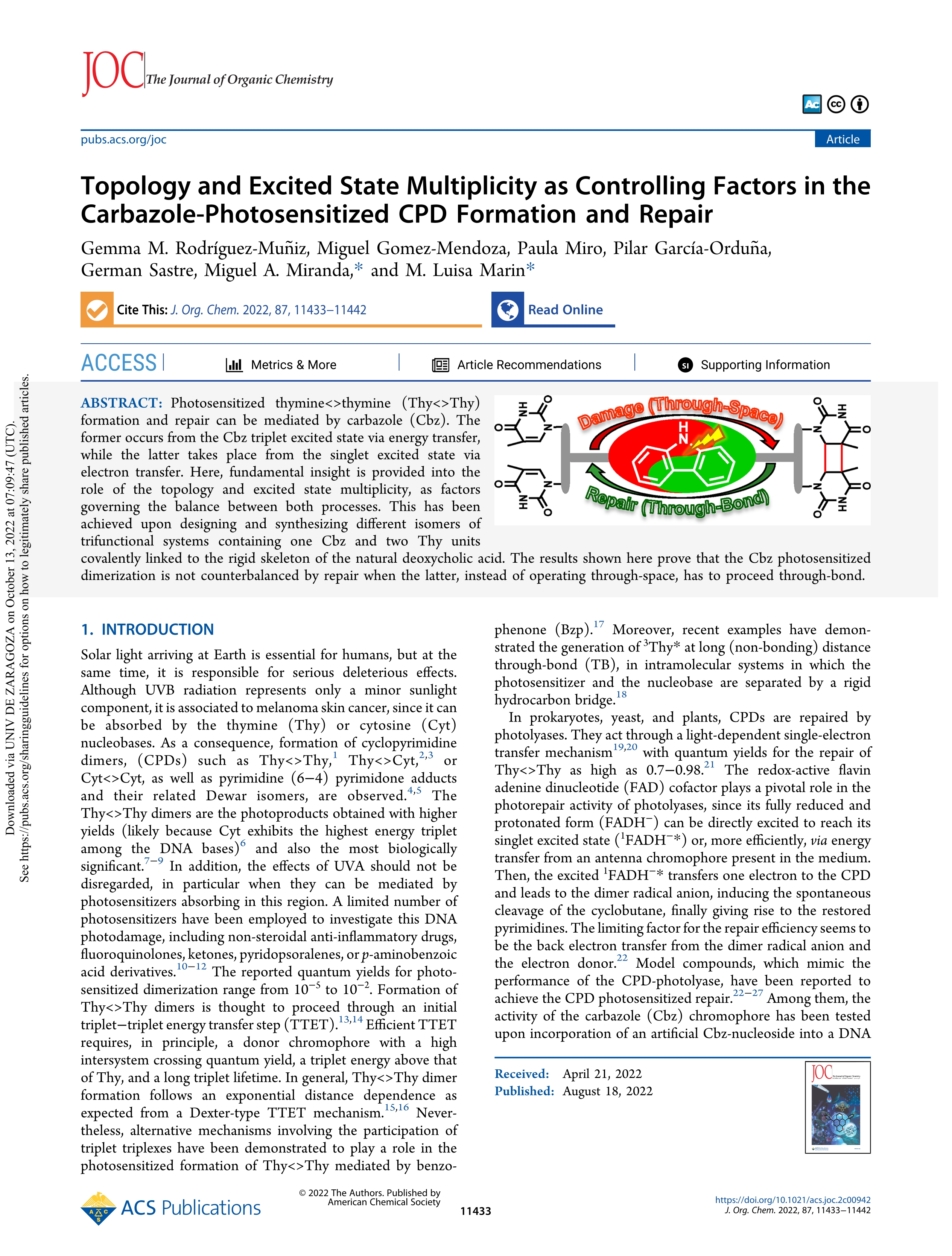
Resumen: Photosensitized thyminethymine (ThyThy) formation and repair can be mediated by carbazole (Cbz). The former occurs from the Cbz triplet excited state via energy transfer, while the latter takes place from the singlet excited state via electron transfer. Here, fundamental insight is provided into the role of the topology and excited state multiplicity, as factors governing the balance between both processes. This has been achieved upon designing and synthesizing different isomers of trifunctional systems containing one Cbz and two Thy units covalently linked to the rigid skeleton of the natural deoxycholic acid. The results shown here prove that the Cbz photosensitized dimerization is not counterbalanced by repair when the latter, instead of operating through-space, has to proceed through-bond. © 2022 The Authors. Published by American Chemical Society.
Idioma: Inglés
DOI: 10.1021/acs.joc.2c00942
Año: 2022
Publicado en: Journal of Organic Chemistry 87, 17 (2022), 11433 - 11442
ISSN: 0022-3263
Factor impacto JCR: 3.6 (2022)
Categ. JCR: CHEMISTRY, ORGANIC rank: 10 / 52 = 0.192 (2022) - Q1 - T1
Factor impacto CITESCORE: 6.8 - Chemistry (Q1)
Factor impacto SCIMAGO: 0.892 - Organic Chemistry (Q1)
Financiación: info:eu-repo/grantAgreement/ES/MINECO/SEV-2016-0683
Tipo y forma: Article (Published version)
 You must give appropriate credit, provide a link to the license, and indicate if changes were made. You may do so in any reasonable manner, but not in any way that suggests the licensor endorses you or your use.
Exportado de SIDERAL (2024-03-18-15:01:41)
Visitas y descargas
Idioma: Inglés
DOI: 10.1021/acs.joc.2c00942
Año: 2022
Publicado en: Journal of Organic Chemistry 87, 17 (2022), 11433 - 11442
ISSN: 0022-3263
Factor impacto JCR: 3.6 (2022)
Categ. JCR: CHEMISTRY, ORGANIC rank: 10 / 52 = 0.192 (2022) - Q1 - T1
Factor impacto CITESCORE: 6.8 - Chemistry (Q1)
Factor impacto SCIMAGO: 0.892 - Organic Chemistry (Q1)
Financiación: info:eu-repo/grantAgreement/ES/MINECO/SEV-2016-0683
Tipo y forma: Article (Published version)
You must give appropriate credit, provide a link to the license, and indicate if changes were made. You may do so in any reasonable manner, but not in any way that suggests the licensor endorses you or your use. Exportado de SIDERAL (2024-03-18-15:01:41)
Permalink:
Visitas y descargas
Este artículo se encuentra en las siguientes colecciones:
Articles
Record created 2022-10-20, last modified 2024-03-19