Effectiveness of mindfulness-based stress reduction and attachment-based compassion therapy for the treatment of depressive, anxious, and adjustment disorders in mental health settings: A randomized controlled trial
Collado-Navarro C. ; Navarro-Gil M. ; Pérez-Aranda A. ; López-del-Hoyo Y. (Universidad de Zaragoza) ; Garcia-Campayo J. (Universidad de Zaragoza) ; Montero-Marin J.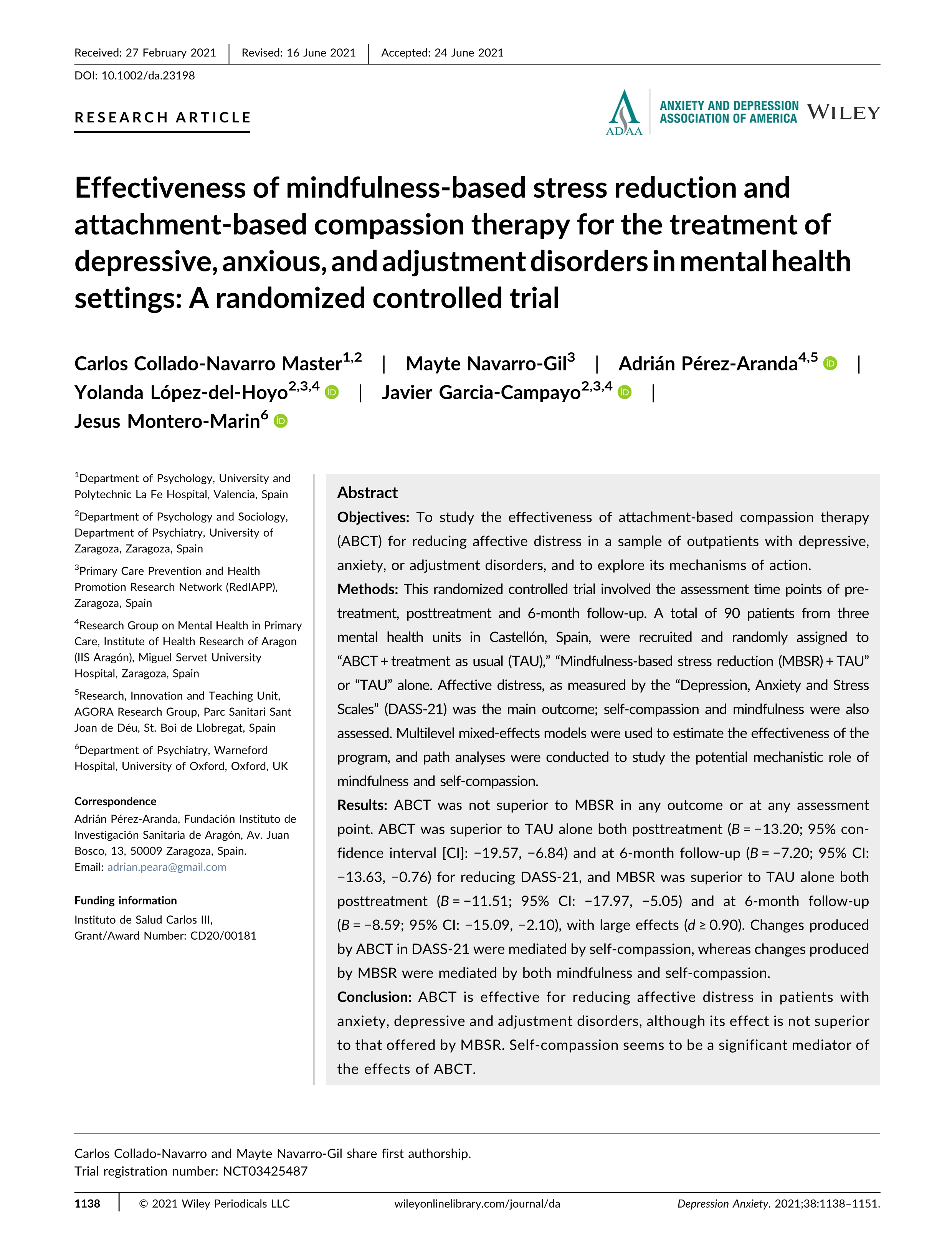
Resumen: Objectives: To study the effectiveness of attachment-based compassion therapy (ABCT) for reducing affective distress in a sample of outpatients with depressive, anxiety, or adjustment disorders, and to explore its mechanisms of action. Methods: This randomized controlled trial involved the assessment time points of pretreatment, posttreatment and 6-month follow-up. A total of 90 patients from three mental health units in Castellón, Spain, were recruited and randomly assigned to “ABCT + treatment as usual (TAU), ” “Mindfulness-based stress reduction (MBSR) + TAU” or “TAU” alone. Affective distress, as measured by the “Depression, Anxiety and Stress Scales” (DASS-21) was the main outcome; self-compassion and mindfulness were also assessed. Multilevel mixed-effects models were used to estimate the effectiveness of the program, and path analyses were conducted to study the potential mechanistic role of mindfulness and self-compassion. Results: ABCT was not superior to MBSR in any outcome or at any assessment point. ABCT was superior to TAU alone both posttreatment (B = -13.20; 95% confidence interval [CI]: -19.57, -6.84) and at 6-month follow-up (B = -7.20; 95% CI: -13.63, -0.76) for reducing DASS-21, and MBSR was superior to TAU alone both posttreatment (B = -11.51; 95% CI: -17.97, -5.05) and at 6-month follow-up (B = -8.59; 95% CI: -15.09, -2.10), with large effects (d = 0.90). Changes produced by ABCT in DASS-21 were mediated by self-compassion, whereas changes produced by MBSR were mediated by both mindfulness and self-compassion. Conclusion: ABCT is effective for reducing affective distress in patients with anxiety, depressive and adjustment disorders, although its effect is not superior to that offered by MBSR. Self-compassion seems to be a significant mediator of the effects of ABCT. © 2021 Wiley Periodicals LLC
Idioma: Inglés
DOI: 10.1002/da.23198
Año: 2021
Publicado en: Depression and Anxiety 38, 11 (2021), 1138-1151
ISSN: 1091-4269
Factor impacto JCR: 8.128 (2021)
Categ. JCR: PSYCHIATRY rank: 15 / 144 = 0.104 (2021) - Q1 - T1
Categ. JCR: PSYCHOLOGY rank: 10 / 81 = 0.123 (2021) - Q1 - T1
Categ. JCR: PSYCHIATRY rank: 21 / 157 = 0.134 (2021) - Q1 - T1
Categ. JCR: PSYCHOLOGY, CLINICAL rank: 9 / 132 = 0.068 (2021) - Q1 - T1
Factor impacto CITESCORE: 11.1 - Medicine (Q1) - Psychology (Q1)
Factor impacto SCIMAGO: 2.657 - Psychiatry and Mental Health (Q1) - Clinical Psychology (Q1)
Financiación: info:eu-repo/grantAgreement/ES/ISCIII/CD20-00181
Tipo y forma: Artículo (PostPrint)
Área (Departamento): Área Psicología Básica (Dpto. Psicología y Sociología)
Área (Departamento): Area Psiquiatría (Dpto. Medicina, Psiqu. y Derm.)
 Derechos reservados por el editor de la revista
Exportado de SIDERAL (2023-05-18-14:54:09)
Visitas y descargas
Idioma: Inglés
DOI: 10.1002/da.23198
Año: 2021
Publicado en: Depression and Anxiety 38, 11 (2021), 1138-1151
ISSN: 1091-4269
Factor impacto JCR: 8.128 (2021)
Categ. JCR: PSYCHIATRY rank: 15 / 144 = 0.104 (2021) - Q1 - T1
Categ. JCR: PSYCHOLOGY rank: 10 / 81 = 0.123 (2021) - Q1 - T1
Categ. JCR: PSYCHIATRY rank: 21 / 157 = 0.134 (2021) - Q1 - T1
Categ. JCR: PSYCHOLOGY, CLINICAL rank: 9 / 132 = 0.068 (2021) - Q1 - T1
Factor impacto CITESCORE: 11.1 - Medicine (Q1) - Psychology (Q1)
Factor impacto SCIMAGO: 2.657 - Psychiatry and Mental Health (Q1) - Clinical Psychology (Q1)
Financiación: info:eu-repo/grantAgreement/ES/ISCIII/CD20-00181
Tipo y forma: Artículo (PostPrint)
Área (Departamento): Área Psicología Básica (Dpto. Psicología y Sociología)
Área (Departamento): Area Psiquiatría (Dpto. Medicina, Psiqu. y Derm.)
Derechos reservados por el editor de la revistaExportado de SIDERAL (2023-05-18-14:54:09)
Enlace permanente:
Visitas y descargas
Este artículo se encuentra en las siguientes colecciones:
Artículos > Artículos por área > Psicología Básica
Artículos > Artículos por área > Psiquiatría
Registro creado el 2022-10-27, última modificación el 2023-05-19