Nanogels with High Loading of Anesthetic Nanocrystals for Extended Duration of Sciatic Nerve Block
Alejo, Teresa (Universidad de Zaragoza) ; Uson, Laura (Universidad de Zaragoza) ; Landa, Guillermo (Universidad de Zaragoza) ; Prieto, Martin ; Yus Argón, Cristina (Universidad de Zaragoza) ; Garcia-Salinas, Sara ; de Miguel, Ricardo (Universidad de Zaragoza) ; Rodríguez-Largo, Ana (Universidad de Zaragoza) ; Irusta, Silvia (Universidad de Zaragoza) ; Sebastian, Victor (Universidad de Zaragoza) ; Mendoza, Gracia ; Arruebo, Manuel (Universidad de Zaragoza)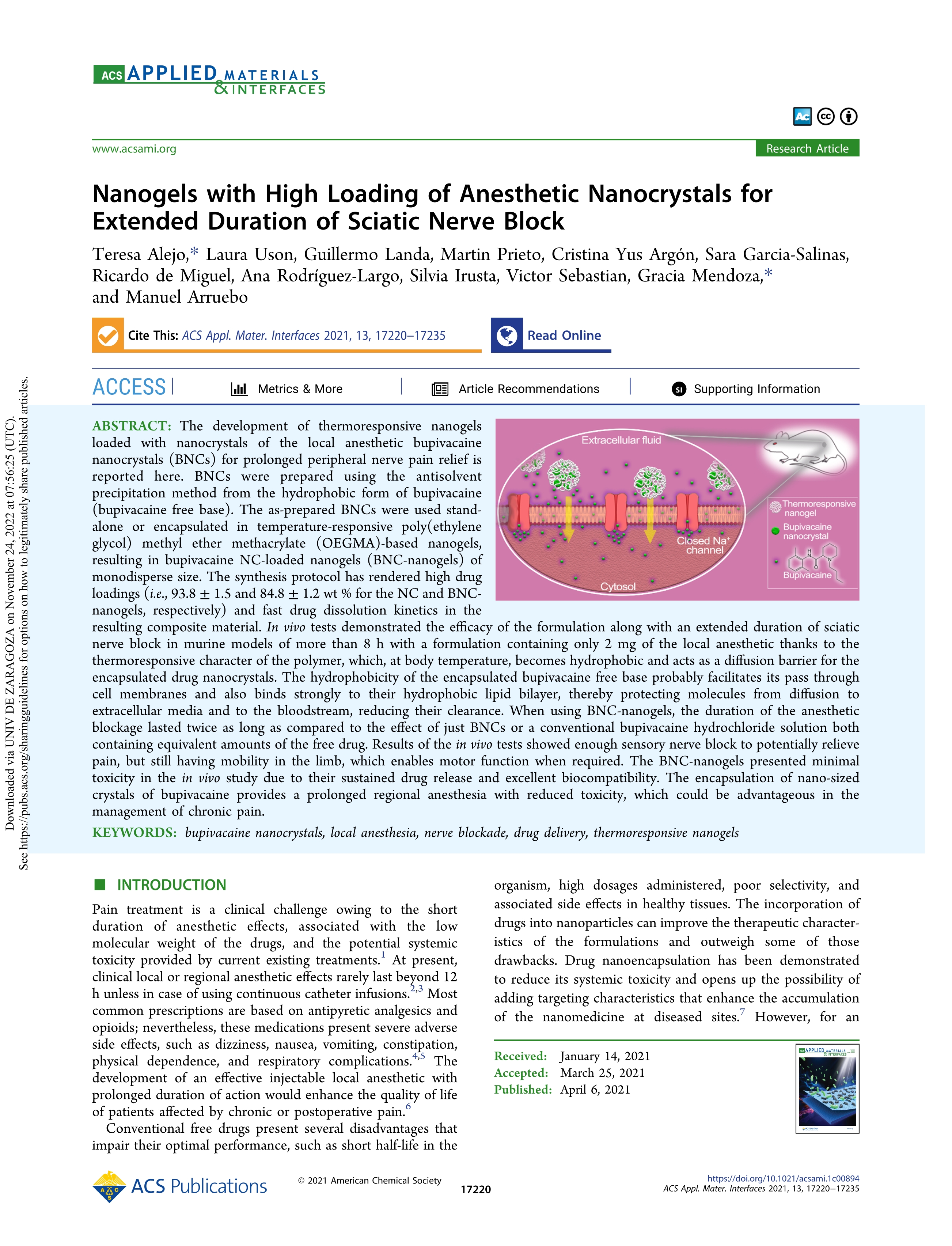
Resumen: The development of thermoresponsive nanogels loaded with nanocrystals of the local anesthetic bupivacaine nanocrystals (BNCs) for prolonged peripheral nerve pain relief is reported here. BNCs were prepared using the antisolvent
precipitation method from the hydrophobic form of bupivacaine(bupivacaine free base). The as-prepared BNCs were used stand-alone or encapsulated in temperature-responsive poly(ethylene glycol) methyl ether methacrylate (OEGMA)-based nanogels, resulting in bupivacaine NC-loaded nanogels (BNC-nanogels) of monodisperse size. The synthesis protocol has rendered high drug loadings (i.e., 93.8 ±1.5 and 84.8 ±1.2 wt % for the NC and BNC-nanogels, respectively) and fast drug dissolution kinetics in the resulting composite material. In vivo tests demonstrated the efficacy of the formulation along with an extended duration of sciatic nerve block in murine models of more than 8 h with a formulation containing only 2 mg of the local anesthetic thanks to the thermoresponsive character of the polymer, which, at body temperature, becomes hydrophobic and acts as a diffusion barrier for the encapsulated drug nanocrystals. The hydrophobicity of the encapsulated bupivacaine free base probably facilitates its pass through cell membranes and also binds strongly to their hydrophobic lipid bilayer, thereby protecting molecules from diffusion to extracellular media and to the bloodstream, reducing their clearance. When using BNC-nanogels, the duration of the anesthetic blockage lasted twice as long as compared to the effect of just BNCs or a conventional bupivacaine hydrochloride solution both containing equivalent amounts of the free drug. Results of the in vivo tests showed enough sensory nerve block to potentially relieve pain, but still having mobility in the limb, which enables motor function when required. The BNC-nanogels presented minimal toxicity in the in vivo study due to their sustained drug release and excellent biocompatibility. The encapsulation of nano-sized crystals of bupivacaine provides a prolonged regional anesthesia with reduced toxicity, which could be advantageous in the management of chronic pain.
Idioma: Inglés
DOI: 10.1021/acsami.1c00894
Año: 2021
Publicado en: ACS applied materials & interfaces 13, 15 (2021), 17220-17235
ISSN: 1944-8244
Factor impacto JCR: 10.383 (2021)
Categ. JCR: MATERIALS SCIENCE, MULTIDISCIPLINARY rank: 49 / 345 = 0.142 (2021) - Q1 - T1
Categ. JCR: NANOSCIENCE & NANOTECHNOLOGY rank: 23 / 109 = 0.211 (2021) - Q1 - T1
Factor impacto CITESCORE: 14.4 - Materials Science (Q1)
Factor impacto SCIMAGO: 2.143 - Medicine (miscellaneous) (Q1) - Materials Science (miscellaneous) (Q1)
Financiación: info:eu-repo/grantAgreement/EUR/ERC-2013-CoG-614715
Financiación: info:eu-repo/grantAgreement/ES/MCIU/RTI2018-099019-A-I00
Tipo y forma: Artículo (Versión definitiva)
Área (Departamento): Área Sanidad Animal (Dpto. Patología Animal)
Área (Departamento): Área Ingeniería Química (Dpto. Ing.Quím.Tecnol.Med.Amb.)
Área (Departamento): Área Tecnologi. Medio Ambiente (Dpto. Ing.Quím.Tecnol.Med.Amb.)
 Debe reconocer adecuadamente la autoría, proporcionar un enlace a la licencia e indicar si se han realizado cambios. Puede hacerlo de cualquier manera razonable, pero no de una manera que sugiera que tiene el apoyo del licenciador o lo recibe por el uso que hace.
Exportado de SIDERAL (2023-05-18-13:54:10)
Visitas y descargas
precipitation method from the hydrophobic form of bupivacaine(bupivacaine free base). The as-prepared BNCs were used stand-alone or encapsulated in temperature-responsive poly(ethylene glycol) methyl ether methacrylate (OEGMA)-based nanogels, resulting in bupivacaine NC-loaded nanogels (BNC-nanogels) of monodisperse size. The synthesis protocol has rendered high drug loadings (i.e., 93.8 ±1.5 and 84.8 ±1.2 wt % for the NC and BNC-nanogels, respectively) and fast drug dissolution kinetics in the resulting composite material. In vivo tests demonstrated the efficacy of the formulation along with an extended duration of sciatic nerve block in murine models of more than 8 h with a formulation containing only 2 mg of the local anesthetic thanks to the thermoresponsive character of the polymer, which, at body temperature, becomes hydrophobic and acts as a diffusion barrier for the encapsulated drug nanocrystals. The hydrophobicity of the encapsulated bupivacaine free base probably facilitates its pass through cell membranes and also binds strongly to their hydrophobic lipid bilayer, thereby protecting molecules from diffusion to extracellular media and to the bloodstream, reducing their clearance. When using BNC-nanogels, the duration of the anesthetic blockage lasted twice as long as compared to the effect of just BNCs or a conventional bupivacaine hydrochloride solution both containing equivalent amounts of the free drug. Results of the in vivo tests showed enough sensory nerve block to potentially relieve pain, but still having mobility in the limb, which enables motor function when required. The BNC-nanogels presented minimal toxicity in the in vivo study due to their sustained drug release and excellent biocompatibility. The encapsulation of nano-sized crystals of bupivacaine provides a prolonged regional anesthesia with reduced toxicity, which could be advantageous in the management of chronic pain.
Idioma: Inglés
DOI: 10.1021/acsami.1c00894
Año: 2021
Publicado en: ACS applied materials & interfaces 13, 15 (2021), 17220-17235
ISSN: 1944-8244
Factor impacto JCR: 10.383 (2021)
Categ. JCR: MATERIALS SCIENCE, MULTIDISCIPLINARY rank: 49 / 345 = 0.142 (2021) - Q1 - T1
Categ. JCR: NANOSCIENCE & NANOTECHNOLOGY rank: 23 / 109 = 0.211 (2021) - Q1 - T1
Factor impacto CITESCORE: 14.4 - Materials Science (Q1)
Factor impacto SCIMAGO: 2.143 - Medicine (miscellaneous) (Q1) - Materials Science (miscellaneous) (Q1)
Financiación: info:eu-repo/grantAgreement/EUR/ERC-2013-CoG-614715
Financiación: info:eu-repo/grantAgreement/ES/MCIU/RTI2018-099019-A-I00
Tipo y forma: Artículo (Versión definitiva)
Área (Departamento): Área Sanidad Animal (Dpto. Patología Animal)
Área (Departamento): Área Ingeniería Química (Dpto. Ing.Quím.Tecnol.Med.Amb.)
Área (Departamento): Área Tecnologi. Medio Ambiente (Dpto. Ing.Quím.Tecnol.Med.Amb.)
Debe reconocer adecuadamente la autoría, proporcionar un enlace a la licencia e indicar si se han realizado cambios. Puede hacerlo de cualquier manera razonable, pero no de una manera que sugiera que tiene el apoyo del licenciador o lo recibe por el uso que hace. Exportado de SIDERAL (2023-05-18-13:54:10)
Enlace permanente:
Visitas y descargas
Este artículo se encuentra en las siguientes colecciones:
Artículos > Artículos por área > Tecnologías del Medio Ambiente
Artículos > Artículos por área > Ingeniería Química
Artículos > Artículos por área > Sanidad Animal
Registro creado el 2022-11-24, última modificación el 2023-05-19