Evaluation of two different Cannabis sativa L. extracts as antioxidant and neuroprotective agents
Cásedas, Guillermo ; Moliner, Cristina ; Maggi, Filippo ; Mazzara, Eugenia ; López, Víctor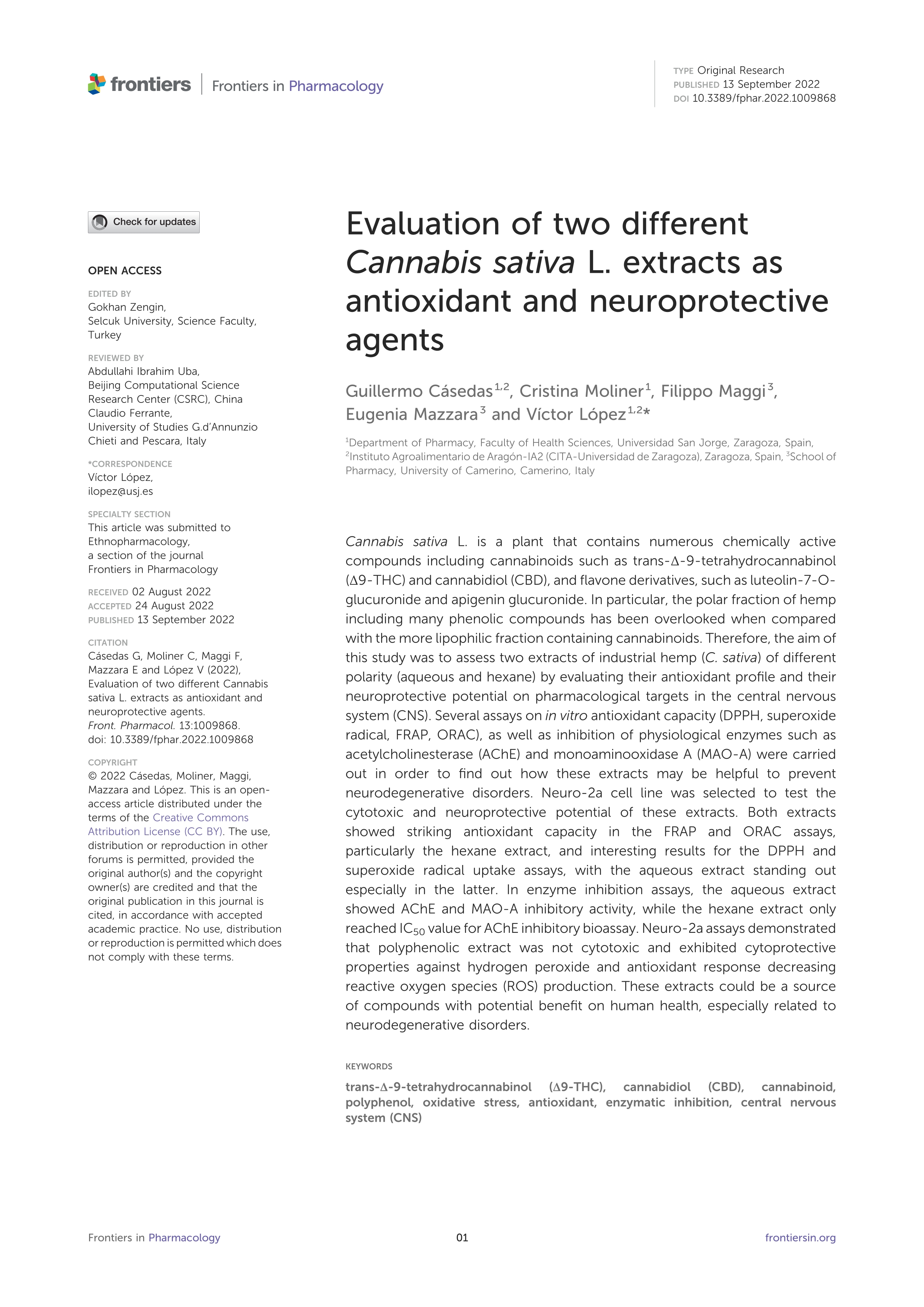
Resumen: Cannabis sativa L. is a plant that contains numerous chemically active compounds including cannabinoids such as trans-Δ-9-tetrahydrocannabinol (Δ9-THC) and cannabidiol (CBD), and flavone derivatives, such as luteolin-7-O-glucuronide and apigenin glucuronide. In particular, the polar fraction of hemp including many phenolic compounds has been overlooked when compared with the more lipophilic fraction containing cannabinoids. Therefore, the aim of this study was to assess two extracts of industrial hemp (C. sativa) of different polarity (aqueous and hexane) by evaluating their antioxidant profile and their neuroprotective potential on pharmacological targets in the central nervous system (CNS). Several assays on in vitro antioxidant capacity (DPPH, superoxide radical, FRAP, ORAC), as well as inhibition of physiological enzymes such as acetylcholinesterase (AChE) and monoaminooxidase A (MAO-A) were carried out in order to find out how these extracts may be helpful to prevent neurodegenerative disorders. Neuro-2a cell line was selected to test the cytotoxic and neuroprotective potential of these extracts. Both extracts showed striking antioxidant capacity in the FRAP and ORAC assays, particularly the hexane extract, and interesting results for the DPPH and superoxide radical uptake assays, with the aqueous extract standing out especially in the latter. In enzyme inhibition assays, the aqueous extract showed AChE and MAO-A inhibitory activity, while the hexane extract only reached IC50 value for AChE inhibitory bioassay. Neuro-2a assays demonstrated that polyphenolic extract was not cytotoxic and exhibited cytoprotective properties against hydrogen peroxide and antioxidant response decreasing reactive oxygen species (ROS) production. These extracts could be a source of compounds with potential benefit on human health, especially related to neurodegenerative disorders.
Idioma: Inglés
DOI: 10.3389/fphar.2022.1009868
Año: 2022
Publicado en: Frontiers in Pharmacology 13 (2022), 1-11
ISSN: 1663-9812
Factor impacto JCR: 5.6 (2022)
Categ. JCR: PHARMACOLOGY & PHARMACY rank: 44 / 278 = 0.158 (2022) - Q1 - T1
Factor impacto CITESCORE: 6.3 - Pharmacology, Toxicology and Pharmaceutics (Q2) - Medicine (Q1)
Factor impacto SCIMAGO: 1.064 - Pharmacology (medical) (Q1) - Pharmacology (Q1)
Tipo y forma: Artículo (Versión definitiva)
 Debe reconocer adecuadamente la autoría, proporcionar un enlace a la licencia e indicar si se han realizado cambios. Puede hacerlo de cualquier manera razonable, pero no de una manera que sugiera que tiene el apoyo del licenciador o lo recibe por el uso que hace.
Exportado de SIDERAL (2024-03-18-15:10:15)
Visitas y descargas
Idioma: Inglés
DOI: 10.3389/fphar.2022.1009868
Año: 2022
Publicado en: Frontiers in Pharmacology 13 (2022), 1-11
ISSN: 1663-9812
Factor impacto JCR: 5.6 (2022)
Categ. JCR: PHARMACOLOGY & PHARMACY rank: 44 / 278 = 0.158 (2022) - Q1 - T1
Factor impacto CITESCORE: 6.3 - Pharmacology, Toxicology and Pharmaceutics (Q2) - Medicine (Q1)
Factor impacto SCIMAGO: 1.064 - Pharmacology (medical) (Q1) - Pharmacology (Q1)
Tipo y forma: Artículo (Versión definitiva)
Debe reconocer adecuadamente la autoría, proporcionar un enlace a la licencia e indicar si se han realizado cambios. Puede hacerlo de cualquier manera razonable, pero no de una manera que sugiera que tiene el apoyo del licenciador o lo recibe por el uso que hace. Exportado de SIDERAL (2024-03-18-15:10:15)
Enlace permanente:
Visitas y descargas
Este artículo se encuentra en las siguientes colecciones:
Artículos
Registro creado el 2022-11-24, última modificación el 2024-03-19