Antioxidant additives produced from Argan shell lignin depolymerization
Afailal, Zainab (Universidad de Zaragoza) ; Gil-Lalaguna, Noemi (Universidad de Zaragoza) ; Torrijos, María Teresa ; Gonzalo, Alberto (Universidad de Zaragoza) ; Arauzo, Jesús (Universidad de Zaragoza) ; Sánchez, José Luis (Universidad de Zaragoza)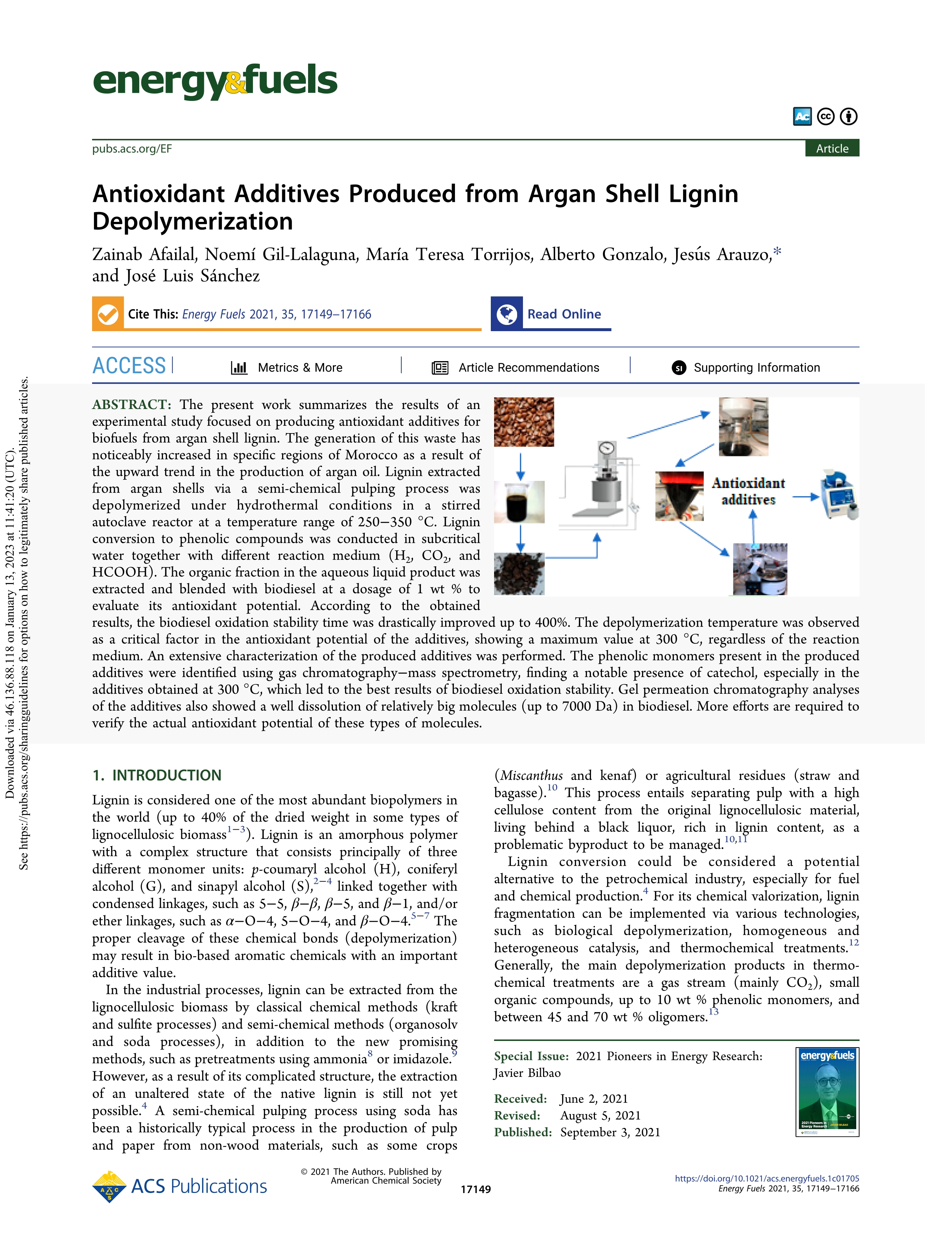
Resumen: The present work summarizes the results of an experimental study focused on producing antioxidant additives for biofuels from argan shell lignin. The generation of this waste has noticeably increased in specific regions of Morocco as a result of the upward trend in the production of argan oil. Lignin extracted from argan shells via a semi-chemical pulping process was depolymerized under hydrothermal conditions in a stirred autoclave reactor at a temperature range of 250-350 °C. Lignin conversion to phenolic compounds was conducted in subcritical water together with different reaction medium (H2, CO2, and HCOOH). The organic fraction in the aqueous liquid product was extracted and blended with biodiesel at a dosage of 1 wt % to evaluate its antioxidant potential. According to the obtained results, the biodiesel oxidation stability time was drastically improved up to 400%. The depolymerization temperature was observed as a critical factor in the antioxidant potential of the additives, showing a maximum value at 300 °C, regardless of the reaction medium. An extensive characterization of the produced additives was performed. The phenolic monomers present in the produced additives were identified using gas chromatography-mass spectrometry, finding a notable presence of catechol, especially in the additives obtained at 300 °C, which led to the best results of biodiesel oxidation stability. Gel permeation chromatography analyses of the additives also showed a well dissolution of relatively big molecules (up to 7000 Da) in biodiesel. More efforts are required to verify the actual antioxidant potential of these types of molecules.
Idioma: Inglés
DOI: 10.1021/acs.energyfuels.1c01705
Año: 2021
Publicado en: Energy and Fuels 35, 21 (2021), 17149-17166
ISSN: 0887-0624
Factor impacto JCR: 4.654 (2021)
Categ. JCR: ENGINEERING, CHEMICAL rank: 45 / 143 = 0.315 (2021) - Q2 - T1
Categ. JCR: ENERGY & FUELS rank: 63 / 119 = 0.529 (2021) - Q3 - T2
Factor impacto CITESCORE: 6.3 - Energy (Q1) - Chemical Engineering (Q2)
Factor impacto SCIMAGO: 0.822 - Chemical Engineering (miscellaneous) (Q1) - Energy Engineering and Power Technology (Q1)
Financiación: info:eu-repo/grantAgreement/ES/DGA-FEDER/T22-20R
Financiación: info:eu-repo/grantAgreement/ES/MINECO/ENE2017-85040-R
Tipo y forma: Artículo (Versión definitiva)
Área (Departamento): Área Ingeniería Química (Dpto. Ing.Quím.Tecnol.Med.Amb.)
Área (Departamento): Área Tecnologi. Medio Ambiente (Dpto. Ing.Quím.Tecnol.Med.Amb.)
 Debe reconocer adecuadamente la autoría, proporcionar un enlace a la licencia e indicar si se han realizado cambios. Puede hacerlo de cualquier manera razonable, pero no de una manera que sugiera que tiene el apoyo del licenciador o lo recibe por el uso que hace.
Exportado de SIDERAL (2023-05-18-15:23:08)
Visitas y descargas
Idioma: Inglés
DOI: 10.1021/acs.energyfuels.1c01705
Año: 2021
Publicado en: Energy and Fuels 35, 21 (2021), 17149-17166
ISSN: 0887-0624
Factor impacto JCR: 4.654 (2021)
Categ. JCR: ENGINEERING, CHEMICAL rank: 45 / 143 = 0.315 (2021) - Q2 - T1
Categ. JCR: ENERGY & FUELS rank: 63 / 119 = 0.529 (2021) - Q3 - T2
Factor impacto CITESCORE: 6.3 - Energy (Q1) - Chemical Engineering (Q2)
Factor impacto SCIMAGO: 0.822 - Chemical Engineering (miscellaneous) (Q1) - Energy Engineering and Power Technology (Q1)
Financiación: info:eu-repo/grantAgreement/ES/DGA-FEDER/T22-20R
Financiación: info:eu-repo/grantAgreement/ES/MINECO/ENE2017-85040-R
Tipo y forma: Artículo (Versión definitiva)
Área (Departamento): Área Ingeniería Química (Dpto. Ing.Quím.Tecnol.Med.Amb.)
Área (Departamento): Área Tecnologi. Medio Ambiente (Dpto. Ing.Quím.Tecnol.Med.Amb.)
Debe reconocer adecuadamente la autoría, proporcionar un enlace a la licencia e indicar si se han realizado cambios. Puede hacerlo de cualquier manera razonable, pero no de una manera que sugiera que tiene el apoyo del licenciador o lo recibe por el uso que hace. Exportado de SIDERAL (2023-05-18-15:23:08)
Enlace permanente:
Visitas y descargas
Este artículo se encuentra en las siguientes colecciones:
Artículos > Artículos por área > Tecnologías del Medio Ambiente
Artículos > Artículos por área > Ingeniería Química
Registro creado el 2023-01-26, última modificación el 2023-05-19