Body mass index interacts with a genetic-risk score for depression increasing the risk of the disease in high-susceptibility individuals
Anguita-Ruiz, Augusto ; Zarza-Rebollo, Juan Antonio ; Pérez-Gutiérrez, Ana M. ; Molina, Esther ; Gutiérrez, Blanca ; Bellón, Juan Ángel ; Moreno-Peral, Patricia ; Conejo-Cerón, Sonia ; Aiarzagüena, Jose María ; Ballesta-Rodríguez, M. Isabel ; Fernández, Anna ; Fernández-Alonso, Carmen ; Martín-Pérez, Carlos ; Montón-Franco, Carmen ; Rodríguez-Bayón, Antonina ; Torres-Martos, Álvaro ; López-Isac, Elena ; Cervilla, Jorge ; Rivera, Margarita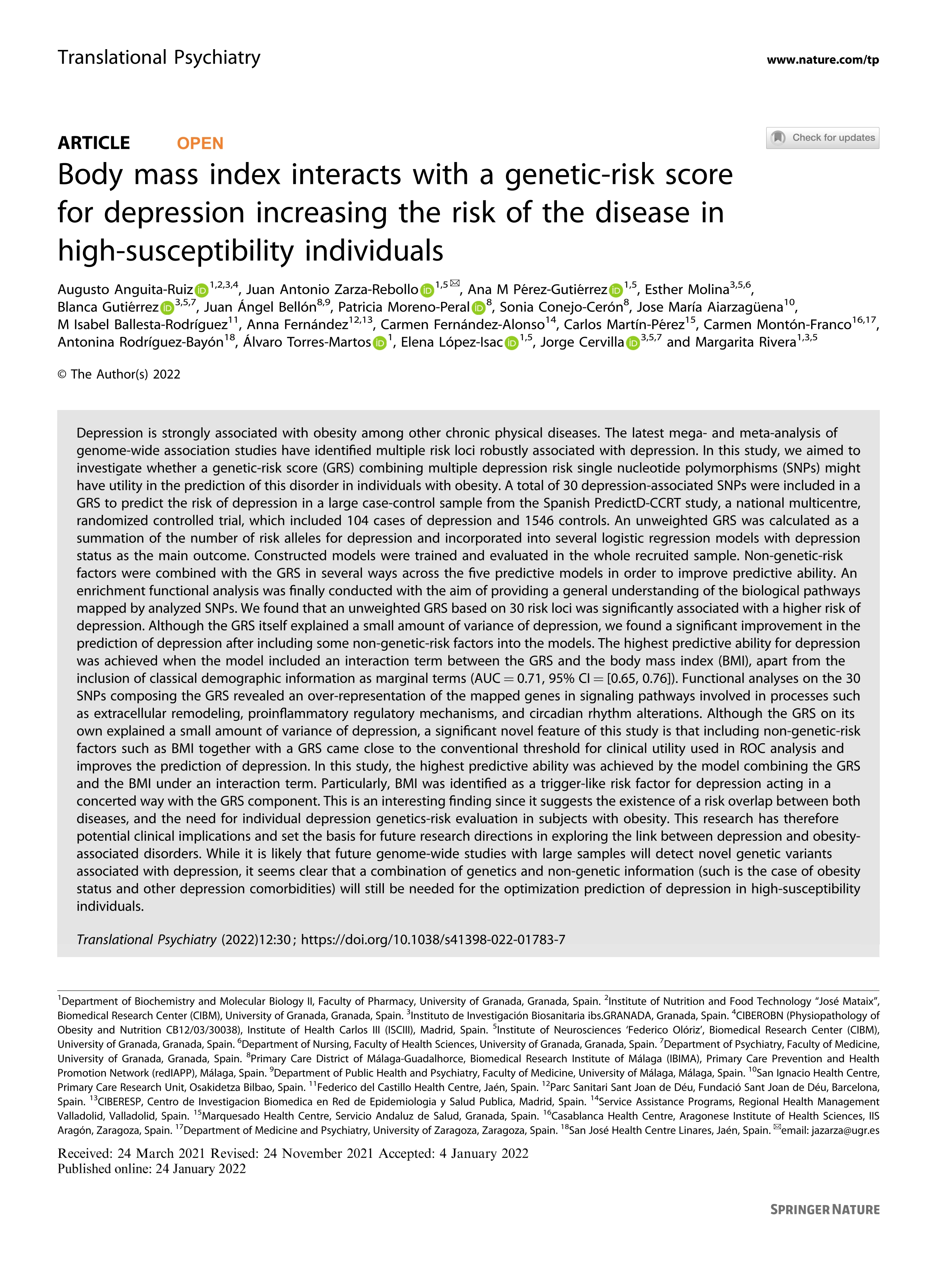
Resumen: Depression is strongly associated with obesity among other chronic physical diseases. The latest mega- and meta-analysis of genome-wide association studies have identified multiple risk loci robustly associated with depression. In this study, we aimed to investigate whether a genetic-risk score (GRS) combining multiple depression risk single nucleotide polymorphisms (SNPs) might have utility in the prediction of this disorder in individuals with obesity. A total of 30 depression-associated SNPs were included in a GRS to predict the risk of depression in a large case-control sample from the Spanish PredictD-CCRT study, a national multicentre, randomized controlled trial, which included 104 cases of depression and 1546 controls. An unweighted GRS was calculated as a summation of the number of risk alleles for depression and incorporated into several logistic regression models with depression status as the main outcome. Constructed models were trained and evaluated in the whole recruited sample. Non-genetic-risk factors were combined with the GRS in several ways across the five predictive models in order to improve predictive ability. An enrichment functional analysis was finally conducted with the aim of providing a general understanding of the biological pathways mapped by analyzed SNPs. We found that an unweighted GRS based on 30 risk loci was significantly associated with a higher risk of depression. Although the GRS itself explained a small amount of variance of depression, we found a significant improvement in the prediction of depression after including some non-genetic-risk factors into the models. The highest predictive ability for depression was achieved when the model included an interaction term between the GRS and the body mass index (BMI), apart from the inclusion of classical demographic information as marginal terms (AUC = 0.71, 95% CI = [0.65, 0.76]). Functional analyses on the 30 SNPs composing the GRS revealed an over-representation of the mapped genes in signaling pathways involved in processes such as extracellular remodeling, proinflammatory regulatory mechanisms, and circadian rhythm alterations. Although the GRS on its own explained a small amount of variance of depression, a significant novel feature of this study is that including non-genetic-risk factors such as BMI together with a GRS came close to the conventional threshold for clinical utility used in ROC analysis and improves the prediction of depression. In this study, the highest predictive ability was achieved by the model combining the GRS and the BMI under an interaction term. Particularly, BMI was identified as a trigger-like risk factor for depression acting in a concerted way with the GRS component. This is an interesting finding since it suggests the existence of a risk overlap between both diseases, and the need for individual depression genetics-risk evaluation in subjects with obesity. This research has therefore potential clinical implications and set the basis for future research directions in exploring the link between depression and obesity-associated disorders. While it is likely that future genome-wide studies with large samples will detect novel genetic variants associated with depression, it seems clear that a combination of genetics and non-genetic information (such is the case of obesity status and other depression comorbidities) will still be needed for the optimization prediction of depression in high-susceptibility individuals.
Idioma: Inglés
DOI: 10.1038/s41398-022-01783-7
Año: 2022
Publicado en: Translational Psychiatry 12 (2022), 30 [10 pp.]
ISSN: 2158-3188
Factor impacto JCR: 6.8 (2022)
Categ. JCR: PSYCHIATRY rank: 29 / 154 = 0.188 (2022) - Q1 - T1
Factor impacto CITESCORE: 10.2 - Neuroscience (Q1) - Medicine (Q1)
Factor impacto SCIMAGO: 2.148 - Biological Psychiatry (Q1) - Psychiatry and Mental Health (Q1) - Cellular and Molecular Neuroscience (Q1)
Financiación: info:eu-repo/grantAgreement/ES/DGA/RD06-0018-0020-Aragon group
Financiación: info:eu-repo/grantAgreement/ES/ISCIII-FSE/FI19-00228
Financiación: info:eu-repo/grantAgreement/ES/ISCIII/PI12-02755
Financiación: info:eu-repo/grantAgreement/ES/ISCIII/PI18-00238
Financiación: info:eu-repo/grantAgreement/ES/ISCIII/PI18-00467
Financiación: info:eu-repo/grantAgreement/ES/ISCIII/PS09-00461
Financiación: info:eu-repo/grantAgreement/ES/ISCIII/PS09-00849
Financiación: info:eu-repo/grantAgreement/ES/ISCIII/PS09-01095
Financiación: info:eu-repo/grantAgreement/ES/ISCIII/PS09-02147
Financiación: info:eu-repo/grantAgreement/ES/ISCIII/PS09-02272
Financiación: info:eu-repo/grantAgreement/ES/ISCIII/RD06-0018
Financiación: info:eu-repo/grantAgreement/ES/MINECO/BES-2017-082698
Financiación: info:eu-repo/grantAgreement/ES/MINECO/IJC-2019-040080-I
Financiación: info:eu-repo/grantAgreement/ES/MINECO-ISCIII/IFI17-00048
Financiación: info:eu-repo/grantAgreement/ES/MINECO/RYC-2014-15774
Tipo y forma: Artículo (Versión definitiva)
 Debe reconocer adecuadamente la autoría, proporcionar un enlace a la licencia e indicar si se han realizado cambios. Puede hacerlo de cualquier manera razonable, pero no de una manera que sugiera que tiene el apoyo del licenciador o lo recibe por el uso que hace.
Exportado de SIDERAL (2024-03-18-16:07:31)
Visitas y descargas
Idioma: Inglés
DOI: 10.1038/s41398-022-01783-7
Año: 2022
Publicado en: Translational Psychiatry 12 (2022), 30 [10 pp.]
ISSN: 2158-3188
Factor impacto JCR: 6.8 (2022)
Categ. JCR: PSYCHIATRY rank: 29 / 154 = 0.188 (2022) - Q1 - T1
Factor impacto CITESCORE: 10.2 - Neuroscience (Q1) - Medicine (Q1)
Factor impacto SCIMAGO: 2.148 - Biological Psychiatry (Q1) - Psychiatry and Mental Health (Q1) - Cellular and Molecular Neuroscience (Q1)
Financiación: info:eu-repo/grantAgreement/ES/DGA/RD06-0018-0020-Aragon group
Financiación: info:eu-repo/grantAgreement/ES/ISCIII-FSE/FI19-00228
Financiación: info:eu-repo/grantAgreement/ES/ISCIII/PI12-02755
Financiación: info:eu-repo/grantAgreement/ES/ISCIII/PI18-00238
Financiación: info:eu-repo/grantAgreement/ES/ISCIII/PI18-00467
Financiación: info:eu-repo/grantAgreement/ES/ISCIII/PS09-00461
Financiación: info:eu-repo/grantAgreement/ES/ISCIII/PS09-00849
Financiación: info:eu-repo/grantAgreement/ES/ISCIII/PS09-01095
Financiación: info:eu-repo/grantAgreement/ES/ISCIII/PS09-02147
Financiación: info:eu-repo/grantAgreement/ES/ISCIII/PS09-02272
Financiación: info:eu-repo/grantAgreement/ES/ISCIII/RD06-0018
Financiación: info:eu-repo/grantAgreement/ES/MINECO/BES-2017-082698
Financiación: info:eu-repo/grantAgreement/ES/MINECO/IJC-2019-040080-I
Financiación: info:eu-repo/grantAgreement/ES/MINECO-ISCIII/IFI17-00048
Financiación: info:eu-repo/grantAgreement/ES/MINECO/RYC-2014-15774
Tipo y forma: Artículo (Versión definitiva)
Debe reconocer adecuadamente la autoría, proporcionar un enlace a la licencia e indicar si se han realizado cambios. Puede hacerlo de cualquier manera razonable, pero no de una manera que sugiera que tiene el apoyo del licenciador o lo recibe por el uso que hace. Exportado de SIDERAL (2024-03-18-16:07:31)
Enlace permanente:
Visitas y descargas
Este artículo se encuentra en las siguientes colecciones:
Artículos
Registro creado el 2023-01-26, última modificación el 2024-03-19