Whose rights are being violated when receiving HIV and sexual and reproductive health services in Nigeria?
Ukpong, M. ; Stevens-Murphy, E.-J. ; Nwakamma, I. ; Lusher, J. ; Oloniniyi, I. O.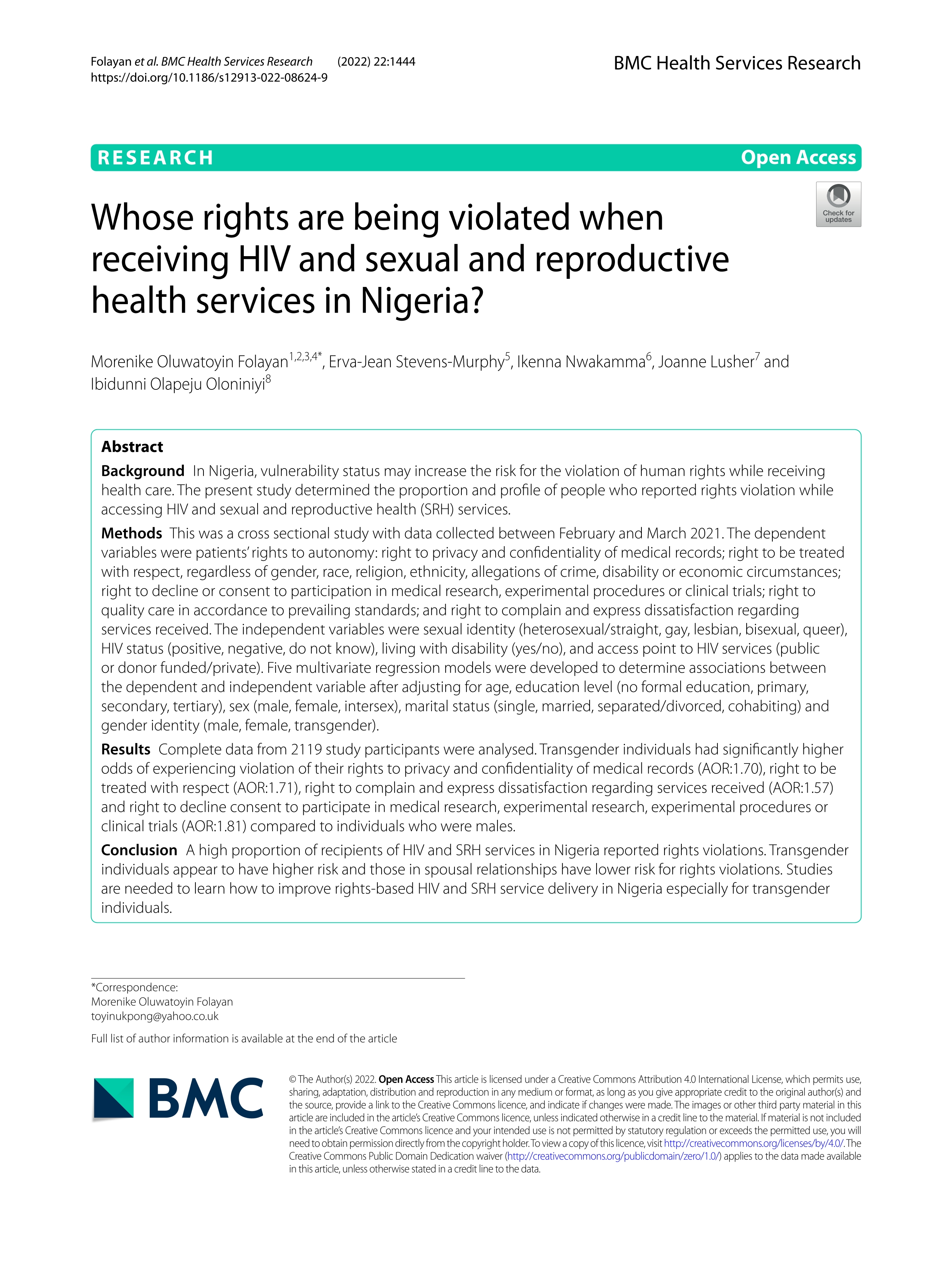
Resumen: Background: In Nigeria, vulnerability status may increase the risk for the violation of human rights while receiving health care. The present study determined the proportion and profile of people who reported rights violation while accessing HIV and sexual and reproductive health (SRH) services. Methods: This was a cross sectional study with data collected between February and March 2021. The dependent variables were patients’ rights to autonomy: right to privacy and confidentiality of medical records; right to be treated with respect, regardless of gender, race, religion, ethnicity, allegations of crime, disability or economic circumstances; right to decline or consent to participation in medical research, experimental procedures or clinical trials; right to quality care in accordance to prevailing standards; and right to complain and express dissatisfaction regarding services received. The independent variables were sexual identity (heterosexual/straight, gay, lesbian, bisexual, queer), HIV status (positive, negative, do not know), living with disability (yes/no), and access point to HIV services (public or donor funded/private). Five multivariate regression models were developed to determine associations between the dependent and independent variable after adjusting for age, education level (no formal education, primary, secondary, tertiary), sex (male, female, intersex), marital status (single, married, separated/divorced, cohabiting) and gender identity (male, female, transgender). Results: Complete data from 2119 study participants were analysed. Transgender individuals had significantly higher odds of experiencing violation of their rights to privacy and confidentiality of medical records (AOR:1.70), right to be treated with respect (AOR:1.71), right to complain and express dissatisfaction regarding services received (AOR:1.57) and right to decline consent to participate in medical research, experimental research, experimental procedures or clinical trials (AOR:1.81) compared to individuals who were males. Conclusion: A high proportion of recipients of HIV and SRH services in Nigeria reported rights violations. Transgender individuals appear to have higher risk and those in spousal relationships have lower risk for rights violations. Studies are needed to learn how to improve rights-based HIV and SRH service delivery in Nigeria especially for transgender individuals.
Idioma: Inglés
DOI: 10.1186/s12913-022-08624-9
Año: 2022
Publicado en: BMC HEALTH SERVICES RESEARCH 22 (2022), 1444[12 pp.]
ISSN: 1472-6963
Factor impacto JCR: 2.8 (2022)
Categ. JCR: HEALTH CARE SCIENCES & SERVICES rank: 57 / 106 = 0.538 (2022) - Q3 - T2
Factor impacto CITESCORE: 4.0 - Medicine (Q2)
Factor impacto SCIMAGO: 0.964 - Health Policy (Q1)
Tipo y forma: Artículo (Versión definitiva)
 Debe reconocer adecuadamente la autoría, proporcionar un enlace a la licencia e indicar si se han realizado cambios. Puede hacerlo de cualquier manera razonable, pero no de una manera que sugiera que tiene el apoyo del licenciador o lo recibe por el uso que hace.
Exportado de SIDERAL (2024-03-18-16:56:21)
Visitas y descargas
Idioma: Inglés
DOI: 10.1186/s12913-022-08624-9
Año: 2022
Publicado en: BMC HEALTH SERVICES RESEARCH 22 (2022), 1444[12 pp.]
ISSN: 1472-6963
Factor impacto JCR: 2.8 (2022)
Categ. JCR: HEALTH CARE SCIENCES & SERVICES rank: 57 / 106 = 0.538 (2022) - Q3 - T2
Factor impacto CITESCORE: 4.0 - Medicine (Q2)
Factor impacto SCIMAGO: 0.964 - Health Policy (Q1)
Tipo y forma: Artículo (Versión definitiva)
Debe reconocer adecuadamente la autoría, proporcionar un enlace a la licencia e indicar si se han realizado cambios. Puede hacerlo de cualquier manera razonable, pero no de una manera que sugiera que tiene el apoyo del licenciador o lo recibe por el uso que hace. Exportado de SIDERAL (2024-03-18-16:56:21)
Enlace permanente:
Visitas y descargas
Este artículo se encuentra en las siguientes colecciones:
Artículos
Registro creado el 2023-02-24, última modificación el 2024-03-19