Cross-sectional and longitudinal associations between family meals frequency and children's overweight/obesity in families at high risk of type 2 diabetes: The Feel4Diabetes <scp>-</scp> study
Mahmood, Lubna ; Gonzalez-Gil, Esther M. ; Makrilakis, Konstantinos ; Liatis, Stavros ; Schwarz, Peter ; Herrmann, Sandra ; Willems, Ruben ; Cardon, Greet ; Latomme, Julie ; Rurik, Imre ; Radó, Sándorné ; Iotova, Violeta ; Usheva, Natalya ; Tankova, Tsvetalina ; Karaglani, Eva ; Manios, Yannis ; Moreno, Luis A. (Universidad de Zaragoza) ;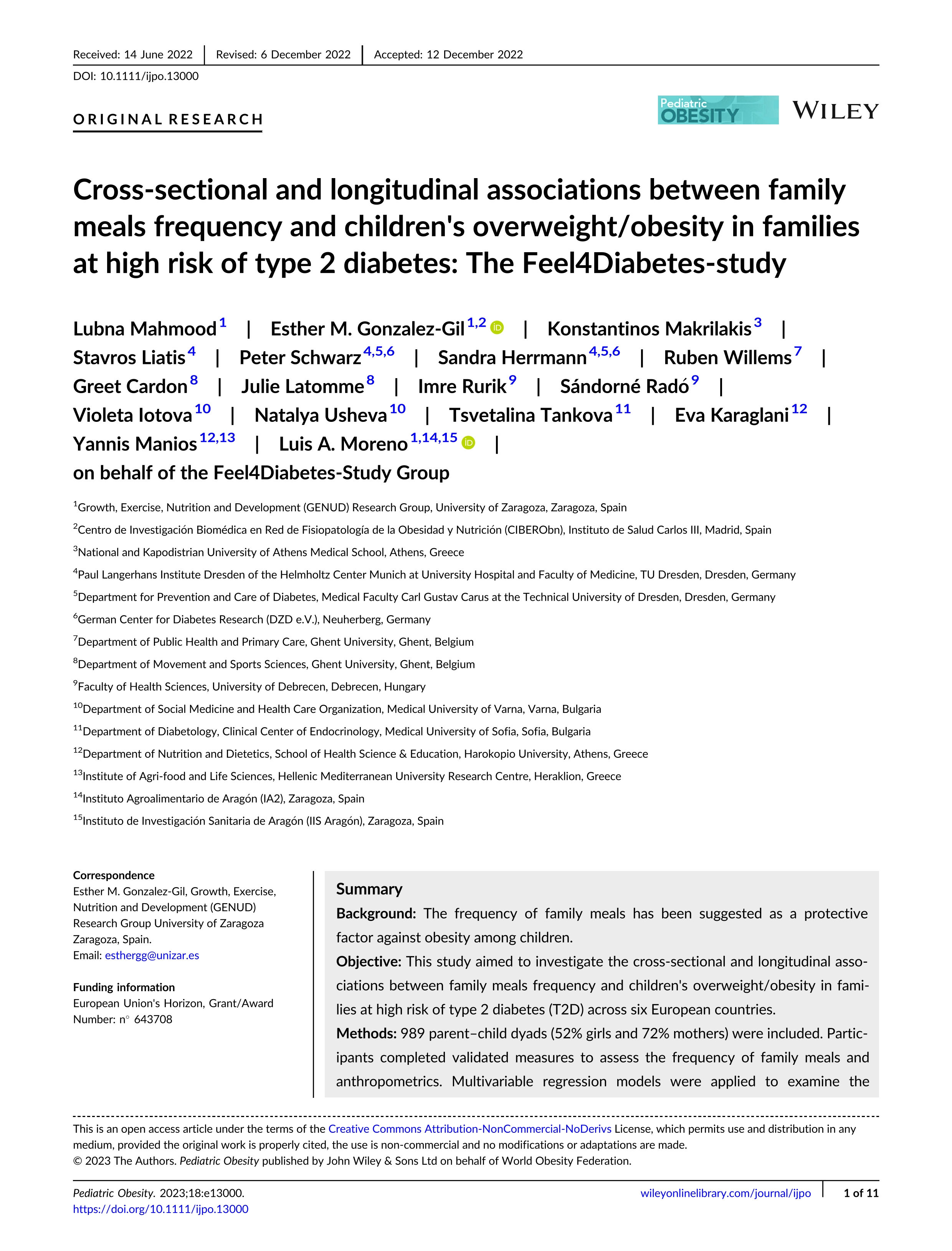

Resumen: Background
The frequency of family meals has been suggested as a protective factor against obesity among children.
Objective
This study aimed to investigate the cross-sectional and longitudinal associations between family meals frequency and children's overweight/obesity in families at high risk of type 2 diabetes (T2D) across six European countries.
Methods
989 parent–child dyads (52% girls and 72% mothers) were included. Participants completed validated measures to assess the frequency of family meals and anthropometrics. Multivariable regression models were applied to examine the longitudinal associations between family meals frequency and overweight/obesity in children. Logistic regression was performed to predict the odds of having overweight/obesity depending on changes in family meals frequency over a two-year follow-up period. Analyses were stratified for children's sex.
Results
High frequency of family breakfasts and/or dinners was inversely associated with children's BMI in boys and girls at T2. Results showed decreased odds of overweight/obesity at follow-up among both boys (OR = 0.65; 95% CI 0.41, 0.96) and girls (OR = 0.53; 95% CI 0.31, 0.87) who consumed minimum of three times family breakfasts and/or family dinners a week at baseline. An increase in family breakfasts and/or dinners frequency was associated with lower odds of overweight/obesity in both boys and girls at follow-up.
Conclusion
A high frequency of family breakfasts and/or dinners but not lunch during childhood is associated with lower odds of overweight/obesity development in children from families at high risk of T2D. The promotion of family meals could help in preventing the development of overweight/obesity among children.
Idioma: Inglés
DOI: 10.1111/ijpo.13000
Año: 2023
Publicado en: Pediatric obesity 18, 4 (2023), e13000 [11 pp.]
ISSN: 2047-6302
Factor impacto JCR: 2.7 (2023)
Categ. JCR: PEDIATRICS rank: 38 / 186 = 0.204 (2023) - Q1 - T1
Factor impacto CITESCORE: 7.3 - Pediatrics, Perinatology and Child Health (Q1) - Nutrition and Dietetics (Q1) - Public Health, Environmental and Occupational Health (Q1) - Health Policy (Q1)
Factor impacto SCIMAGO: 1.247 - Health Policy (Q1) - Public Health, Environmental and Occupational Health (Q1) - Pediatrics, Perinatology and Child Health (Q1) - Nutrition and Dietetics (Q1)
Financiación: info:eu-repo/grantAgreement/EC/H2020/643708/EU/Developing and implementing a community-based intervention to create a more supportive social and physical environment for lifestyle changes to prevent diabetes in vulnerable families across Europe/Feel4Diabetes
Tipo y forma: Artículo (Versión definitiva)
Área (Departamento): Área Enfermería (Dpto. Fisiatría y Enfermería)
 Debe reconocer adecuadamente la autoría, proporcionar un enlace a la licencia e indicar si se han realizado cambios. Puede hacerlo de cualquier manera razonable, pero no de una manera que sugiera que tiene el apoyo del licenciador o lo recibe por el uso que hace. No puede utilizar el material para una finalidad comercial. Si remezcla, transforma o crea a partir del material, no puede difundir el material modificado.
Exportado de SIDERAL (2024-11-22-11:59:00)
Visitas y descargas
The frequency of family meals has been suggested as a protective factor against obesity among children.
Objective
This study aimed to investigate the cross-sectional and longitudinal associations between family meals frequency and children's overweight/obesity in families at high risk of type 2 diabetes (T2D) across six European countries.
Methods
989 parent–child dyads (52% girls and 72% mothers) were included. Participants completed validated measures to assess the frequency of family meals and anthropometrics. Multivariable regression models were applied to examine the longitudinal associations between family meals frequency and overweight/obesity in children. Logistic regression was performed to predict the odds of having overweight/obesity depending on changes in family meals frequency over a two-year follow-up period. Analyses were stratified for children's sex.
Results
High frequency of family breakfasts and/or dinners was inversely associated with children's BMI in boys and girls at T2. Results showed decreased odds of overweight/obesity at follow-up among both boys (OR = 0.65; 95% CI 0.41, 0.96) and girls (OR = 0.53; 95% CI 0.31, 0.87) who consumed minimum of three times family breakfasts and/or family dinners a week at baseline. An increase in family breakfasts and/or dinners frequency was associated with lower odds of overweight/obesity in both boys and girls at follow-up.
Conclusion
A high frequency of family breakfasts and/or dinners but not lunch during childhood is associated with lower odds of overweight/obesity development in children from families at high risk of T2D. The promotion of family meals could help in preventing the development of overweight/obesity among children.
Idioma: Inglés
DOI: 10.1111/ijpo.13000
Año: 2023
Publicado en: Pediatric obesity 18, 4 (2023), e13000 [11 pp.]
ISSN: 2047-6302
Factor impacto JCR: 2.7 (2023)
Categ. JCR: PEDIATRICS rank: 38 / 186 = 0.204 (2023) - Q1 - T1
Factor impacto CITESCORE: 7.3 - Pediatrics, Perinatology and Child Health (Q1) - Nutrition and Dietetics (Q1) - Public Health, Environmental and Occupational Health (Q1) - Health Policy (Q1)
Factor impacto SCIMAGO: 1.247 - Health Policy (Q1) - Public Health, Environmental and Occupational Health (Q1) - Pediatrics, Perinatology and Child Health (Q1) - Nutrition and Dietetics (Q1)
Financiación: info:eu-repo/grantAgreement/EC/H2020/643708/EU/Developing and implementing a community-based intervention to create a more supportive social and physical environment for lifestyle changes to prevent diabetes in vulnerable families across Europe/Feel4Diabetes
Tipo y forma: Artículo (Versión definitiva)
Área (Departamento): Área Enfermería (Dpto. Fisiatría y Enfermería)
Debe reconocer adecuadamente la autoría, proporcionar un enlace a la licencia e indicar si se han realizado cambios. Puede hacerlo de cualquier manera razonable, pero no de una manera que sugiera que tiene el apoyo del licenciador o lo recibe por el uso que hace. No puede utilizar el material para una finalidad comercial. Si remezcla, transforma o crea a partir del material, no puede difundir el material modificado.Exportado de SIDERAL (2024-11-22-11:59:00)
Enlace permanente:
Visitas y descargas
Este artículo se encuentra en las siguientes colecciones:
Artículos > Artículos por área > Enfermería
Registro creado el 2023-03-13, última modificación el 2024-11-25