In vitro study of the effect of ensiling length and processing on the nutritive value of maize silages
Gordo, Ana (Universidad de Zaragoza) ; Hernando, Belén (Universidad de Zaragoza) ; Artajona, Jesús (Universidad de Zaragoza) ; Fondevila, Manuel (Universidad de Zaragoza)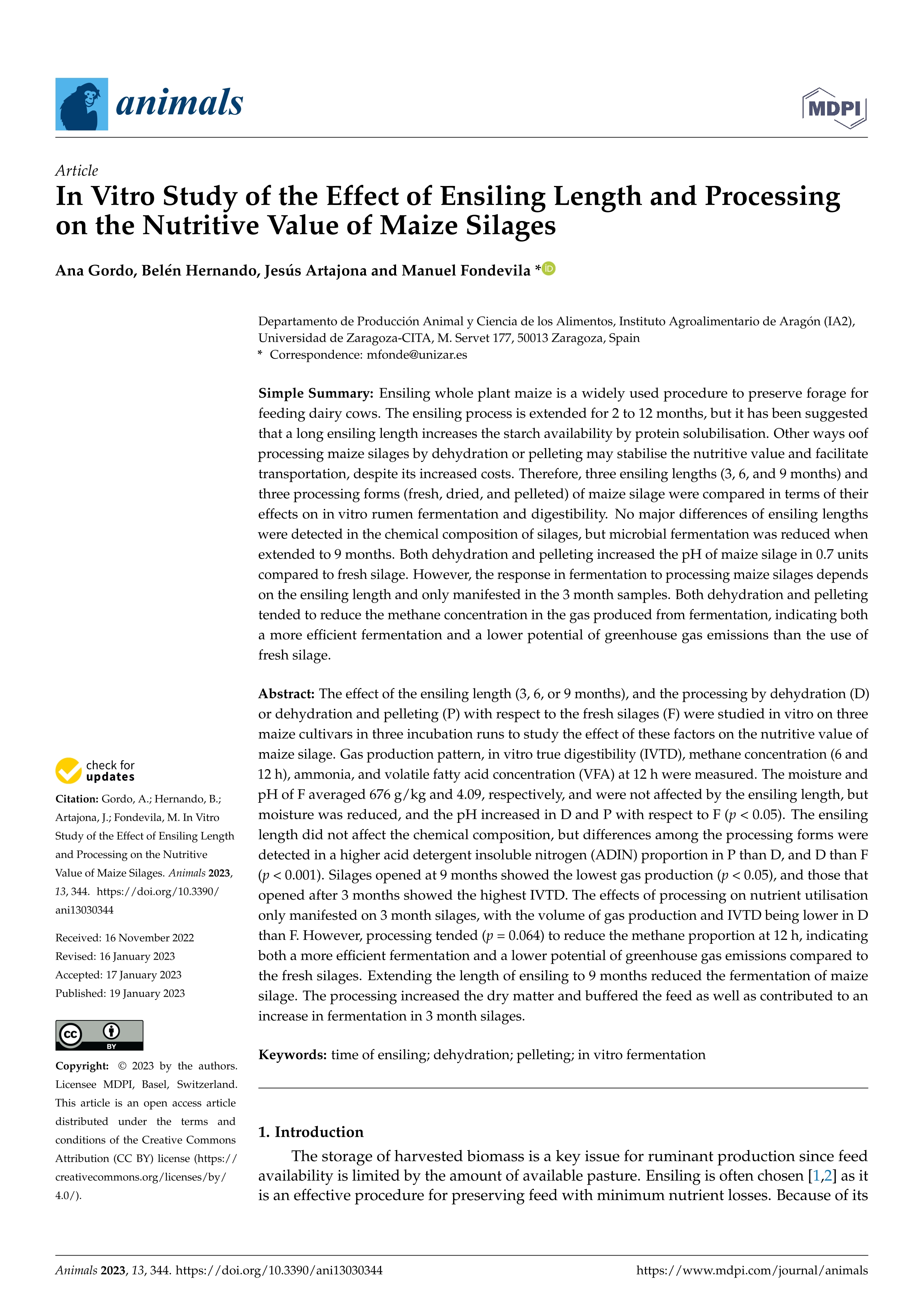
Resumen: The effect of the ensiling length (3, 6, or 9 months), and the processing by dehydration (D) or dehydration and pelleting (P) with respect to the fresh silages (F) were studied in vitro on three maize cultivars in three incubation runs to study the effect of these factors on the nutritive value of maize silage. Gas production pattern, in vitro true digestibility (IVTD), methane concentration (6 and 12 h), ammonia, and volatile fatty acid concentration (VFA) at 12 h were measured. The moisture and pH of F averaged 676 g/kg and 4.09, respectively, and were not affected by the ensiling length, but moisture was reduced, and the pH increased in D and P with respect to F (p < 0.05). The ensiling length did not affect the chemical composition, but differences among the processing forms were detected in a higher acid detergent insoluble nitrogen (ADIN) proportion in P than D, and D than F (p < 0.001). Silages opened at 9 months showed the lowest gas production (p < 0.05), and those that opened after 3 months showed the highest IVTD. The effects of processing on nutrient utilisation only manifested on 3 month silages, with the volume of gas production and IVTD being lower in D than F. However, processing tended (p = 0.064) to reduce the methane proportion at 12 h, indicating both a more efficient fermentation and a lower potential of greenhouse gas emissions compared to the fresh silages. Extending the length of ensiling to 9 months reduced the fermentation of maize silage. The processing increased the dry matter and buffered the feed as well as contributed to an increase in fermentation in 3 month silages.
Idioma: Inglés
DOI: 10.3390/ani13030344
Año: 2023
Publicado en: Animals 13, 3 (2023), 344 [11 pp]
ISSN: 2076-2615
Factor impacto JCR: 2.7 (2023)
Categ. JCR: VETERINARY SCIENCES rank: 16 / 167 = 0.096 (2023) - Q1 - T1
Categ. JCR: AGRICULTURE, DAIRY & ANIMAL SCIENCE rank: 10 / 80 = 0.125 (2023) - Q1 - T1
Factor impacto CITESCORE: 4.9 - Animal Science and Zoology (Q1) - Veterinary (all) (Q1)
Factor impacto SCIMAGO: 0.698 - Veterinary (miscellaneous) (Q1) - Animal Science and Zoology (Q1)
Tipo y forma: Artículo (Versión definitiva)
Área (Departamento): Área Producción Animal (Dpto. Produc.Animal Cienc.Ali.)
Área (Departamento): Proy. investigación HTA (Dpto. Produc.Animal Cienc.Ali.)
 Debe reconocer adecuadamente la autoría, proporcionar un enlace a la licencia e indicar si se han realizado cambios. Puede hacerlo de cualquier manera razonable, pero no de una manera que sugiera que tiene el apoyo del licenciador o lo recibe por el uso que hace.
Exportado de SIDERAL (2024-11-22-11:59:47)
Visitas y descargas
Idioma: Inglés
DOI: 10.3390/ani13030344
Año: 2023
Publicado en: Animals 13, 3 (2023), 344 [11 pp]
ISSN: 2076-2615
Factor impacto JCR: 2.7 (2023)
Categ. JCR: VETERINARY SCIENCES rank: 16 / 167 = 0.096 (2023) - Q1 - T1
Categ. JCR: AGRICULTURE, DAIRY & ANIMAL SCIENCE rank: 10 / 80 = 0.125 (2023) - Q1 - T1
Factor impacto CITESCORE: 4.9 - Animal Science and Zoology (Q1) - Veterinary (all) (Q1)
Factor impacto SCIMAGO: 0.698 - Veterinary (miscellaneous) (Q1) - Animal Science and Zoology (Q1)
Tipo y forma: Artículo (Versión definitiva)
Área (Departamento): Área Producción Animal (Dpto. Produc.Animal Cienc.Ali.)
Área (Departamento): Proy. investigación HTA (Dpto. Produc.Animal Cienc.Ali.)
Debe reconocer adecuadamente la autoría, proporcionar un enlace a la licencia e indicar si se han realizado cambios. Puede hacerlo de cualquier manera razonable, pero no de una manera que sugiera que tiene el apoyo del licenciador o lo recibe por el uso que hace. Exportado de SIDERAL (2024-11-22-11:59:47)
Enlace permanente:
Visitas y descargas
Este artículo se encuentra en las siguientes colecciones:
Artículos > Artículos por área > Producción Animal
Registro creado el 2023-03-13, última modificación el 2024-11-25