Polyphenol intake and mortality: A nationwide cohort study in the adult population of Spain
Mérida, Diana María ; Vitelli-Storelli, Facundo ; Moreno-Franco, Belén (Universidad de Zaragoza) ; Rodríguez-Ayala, Montserrat ; López-García, Esther ; Banegas, José R. ; Rodríguez-Artalejo, Fernando ; Guallar-Castillón, Pilar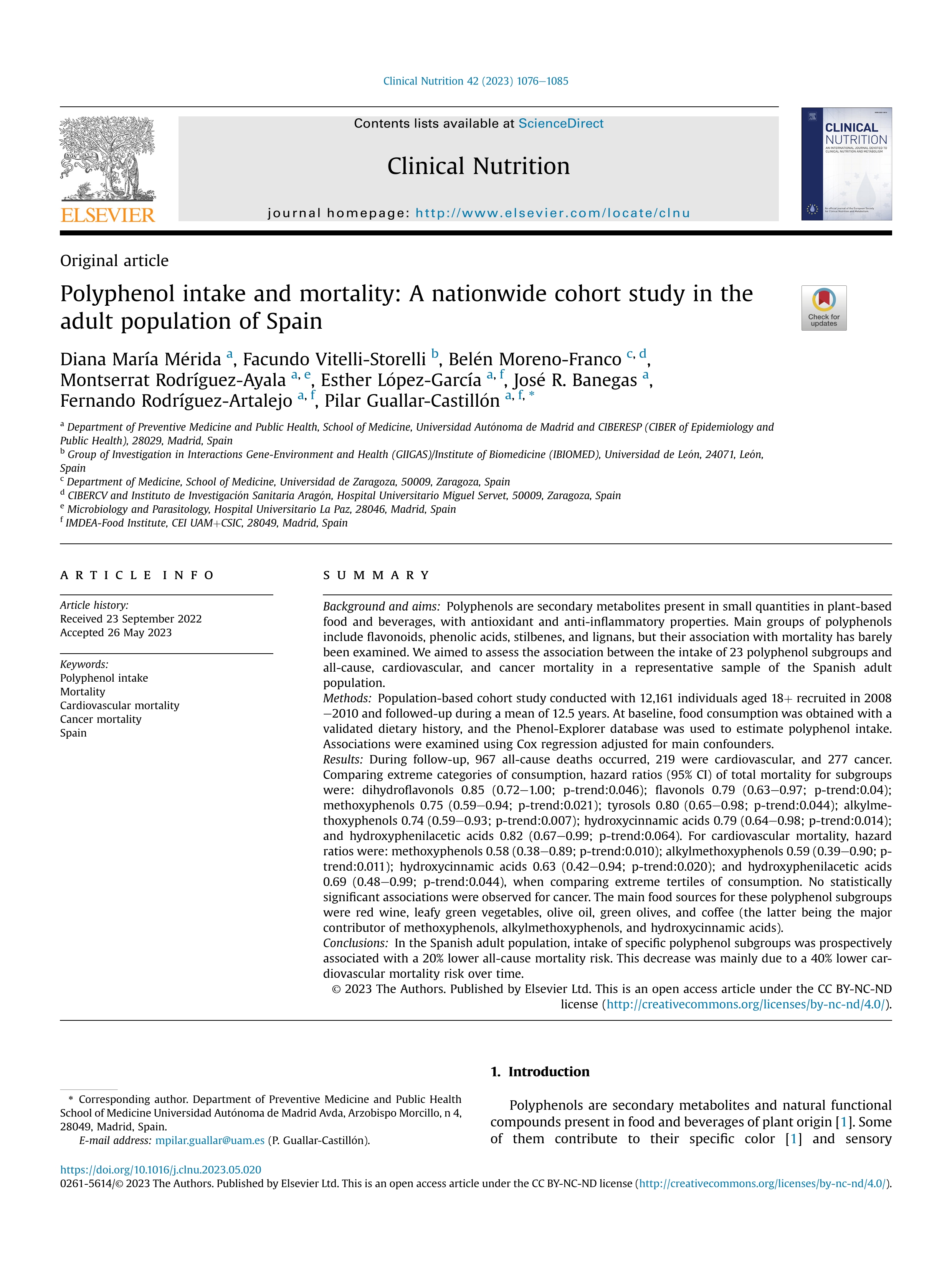
Resumen: Background and aims
Polyphenols are secondary metabolites present in small quantities in plant-based food and beverages, with antioxidant and anti-inflammatory properties. Main groups of polyphenols include flavonoids, phenolic acids, stilbenes, and lignans, but their association with mortality has barely been examined. We aimed to assess the association between the intake of 23 polyphenol subgroups and all-cause, cardiovascular, and cancer mortality in a representative sample of the Spanish adult population.
Methods
Population-based cohort study conducted with 12,161 individuals aged 18+ recruited in 2008–2010 and followed-up during a mean of 12.5 years. At baseline, food consumption was obtained with a validated dietary history, and the Phenol-Explorer database was used to estimate polyphenol intake. Associations were examined using Cox regression adjusted for main confounders.
Results
During follow-up, 967 all-cause deaths occurred, 219 were cardiovascular, and 277 cancer. Comparing extreme categories of consumption, hazard ratios (95% CI) of total mortality for subgroups were: dihydroflavonols 0.85 (0.72–1.00; p-trend:0.046); flavonols 0.79 (0.63–0.97; p-trend:0.04); methoxyphenols 0.75 (0.59–0.94; p-trend:0.021); tyrosols 0.80 (0.65–0.98; p-trend:0.044); alkylmethoxyphenols 0.74 (0.59–0.93; p-trend:0.007); hydroxycinnamic acids 0.79 (0.64–0.98; p-trend:0.014); and hydroxyphenilacetic acids 0.82 (0.67–0.99; p-trend:0.064). For cardiovascular mortality, hazard ratios were: methoxyphenols 0.58 (0.38–0.89; p-trend:0.010); alkylmethoxyphenols 0.59 (0.39–0.90; p-trend:0.011); hydroxycinnamic acids 0.63 (0.42–0.94; p-trend:0.020); and hydroxyphenilacetic acids 0.69 (0.48–0.99; p-trend:0.044), when comparing extreme tertiles of consumption. No statistically significant associations were observed for cancer. The main food sources for these polyphenol subgroups were red wine, leafy green vegetables, olive oil, green olives, and coffee (the latter being the major contributor of methoxyphenols, alkylmethoxyphenols, and hydroxycinnamic acids).
Conclusions
In the Spanish adult population, intake of specific polyphenol subgroups was prospectively associated with a 20% lower all-cause mortality risk. This decrease was mainly due to a 40% lower cardiovascular mortality risk over time.
Idioma: Inglés
DOI: 10.1016/j.clnu.2023.05.020
Año: 2023
Publicado en: Clinical Nutrition 42, 7 (2023), 1076-1085
ISSN: 0261-5614
Factor impacto JCR: 6.6 (2023)
Categ. JCR: NUTRITION & DIETETICS rank: 10 / 114 = 0.088 (2023) - Q1 - T1
Factor impacto CITESCORE: 14.1 - Nutrition and Dietetics (Q1) - Critical Care and Intensive Care Medicine (Q1)
Factor impacto SCIMAGO: 1.893 - Nutrition and Dietetics (Q1) - Critical Care and Intensive Care Medicine (Q1)
Financiación: info:eu-repo/grantAgreement/ES/FIS/PI17-1709
Financiación: info:eu-repo/grantAgreement/ES/FIS/PI20-144
Tipo y forma: Artículo (Versión definitiva)
Área (Departamento): Área Medic.Prevent.Salud Públ. (Dpto. Microb.Ped.Radio.Sal.Pú.)
 Debe reconocer adecuadamente la autoría, proporcionar un enlace a la licencia e indicar si se han realizado cambios. Puede hacerlo de cualquier manera razonable, pero no de una manera que sugiera que tiene el apoyo del licenciador o lo recibe por el uso que hace. No puede utilizar el material para una finalidad comercial. Si remezcla, transforma o crea a partir del material, no puede difundir el material modificado.
Exportado de SIDERAL (2024-11-22-12:09:24)
Visitas y descargas
Polyphenols are secondary metabolites present in small quantities in plant-based food and beverages, with antioxidant and anti-inflammatory properties. Main groups of polyphenols include flavonoids, phenolic acids, stilbenes, and lignans, but their association with mortality has barely been examined. We aimed to assess the association between the intake of 23 polyphenol subgroups and all-cause, cardiovascular, and cancer mortality in a representative sample of the Spanish adult population.
Methods
Population-based cohort study conducted with 12,161 individuals aged 18+ recruited in 2008–2010 and followed-up during a mean of 12.5 years. At baseline, food consumption was obtained with a validated dietary history, and the Phenol-Explorer database was used to estimate polyphenol intake. Associations were examined using Cox regression adjusted for main confounders.
Results
During follow-up, 967 all-cause deaths occurred, 219 were cardiovascular, and 277 cancer. Comparing extreme categories of consumption, hazard ratios (95% CI) of total mortality for subgroups were: dihydroflavonols 0.85 (0.72–1.00; p-trend:0.046); flavonols 0.79 (0.63–0.97; p-trend:0.04); methoxyphenols 0.75 (0.59–0.94; p-trend:0.021); tyrosols 0.80 (0.65–0.98; p-trend:0.044); alkylmethoxyphenols 0.74 (0.59–0.93; p-trend:0.007); hydroxycinnamic acids 0.79 (0.64–0.98; p-trend:0.014); and hydroxyphenilacetic acids 0.82 (0.67–0.99; p-trend:0.064). For cardiovascular mortality, hazard ratios were: methoxyphenols 0.58 (0.38–0.89; p-trend:0.010); alkylmethoxyphenols 0.59 (0.39–0.90; p-trend:0.011); hydroxycinnamic acids 0.63 (0.42–0.94; p-trend:0.020); and hydroxyphenilacetic acids 0.69 (0.48–0.99; p-trend:0.044), when comparing extreme tertiles of consumption. No statistically significant associations were observed for cancer. The main food sources for these polyphenol subgroups were red wine, leafy green vegetables, olive oil, green olives, and coffee (the latter being the major contributor of methoxyphenols, alkylmethoxyphenols, and hydroxycinnamic acids).
Conclusions
In the Spanish adult population, intake of specific polyphenol subgroups was prospectively associated with a 20% lower all-cause mortality risk. This decrease was mainly due to a 40% lower cardiovascular mortality risk over time.
Idioma: Inglés
DOI: 10.1016/j.clnu.2023.05.020
Año: 2023
Publicado en: Clinical Nutrition 42, 7 (2023), 1076-1085
ISSN: 0261-5614
Factor impacto JCR: 6.6 (2023)
Categ. JCR: NUTRITION & DIETETICS rank: 10 / 114 = 0.088 (2023) - Q1 - T1
Factor impacto CITESCORE: 14.1 - Nutrition and Dietetics (Q1) - Critical Care and Intensive Care Medicine (Q1)
Factor impacto SCIMAGO: 1.893 - Nutrition and Dietetics (Q1) - Critical Care and Intensive Care Medicine (Q1)
Financiación: info:eu-repo/grantAgreement/ES/FIS/PI17-1709
Financiación: info:eu-repo/grantAgreement/ES/FIS/PI20-144
Tipo y forma: Artículo (Versión definitiva)
Área (Departamento): Área Medic.Prevent.Salud Públ. (Dpto. Microb.Ped.Radio.Sal.Pú.)
Debe reconocer adecuadamente la autoría, proporcionar un enlace a la licencia e indicar si se han realizado cambios. Puede hacerlo de cualquier manera razonable, pero no de una manera que sugiera que tiene el apoyo del licenciador o lo recibe por el uso que hace. No puede utilizar el material para una finalidad comercial. Si remezcla, transforma o crea a partir del material, no puede difundir el material modificado.Exportado de SIDERAL (2024-11-22-12:09:24)
Enlace permanente:
Visitas y descargas
Este artículo se encuentra en las siguientes colecciones:
Artículos > Artículos por área > Medicina Preventiva y Salud Pública
Registro creado el 2023-07-28, última modificación el 2024-11-25