Rhodium Complexes with a Pyridine-2-yloxy-silyl-Based N,Si-Ligand: Bonding Situation and Activity as Alkene Hydrogenation Catalysts
Gómez-España, Alejandra ; García-Orduña, Pilar ; Lahoz, Fernando J. ; Fernández, Israel ; Fernández-Álvarez, Francisco J. (Universidad de Zaragoza)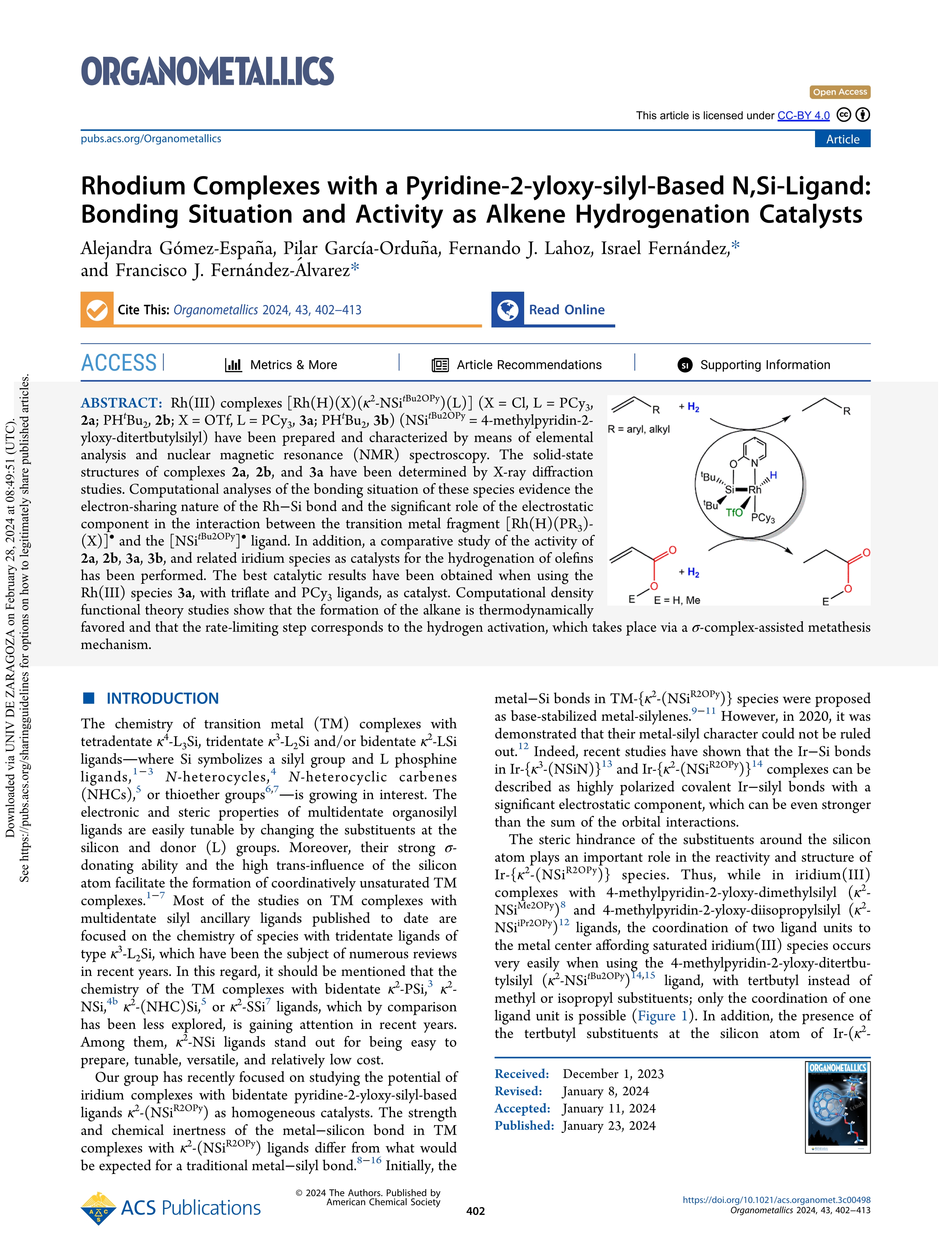
Resumen: Rh(III) complexes [Rh(H)(X)(κ2-NSitBu2OPy)(L)] (X = Cl, L = PCy3, 2a; PHtBu2, 2b; X = OTf, L = PCy3, 3a; PHtBu2, 3b) (NSitBu2OPy = 4-methylpyridin-2-yloxy-ditertbutylsilyl) have been prepared and characterized by means of elemental analysis and nuclear magnetic resonance (NMR) spectroscopy. The solid-state structures of complexes 2a, 2b, and 3a have been determined by X-ray diffraction studies. Computational analyses of the bonding situation of these species evidence the electron-sharing nature of the Rh–Si bond and the significant role of the electrostatic component in the interaction between the transition metal fragment [Rh(H)(PR3)(X)]• and the [NSitBu2OPy]• ligand. In addition, a comparative study of the activity of 2a, 2b, 3a, 3b, and related iridium species as catalysts for the hydrogenation of olefins has been performed. The best catalytic results have been obtained when using the Rh(III) species 3a, with triflate and PCy3 ligands, as catalyst. Computational density functional theory studies show that the formation of the alkane is thermodynamically favored and that the rate-limiting step corresponds to the hydrogen activation, which takes place via a σ-complex-assisted metathesis mechanism.
Idioma: Inglés
DOI: 10.1021/acs.organomet.3c00498
Año: 2024
Publicado en: Organometallics 43, 3 (2024), 402-413
ISSN: 0276-7333
Factor impacto JCR: 2.9 (2024)
Categ. JCR: CHEMISTRY, ORGANIC rank: 14 / 57 = 0.246 (2024) - Q1 - T1
Categ. JCR: CHEMISTRY, INORGANIC & NUCLEAR rank: 17 / 43 = 0.395 (2024) - Q2 - T2
Factor impacto CITESCORE: 5.1 - Physical and Theoretical Chemistry (Q2) - Organic Chemistry (Q2) - Inorganic Chemistry (Q2)
Factor impacto SCIMAGO: 0.676 - Inorganic Chemistry (Q2) - Physical and Theoretical Chemistry (Q2) - Organic Chemistry (Q2)
Tipo y forma: Artículo (Versión definitiva)
Área (Departamento): Área Química Inorgánica (Dpto. Química Inorgánica)
 Debe reconocer adecuadamente la autoría, proporcionar un enlace a la licencia e indicar si se han realizado cambios. Puede hacerlo de cualquier manera razonable, pero no de una manera que sugiera que tiene el apoyo del licenciador o lo recibe por el uso que hace.
Exportado de SIDERAL (2026-02-17-20:19:56)
Visitas y descargas
Idioma: Inglés
DOI: 10.1021/acs.organomet.3c00498
Año: 2024
Publicado en: Organometallics 43, 3 (2024), 402-413
ISSN: 0276-7333
Factor impacto JCR: 2.9 (2024)
Categ. JCR: CHEMISTRY, ORGANIC rank: 14 / 57 = 0.246 (2024) - Q1 - T1
Categ. JCR: CHEMISTRY, INORGANIC & NUCLEAR rank: 17 / 43 = 0.395 (2024) - Q2 - T2
Factor impacto CITESCORE: 5.1 - Physical and Theoretical Chemistry (Q2) - Organic Chemistry (Q2) - Inorganic Chemistry (Q2)
Factor impacto SCIMAGO: 0.676 - Inorganic Chemistry (Q2) - Physical and Theoretical Chemistry (Q2) - Organic Chemistry (Q2)
Tipo y forma: Artículo (Versión definitiva)
Área (Departamento): Área Química Inorgánica (Dpto. Química Inorgánica)
Debe reconocer adecuadamente la autoría, proporcionar un enlace a la licencia e indicar si se han realizado cambios. Puede hacerlo de cualquier manera razonable, pero no de una manera que sugiera que tiene el apoyo del licenciador o lo recibe por el uso que hace. Exportado de SIDERAL (2026-02-17-20:19:56)
Enlace permanente:
Visitas y descargas
Este artículo se encuentra en las siguientes colecciones:
Artículos > Artículos por área > Química Inorgánica
Registro creado el 2024-03-01, última modificación el 2026-02-17