Columnar liquid crystals based on antiaromatic expanded porphyrins
Nguyen, Duong D. ; Labella, Jorge ; Laforga-Martín, Juan ; Folcia, César L. ; Ortega, Josu ; Torres, Tomás ; Sierra Travieso, Teresa ; Sessler, Jonathan L.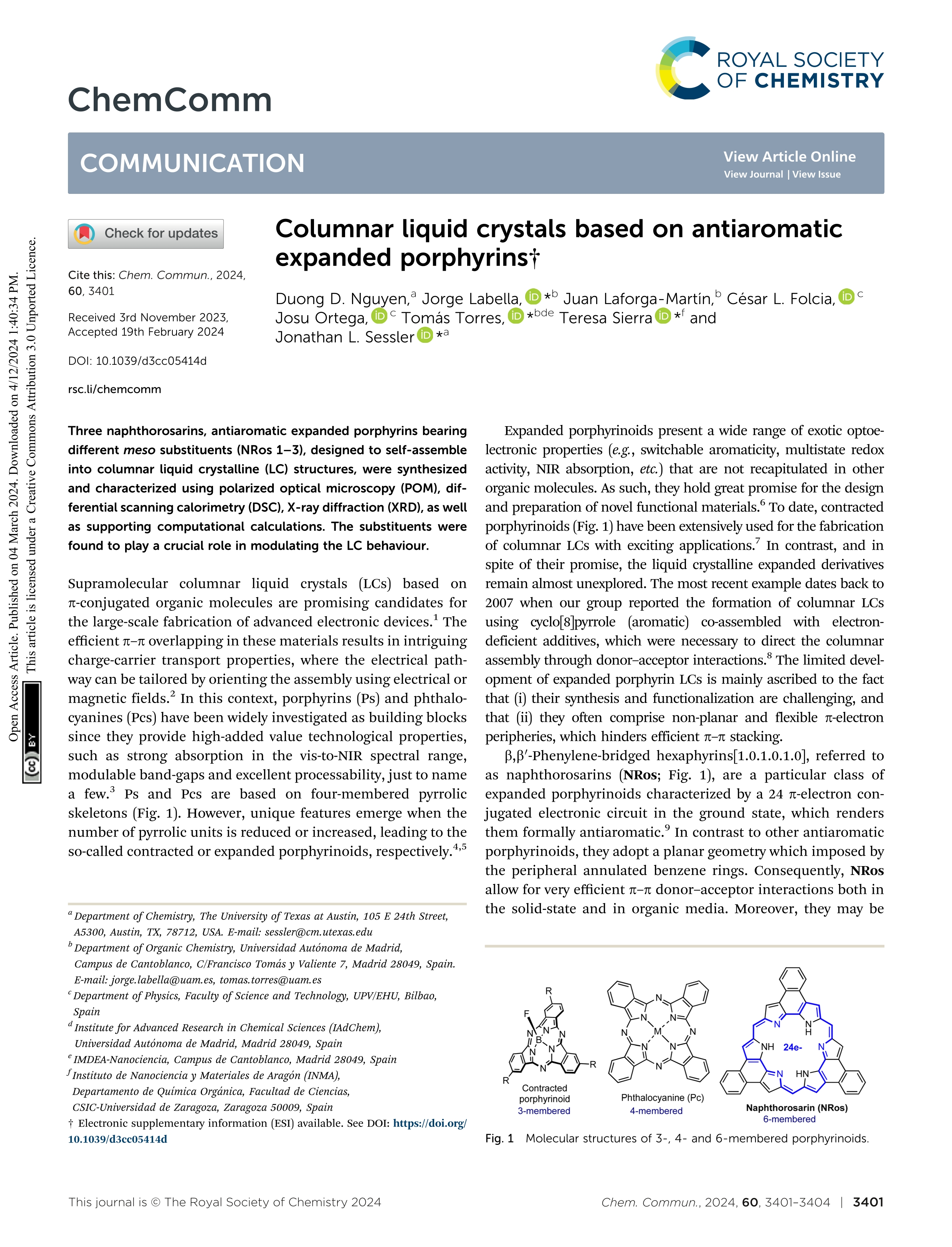
Resumen: Three naphthorosarins, antiaromatic expanded porphyrins bearing different meso substituents (NRos 1–3), designed to self-assemble into columnar liquid crystalline (LC) structures, were synthesized and characterized using polarized optical microscopy (POM), differential scanning calorimetry (DSC), X-ray diffraction (XRD), as well as supporting computational calculations. The substituents were found to play a crucial role in modulating the LC behaviour.
Supramolecular columnar liquid crystals (LCs) based on π-conjugated organic molecules are promising candidates for the large-scale fabrication of advanced electronic devices.1 The efficient π–π overlapping in these materials results in intriguing charge-carrier transport properties, where the electrical pathway can be tailored by orienting the assembly using electrical or magnetic fields.2 In this context, porphyrins (Ps) and phthalocyanines (Pcs) have been widely investigated as building blocks since they provide high-added value technological properties, such as strong absorption in the vis-to-NIR spectral range, modulable band-gaps and excellent processability, just to name a few.3 Ps and Pcs are based on four-membered pyrrolic skeletons (Fig. 1). However, unique features emerge when the number of pyrrolic units is reduced or increased, leading to the so-called contracted or expanded porphyrinoids, respectively.4,5
Idioma: Inglés
DOI: 10.1039/d3cc05414d
Año: 2024
Publicado en: Chemical Communications 60, 25 (2024), 3401-3404
ISSN: 1359-7345
Factor impacto JCR: 4.2 (2024)
Categ. JCR: CHEMISTRY, MULTIDISCIPLINARY rank: 84 / 239 = 0.351 (2024) - Q2 - T2
Factor impacto CITESCORE: 7.4 - Electronic, Optical and Magnetic Materials (Q1) - Chemistry (all) (Q1) - Materials Chemistry (Q1) - Surfaces, Coatings and Films (Q1) - Ceramics and Composites (Q2) - Metals and Alloys (Q1) - Catalysis (Q2)
Factor impacto SCIMAGO: 1.037 - Electronic, Optical and Magnetic Materials (Q1) - Ceramics and Composites (Q1) - Chemistry (miscellaneous) (Q1) - Surfaces, Coatings and Films (Q1) - Materials Chemistry (Q1) - Metals and Alloys (Q1) - Catalysis (Q2)
Financiación: info:eu-repo/grantAgreement/ES/AEI/PID2020-116490GB-I00
Financiación: info:eu-repo/grantAgreement/ES/DGA/E47-23R
Financiación: info:eu-repo/grantAgreement/ES/MICINN/PID2021-126132NB-I00
Financiación: info:eu-repo/grantAgreement/EUR/MICINN/TED2021-131255B-C43
Financiación: info:eu-repo/grantAgreement/ES/MINECO/SEV-2016-0686
Tipo y forma: Artículo (Versión definitiva)
 Debe reconocer adecuadamente la autoría, proporcionar un enlace a la licencia e indicar si se han realizado cambios. Puede hacerlo de cualquier manera razonable, pero no de una manera que sugiera que tiene el apoyo del licenciador o lo recibe por el uso que hace.
Exportado de SIDERAL (2026-01-12-12:37:17)
Visitas y descargas
Supramolecular columnar liquid crystals (LCs) based on π-conjugated organic molecules are promising candidates for the large-scale fabrication of advanced electronic devices.1 The efficient π–π overlapping in these materials results in intriguing charge-carrier transport properties, where the electrical pathway can be tailored by orienting the assembly using electrical or magnetic fields.2 In this context, porphyrins (Ps) and phthalocyanines (Pcs) have been widely investigated as building blocks since they provide high-added value technological properties, such as strong absorption in the vis-to-NIR spectral range, modulable band-gaps and excellent processability, just to name a few.3 Ps and Pcs are based on four-membered pyrrolic skeletons (Fig. 1). However, unique features emerge when the number of pyrrolic units is reduced or increased, leading to the so-called contracted or expanded porphyrinoids, respectively.4,5
Idioma: Inglés
DOI: 10.1039/d3cc05414d
Año: 2024
Publicado en: Chemical Communications 60, 25 (2024), 3401-3404
ISSN: 1359-7345
Factor impacto JCR: 4.2 (2024)
Categ. JCR: CHEMISTRY, MULTIDISCIPLINARY rank: 84 / 239 = 0.351 (2024) - Q2 - T2
Factor impacto CITESCORE: 7.4 - Electronic, Optical and Magnetic Materials (Q1) - Chemistry (all) (Q1) - Materials Chemistry (Q1) - Surfaces, Coatings and Films (Q1) - Ceramics and Composites (Q2) - Metals and Alloys (Q1) - Catalysis (Q2)
Factor impacto SCIMAGO: 1.037 - Electronic, Optical and Magnetic Materials (Q1) - Ceramics and Composites (Q1) - Chemistry (miscellaneous) (Q1) - Surfaces, Coatings and Films (Q1) - Materials Chemistry (Q1) - Metals and Alloys (Q1) - Catalysis (Q2)
Financiación: info:eu-repo/grantAgreement/ES/AEI/PID2020-116490GB-I00
Financiación: info:eu-repo/grantAgreement/ES/DGA/E47-23R
Financiación: info:eu-repo/grantAgreement/ES/MICINN/PID2021-126132NB-I00
Financiación: info:eu-repo/grantAgreement/EUR/MICINN/TED2021-131255B-C43
Financiación: info:eu-repo/grantAgreement/ES/MINECO/SEV-2016-0686
Tipo y forma: Artículo (Versión definitiva)
Debe reconocer adecuadamente la autoría, proporcionar un enlace a la licencia e indicar si se han realizado cambios. Puede hacerlo de cualquier manera razonable, pero no de una manera que sugiera que tiene el apoyo del licenciador o lo recibe por el uso que hace. Exportado de SIDERAL (2026-01-12-12:37:17)
Enlace permanente:
Visitas y descargas
Este artículo se encuentra en las siguientes colecciones:
Artículos
Registro creado el 2024-04-16, última modificación el 2026-01-12