Nutritional and physical fitness parameters in adolescence impact cardiovascular health in adulthood
Morcel, Jules ; Béghin, Laurent ; Michels, Nathalie ; De Ruyter, Thaïs ; Drumez, Elodie ; Cailliau, Emeline ; Polito, Angela ; Le Donne, Cinzia ; Barnaba, Lorenzo ; Azzini, Elena ; De Henauw, Stefaan ; Miguel Berges, Maria Luisa ; Cacau, Leandro Teixeira ; Moreno, Luis A. (Universidad de Zaragoza) ; Gottrand, Frédéric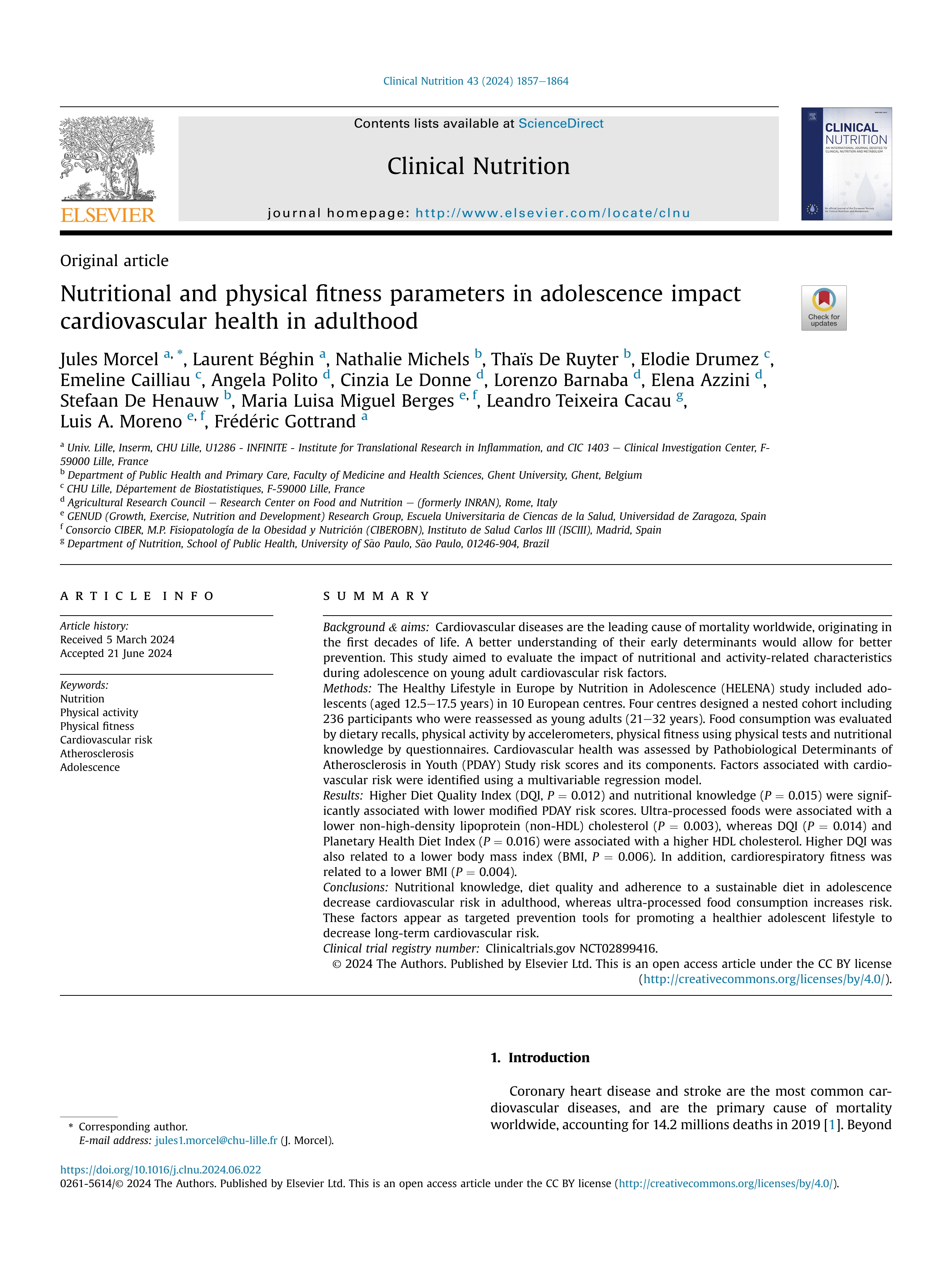

Resumen: Background & aims: Cardiovascular diseases are the leading cause of mortality worldwide, originating in the first decades of life. A better understanding of their early determinants would allow for better prevention. This study aimed to evaluate the impact of nutritional and activity-related characteristics during adolescence on young adult cardiovascular risk factors. Methods: The Healthy Lifestyle in Europe by Nutrition in Adolescence (HELENA) study included adolescents (aged 12.5–17.5 years) in 10 European centres. Four centres designed a nested cohort including 236 participants who were reassessed as young adults (21–32 years). Food consumption was evaluated by dietary recalls, physical activity by accelerometers, physical fitness using physical tests and nutritional knowledge by questionnaires. Cardiovascular health was assessed by Pathobiological Determinants of Atherosclerosis in Youth (PDAY) Study risk scores and its components. Factors associated with cardiovascular risk were identified using a multivariable regression model. Results: Higher Diet Quality Index (DQI, P = 0.012) and nutritional knowledge (P = 0.015) were significantly associated with lower modified PDAY risk scores. Ultra-processed foods were associated with a lower non-high-density lipoprotein (non-HDL) cholesterol (P = 0.003), whereas DQI (P = 0.014) and Planetary Health Diet Index (P = 0.016) were associated with a higher HDL cholesterol. Higher DQI was also related to a lower body mass index (BMI, P = 0.006). In addition, cardiorespiratory fitness was related to a lower BMI (P = 0.004). Conclusions: Nutritional knowledge, diet quality and adherence to a sustainable diet in adolescence decrease cardiovascular risk in adulthood, whereas ultra-processed food consumption increases risk. These factors appear as targeted prevention tools for promoting a healthier adolescent lifestyle to decrease long-term cardiovascular risk.
Idioma: Inglés
DOI: 10.1016/j.clnu.2024.06.022
Año: 2024
Publicado en: Clinical Nutrition 43, 8 (2024), 1857-1864
ISSN: 0261-5614
Factor impacto JCR: 7.4 (2024)
Categ. JCR: NUTRITION & DIETETICS rank: 8 / 113 = 0.071 (2024) - Q1 - T1
Factor impacto CITESCORE: 15.5 - Nutrition and Dietetics (Q1) - Critical Care and Intensive Care Medicine (Q1)
Factor impacto SCIMAGO: 2.212 - Nutrition and Dietetics (Q1) - Critical Care and Intensive Care Medicine (Q1)
Financiación: info:eu-repo/grantAgreement/EUR/FP6/FOOD-CT-2005-6007034
Tipo y forma: Artículo (Versión definitiva)
Área (Departamento): Área Enfermería (Dpto. Fisiatría y Enfermería)
 Debe reconocer adecuadamente la autoría, proporcionar un enlace a la licencia e indicar si se han realizado cambios. Puede hacerlo de cualquier manera razonable, pero no de una manera que sugiera que tiene el apoyo del licenciador o lo recibe por el uso que hace.
Exportado de SIDERAL (2026-02-17-20:38:10)
Visitas y descargas
Idioma: Inglés
DOI: 10.1016/j.clnu.2024.06.022
Año: 2024
Publicado en: Clinical Nutrition 43, 8 (2024), 1857-1864
ISSN: 0261-5614
Factor impacto JCR: 7.4 (2024)
Categ. JCR: NUTRITION & DIETETICS rank: 8 / 113 = 0.071 (2024) - Q1 - T1
Factor impacto CITESCORE: 15.5 - Nutrition and Dietetics (Q1) - Critical Care and Intensive Care Medicine (Q1)
Factor impacto SCIMAGO: 2.212 - Nutrition and Dietetics (Q1) - Critical Care and Intensive Care Medicine (Q1)
Financiación: info:eu-repo/grantAgreement/EUR/FP6/FOOD-CT-2005-6007034
Tipo y forma: Artículo (Versión definitiva)
Área (Departamento): Área Enfermería (Dpto. Fisiatría y Enfermería)
Debe reconocer adecuadamente la autoría, proporcionar un enlace a la licencia e indicar si se han realizado cambios. Puede hacerlo de cualquier manera razonable, pero no de una manera que sugiera que tiene el apoyo del licenciador o lo recibe por el uso que hace. Exportado de SIDERAL (2026-02-17-20:38:10)
Enlace permanente:
Visitas y descargas
Este artículo se encuentra en las siguientes colecciones:
Artículos > Artículos por área > Enfermería
Registro creado el 2024-07-19, última modificación el 2026-02-17