Sustainable conversion of vine shoots and pig manure into high-performance anode materials for sodium-ion batteries
Alvira, Darío (Universidad de Zaragoza) ; Antorán, Daniel (Universidad de Zaragoza) ; Darjazi, Hamideh ; Elia, Giuseppe Antonio ; Sebastian, Victor (Universidad de Zaragoza) ; Manyà, Joan J. (Universidad de Zaragoza)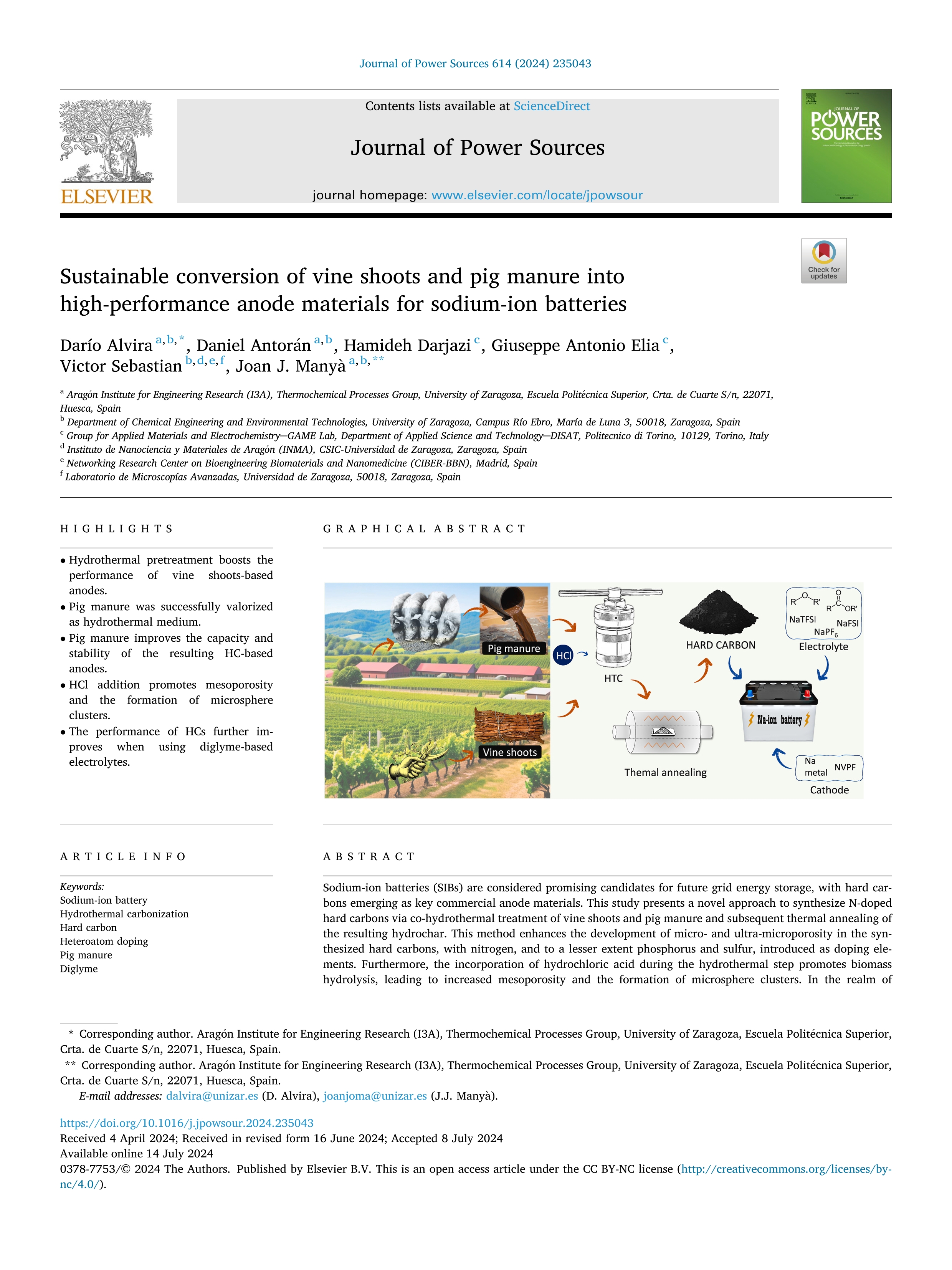
Resumen: Sodium-ion batteries (SIBs) are considered promising candidates for future grid energy storage, with hard carbons emerging as key commercial anode materials. This study presents a novel approach to synthesize N-doped hard carbons via co-hydrothermal treatment of vine shoots and pig manure and subsequent thermal annealing of the resulting hydrochar. This method enhances the development of micro- and ultra-microporosity in the synthesized hard carbons, with nitrogen, and to a lesser extent phosphorus and sulfur, introduced as doping elements. Furthermore, the incorporation of hydrochloric acid during the hydrothermal step promotes biomass hydrolysis, leading to increased mesoporosity and the formation of microsphere clusters. In the realm of electrochemical performance, an investigation into various ester- and ether-based electrolytes has revealed NaPF6 in diglyme as the best formulation, thanks to its thinner and more stable solid electrolyte interface (SEI). Using this electrolyte, the best-performing electrode showed an initial Coulombic efficiency (ICE) of 73 %, with reversible capacities of 239, 180, 86, and 57 mAh g−1 at 0.1, 1, 5, and 10 A g−1, respectively. In addition, the electrode exhibited a remarkable capacity retention of 88 % after 250 cycles as well as a compatible behavior when paired with a NVPF-based cathode.
Idioma: Inglés
DOI: 10.1016/j.jpowsour.2024.235043
Año: 2024
Publicado en: JOURNAL OF POWER SOURCES 614 (2024), 235043 [16 pp.]
ISSN: 0378-7753
Factor impacto JCR: 7.9 (2024)
Categ. JCR: CHEMISTRY, PHYSICAL rank: 43 / 185 = 0.232 (2024) - Q1 - T1
Categ. JCR: MATERIALS SCIENCE, MULTIDISCIPLINARY rank: 88 / 461 = 0.191 (2024) - Q1 - T1
Categ. JCR: ENERGY & FUELS rank: 41 / 182 = 0.225 (2024) - Q1 - T1
Categ. JCR: ELECTROCHEMISTRY rank: 7 / 44 = 0.159 (2024) - Q1 - T1
Factor impacto CITESCORE: 14.9 - Electrical and Electronic Engineering (Q1) - Renewable Energy, Sustainability and the Environment (Q1) - Energy Engineering and Power Technology (Q1) - Physical and Theoretical Chemistry (Q1)
Factor impacto SCIMAGO: 1.784 - Electrical and Electronic Engineering (Q1) - Renewable Energy, Sustainability and the Environment (Q1) - Physical and Theoretical Chemistry (Q1) - Energy Engineering and Power Technology (Q1)
Financiación: info:eu-repo/grantAgreement/ES/DGA-FEDER/T22-23R
Financiación: info:eu-repo/grantAgreement/ES/MICINN/PID2029-107737RB-I00
Tipo y forma: Artículo (Versión definitiva)
Área (Departamento): Área Ingeniería Química (Dpto. Ing.Quím.Tecnol.Med.Amb.)
Área (Departamento): Proy. investigación HKA (Dpto. Ing.Quím.Tecnol.Med.Amb.)
 Debe reconocer adecuadamente la autoría, proporcionar un enlace a la licencia e indicar si se han realizado cambios. Puede hacerlo de cualquier manera razonable, pero no de una manera que sugiera que tiene el apoyo del licenciador o lo recibe por el uso que hace. No puede utilizar el material para una finalidad comercial.
Exportado de SIDERAL (2026-02-17-20:40:02)
Visitas y descargas
Idioma: Inglés
DOI: 10.1016/j.jpowsour.2024.235043
Año: 2024
Publicado en: JOURNAL OF POWER SOURCES 614 (2024), 235043 [16 pp.]
ISSN: 0378-7753
Factor impacto JCR: 7.9 (2024)
Categ. JCR: CHEMISTRY, PHYSICAL rank: 43 / 185 = 0.232 (2024) - Q1 - T1
Categ. JCR: MATERIALS SCIENCE, MULTIDISCIPLINARY rank: 88 / 461 = 0.191 (2024) - Q1 - T1
Categ. JCR: ENERGY & FUELS rank: 41 / 182 = 0.225 (2024) - Q1 - T1
Categ. JCR: ELECTROCHEMISTRY rank: 7 / 44 = 0.159 (2024) - Q1 - T1
Factor impacto CITESCORE: 14.9 - Electrical and Electronic Engineering (Q1) - Renewable Energy, Sustainability and the Environment (Q1) - Energy Engineering and Power Technology (Q1) - Physical and Theoretical Chemistry (Q1)
Factor impacto SCIMAGO: 1.784 - Electrical and Electronic Engineering (Q1) - Renewable Energy, Sustainability and the Environment (Q1) - Physical and Theoretical Chemistry (Q1) - Energy Engineering and Power Technology (Q1)
Financiación: info:eu-repo/grantAgreement/ES/DGA-FEDER/T22-23R
Financiación: info:eu-repo/grantAgreement/ES/MICINN/PID2029-107737RB-I00
Tipo y forma: Artículo (Versión definitiva)
Área (Departamento): Área Ingeniería Química (Dpto. Ing.Quím.Tecnol.Med.Amb.)
Área (Departamento): Proy. investigación HKA (Dpto. Ing.Quím.Tecnol.Med.Amb.)
Debe reconocer adecuadamente la autoría, proporcionar un enlace a la licencia e indicar si se han realizado cambios. Puede hacerlo de cualquier manera razonable, pero no de una manera que sugiera que tiene el apoyo del licenciador o lo recibe por el uso que hace. No puede utilizar el material para una finalidad comercial.Exportado de SIDERAL (2026-02-17-20:40:02)
Enlace permanente:
Visitas y descargas
Este artículo se encuentra en las siguientes colecciones:
Artículos > Artículos por área > Ingeniería Química
Registro creado el 2024-07-31, última modificación el 2026-02-17