Hematological and performance adaptations to altitude training (2,320 m) in elite middle-distance and distance swimmers
Mujika, Iñigo ; Bourdillon, Nicolas ; Zelenkova, Irina ; Vergnoux, Frédéric ; Millet, Grégoire P.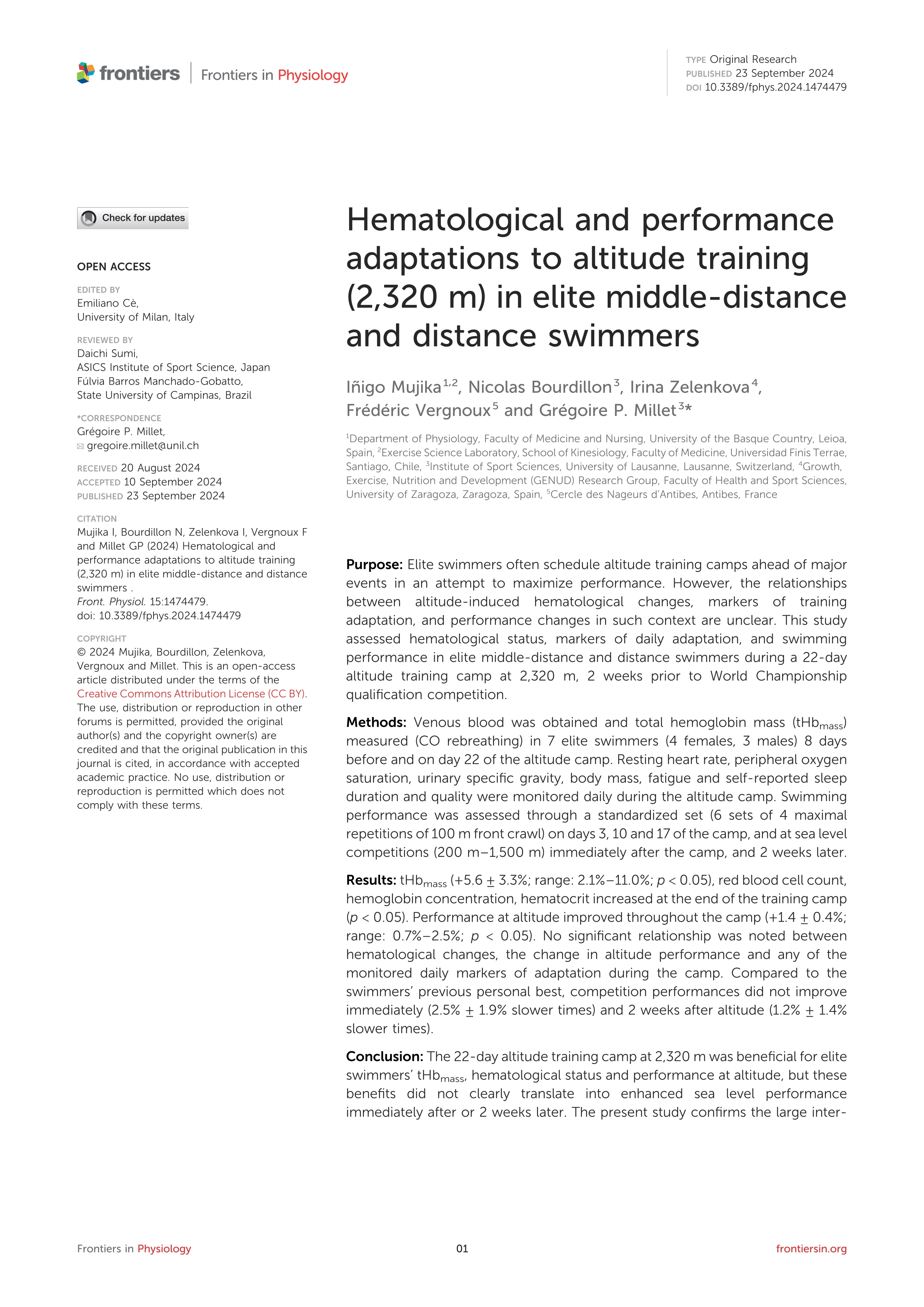
Resumen: PurposeElite swimmers often schedule altitude training camps ahead of major events in an attempt to maximize performance. However, the relationships between altitude-induced hematological changes, markers of training adaptation, and performance changes in such context are unclear. This study assessed hematological status, markers of daily adaptation, and swimming performance in elite middle-distance and distance swimmers during a 22-day altitude training camp at 2,320 m, 2 weeks prior to World Championship qualification competition.MethodsVenous blood was obtained and total hemoglobin mass (tHbmass) measured (CO rebreathing) in 7 elite swimmers (4 females, 3 males) 8 days before and on day 22 of the altitude camp. Resting heart rate, peripheral oxygen saturation, urinary specific gravity, body mass, fatigue and self-reported sleep duration and quality were monitored daily during the altitude camp. Swimming performance was assessed through a standardized set (6 sets of 4 maximal repetitions of 100 m front crawl) on days 3, 10 and 17 of the camp, and at sea level competitions (200 m–1,500 m) immediately after the camp, and 2 weeks later.ResultstHbmass (+5.6 ± 3.3%; range: 2.1%–11.0%; p < 0.05), red blood cell count, hemoglobin concentration, hematocrit increased at the end of the training camp (p < 0.05). Performance at altitude improved throughout the camp (+1.4 ± 0.4%; range: 0.7%–2.5%; p < 0.05). No significant relationship was noted between hematological changes, the change in altitude performance and any of the monitored daily markers of adaptation during the camp. Compared to the swimmers’ previous personal best, competition performances did not improve immediately (2.5% ± 1.9% slower times) and 2 weeks after altitude (1.2% ± 1.4% slower times).ConclusionThe 22-day altitude training camp at 2,320 m was beneficial for elite swimmers’ tHbmass, hematological status and performance at altitude, but these benefits did not clearly translate into enhanced sea level performance immediately after or 2 weeks later. The present study confirms the large inter-individual variability in hematological responses to altitude training, and that the improvement in performance at altitude and sea level may depend on factors other than the increase in tHbmass alone.
Idioma: Inglés
DOI: 10.3389/fphys.2024.1474479
Año: 2024
Publicado en: Frontiers in physiology 15 (2024), 8 pp.
ISSN: 1664-042X
Factor impacto JCR: 3.4 (2024)
Categ. JCR: PHYSIOLOGY rank: 20 / 87 = 0.23 (2024) - Q1 - T1
Factor impacto CITESCORE: 7.3 - Physiology (medical) (Q1) - Physiology (Q1)
Factor impacto SCIMAGO: 1.023 - Physiology (medical) (Q2) - Physiology (Q2)
Tipo y forma: Artículo (Versión definitiva)
 Debe reconocer adecuadamente la autoría, proporcionar un enlace a la licencia e indicar si se han realizado cambios. Puede hacerlo de cualquier manera razonable, pero no de una manera que sugiera que tiene el apoyo del licenciador o lo recibe por el uso que hace.
Exportado de SIDERAL (2026-01-12-13:16:23)
Visitas y descargas
Idioma: Inglés
DOI: 10.3389/fphys.2024.1474479
Año: 2024
Publicado en: Frontiers in physiology 15 (2024), 8 pp.
ISSN: 1664-042X
Factor impacto JCR: 3.4 (2024)
Categ. JCR: PHYSIOLOGY rank: 20 / 87 = 0.23 (2024) - Q1 - T1
Factor impacto CITESCORE: 7.3 - Physiology (medical) (Q1) - Physiology (Q1)
Factor impacto SCIMAGO: 1.023 - Physiology (medical) (Q2) - Physiology (Q2)
Tipo y forma: Artículo (Versión definitiva)
Debe reconocer adecuadamente la autoría, proporcionar un enlace a la licencia e indicar si se han realizado cambios. Puede hacerlo de cualquier manera razonable, pero no de una manera que sugiera que tiene el apoyo del licenciador o lo recibe por el uso que hace. Exportado de SIDERAL (2026-01-12-13:16:23)
Enlace permanente:
Visitas y descargas
Este artículo se encuentra en las siguientes colecciones:
Artículos
Registro creado el 2024-10-30, última modificación el 2026-01-12