Association of Muscle Strength With All-Cause Mortality in the Oldest Old: Prospective Cohort Study From 28 Countries
Andersen, Lars Louis ; López-Bueno, Rubén (Universidad de Zaragoza) ; Núñez- Cortés, Rodrigo ; Lusa Cadore, Eduardo ; Polo-López, Ana ; Calatayud, Joaquín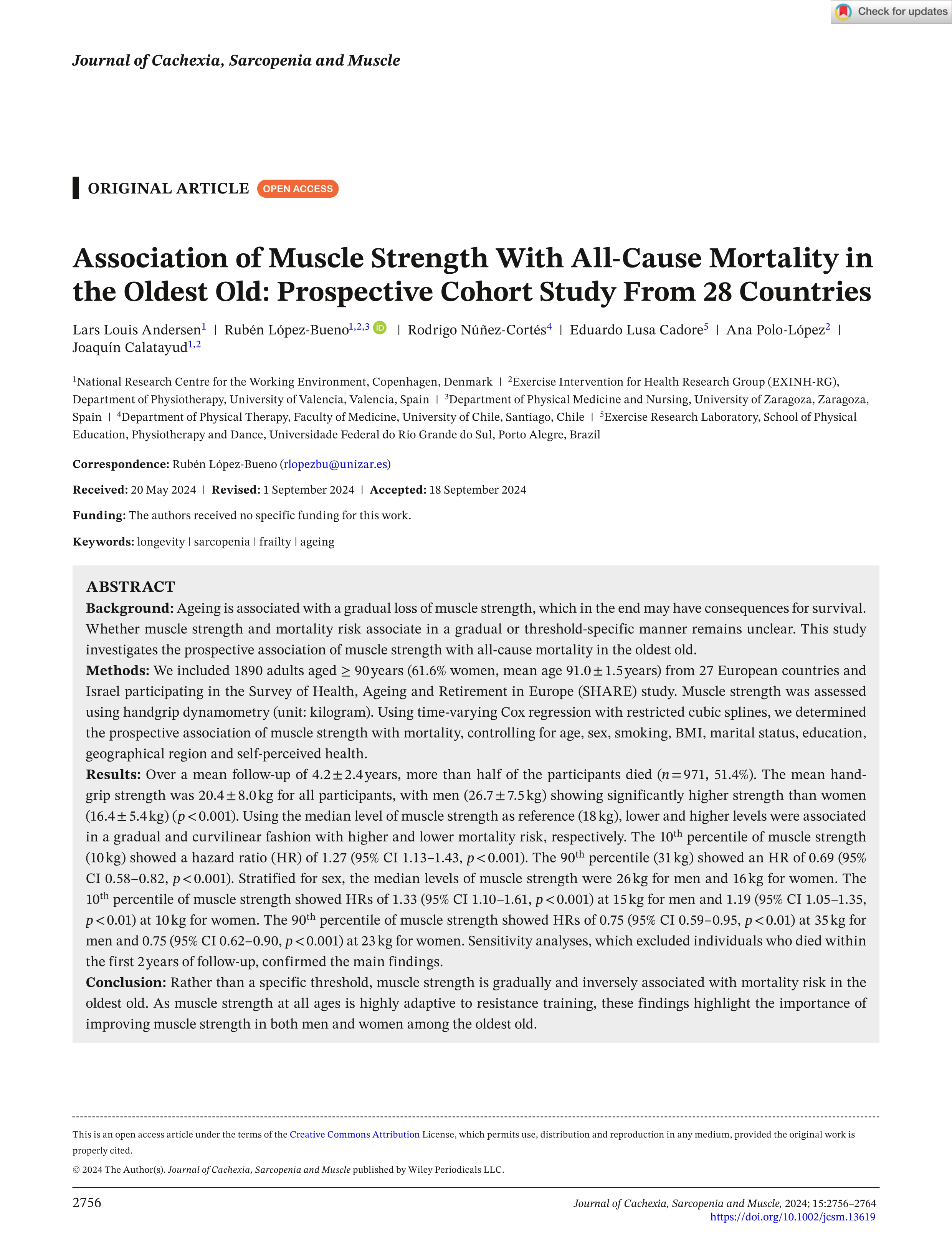
Resumen: Background: Ageing is associated with a gradual loss of muscle strength, which in the end may have consequences for survival.Whether muscle strength and mortality risk associate in a gradual or threshold-specific manner remains unclear. This studyinvestigates the prospective association of muscle strength with all-cause mortality in the oldest old.Methods: We included 1890 adults aged ≥ 90 years (61.6% women, mean age 91.0 ± 1.5 years) from 27 European countries andIsrael participating in the Survey of Health, Ageing and Retirement in Europe (SHARE) study. Muscle strength was assessedusing handgrip dynamometry (unit: kilogram). Using time-varying Cox regression with restricted cubic splines, we determinedthe prospective association of muscle strength with mortality, controlling for age, sex, smoking, BMI, marital status, education,geographical region and self-perceived health.Results: Over a mean follow-up of 4.2 ± 2.4 years, more than half of the participants died (n = 971, 51.4%). The mean hand-grip strength was 20.4 ± 8.0 kg for all participants, with men (26.7 ± 7.5 kg) showing significantly higher strength than women(16.4 ± 5.4 kg) (p < 0.001). Using the median level of muscle strength as reference (18 kg), lower and higher levels were associatedin a gradual and curvilinear fashion with higher and lower mortality risk, respectively. The 10 th percentile of muscle strength(10 kg) showed a hazard ratio (HR) of 1.27 (95% CI 1.13–1.43, p < 0.001). The 90 th percentile (31 kg) showed an HR of 0.69 (95%CI 0.58–0.82, p < 0.001). Stratified for sex, the median levels of muscle strength were 26 kg for men and 16 kg for women. The10 th percentile of muscle strength showed HRs of 1.33 (95% CI 1.10–1.61, p < 0.001) at 15 kg for men and 1.19 (95% CI 1.05–1.35,p < 0.01) at 10 kg for women. The 90 th percentile of muscle strength showed HRs of 0.75 (95% CI 0.59–0.95, p < 0.01) at 35 kg formen and 0.75 (95% CI 0.62–0.90, p < 0.001) at 23 kg for women. Sensitivity analyses, which excluded individuals who died withinthe first 2 years of follow-up, confirmed the main findings.Conclusion: Rather than a specific threshold, muscle strength is gradually and inversely associated with mortality risk in theoldest old. As muscle strength at all ages is highly adaptive to resistance training, these findings highlight the importance ofimproving muscle strength in both men and women among the oldest old.
Idioma: Inglés
DOI: 10.1002/jcsm.13619
Año: 2024
Publicado en: Journal of Cachexia, Sarcopenia and Muscle 15, 6 (2024), 2187-2903
ISSN: 2190-5991
Factor impacto JCR: 9.1 (2024)
Categ. JCR: MEDICINE, GENERAL & INTERNAL rank: 19 / 332 = 0.057 (2024) - Q1 - T1
Categ. JCR: GERIATRICS & GERONTOLOGY rank: 4 / 73 = 0.055 (2024) - Q1 - T1
Factor impacto CITESCORE: 15.6 - Physiology (medical) (Q1) - Orthopedics and Sports Medicine (Q1)
Tipo y forma: Artículo (Versión definitiva)
Área (Departamento): Área Didáctica Expres.Corporal (Dpto. Expres.Music.Plást.Corp.)
 Debe reconocer adecuadamente la autoría, proporcionar un enlace a la licencia e indicar si se han realizado cambios. Puede hacerlo de cualquier manera razonable, pero no de una manera que sugiera que tiene el apoyo del licenciador o lo recibe por el uso que hace.
Exportado de SIDERAL (2026-02-17-20:47:48)
Visitas y descargas
Idioma: Inglés
DOI: 10.1002/jcsm.13619
Año: 2024
Publicado en: Journal of Cachexia, Sarcopenia and Muscle 15, 6 (2024), 2187-2903
ISSN: 2190-5991
Factor impacto JCR: 9.1 (2024)
Categ. JCR: MEDICINE, GENERAL & INTERNAL rank: 19 / 332 = 0.057 (2024) - Q1 - T1
Categ. JCR: GERIATRICS & GERONTOLOGY rank: 4 / 73 = 0.055 (2024) - Q1 - T1
Factor impacto CITESCORE: 15.6 - Physiology (medical) (Q1) - Orthopedics and Sports Medicine (Q1)
Tipo y forma: Artículo (Versión definitiva)
Área (Departamento): Área Didáctica Expres.Corporal (Dpto. Expres.Music.Plást.Corp.)
Debe reconocer adecuadamente la autoría, proporcionar un enlace a la licencia e indicar si se han realizado cambios. Puede hacerlo de cualquier manera razonable, pero no de una manera que sugiera que tiene el apoyo del licenciador o lo recibe por el uso que hace. Exportado de SIDERAL (2026-02-17-20:47:48)
Enlace permanente:
Visitas y descargas
Este artículo se encuentra en las siguientes colecciones:
Artículos > Artículos por área > Didáctica de la Expresión Corporal
Registro creado el 2024-12-20, última modificación el 2026-02-17