Determination of the frequency of individuals with broadly cross-reactive neutralizing antibodies against PRRSV in the sow population under field conditions
Plaza-Soriano, Ángeles ; Martínez-Lobo, Francisco Javier ; Garza-Moreno, Laura (Universidad de Zaragoza) ; Castillo-Pérez, Jaime ; Caballero, Elki ; Castro, José María ; Simarro, Isabel ; Prieto, Cinta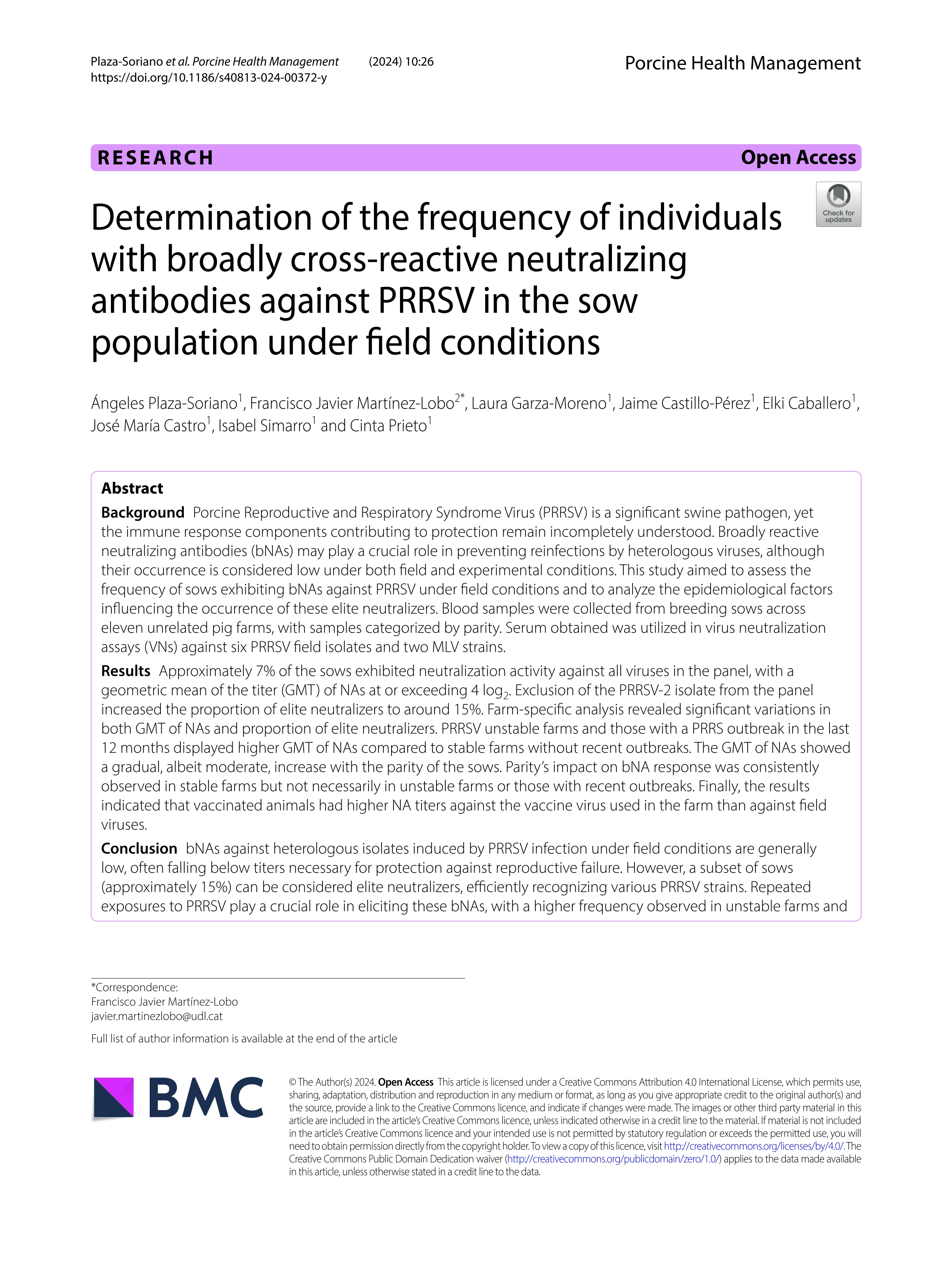
Resumen: AbstractPorcine Reproductive and Respiratory Syndrome Virus (PRRSV) is a significant swine pathogen, yet the immune response components contributing to protection remain incompletely understood. Broadly reactive neutralizing antibodies (bNAs) may play a crucial role in preventing reinfections by heterologous viruses, although their occurrence is considered low under both field and experimental conditions. This study aimed to assess the frequency of sows exhibiting bNAs against PRRSV under field conditions and to analyze the epidemiological factors influencing the occurrence of these elite neutralizers. Blood samples were collected from breeding sows across eleven unrelated pig farms, with samples categorized by parity. Serum obtained was utilized in virus neutralization assays (VNs) against six PRRSV field isolates and two MLV strains.ResultsApproximately 7% of the sows exhibited neutralization activity against all viruses in the panel, with a geometric mean of the titer (GMT) of NAs at or exceeding 4 log2. Exclusion of the PRRSV-2 isolate from the panel increased the proportion of elite neutralizers to around 15%. Farm-specific analysis revealed significant variations in both GMT of NAs and proportion of elite neutralizers. PRRSV unstable farms and those with a PRRS outbreak in the last 12 months displayed higher GMT of NAs compared to stable farms without recent outbreaks. The GMT of NAs showed a gradual, albeit moderate, increase with the parity of the sows. Parity’s impact on bNA response was consistently observed in stable farms but not necessarily in unstable farms or those with recent outbreaks. Finally, the results indicated that vaccinated animals had higher NA titers against the vaccine virus used in the farm than against field viruses.ConclusionbNAs against heterologous isolates induced by PRRSV infection under field conditions are generally low, often falling below titers necessary for protection against reproductive failure. However, a subset of sows (approximately 15%) can be considered elite neutralizers, efficiently recognizing various PRRSV strains. Repeated exposures to PRRSV play a crucial role in eliciting these bNAs, with a higher frequency observed in unstable farms and those with recent outbreaks. In stable farms, parity only marginally influences bNA titers, highlighting its limited role compared to the impact of PRRSV exposure history.
Idioma: Inglés
DOI: 10.1186/s40813-024-00372-y
Año: 2024
Publicado en: Porcine Health Management 10 (2024), 26 [12 pp.]
ISSN: 2055-5660
Factor impacto JCR: 3.1 (2024)
Categ. JCR: VETERINARY SCIENCES rank: 14 / 170 = 0.082 (2024) - Q1 - T1
Factor impacto CITESCORE: 5.7 - Food Animals (Q1) - Animal Science and Zoology (Q1)
Factor impacto SCIMAGO: 0.776 - Animal Science and Zoology (Q1) - Small Animals (Q1) - Food Animals (Q1)
Financiación: info:eu-repo/grantAgreement/ES/MICINN/AGL2011-30133
Tipo y forma: Artículo (Versión definitiva)
Área (Departamento): Área Sanidad Animal (Dpto. Patología Animal)
 Debe reconocer adecuadamente la autoría, proporcionar un enlace a la licencia e indicar si se han realizado cambios. Puede hacerlo de cualquier manera razonable, pero no de una manera que sugiera que tiene el apoyo del licenciador o lo recibe por el uso que hace.
Exportado de SIDERAL (2026-01-12-12:35:41)
Visitas y descargas
Idioma: Inglés
DOI: 10.1186/s40813-024-00372-y
Año: 2024
Publicado en: Porcine Health Management 10 (2024), 26 [12 pp.]
ISSN: 2055-5660
Factor impacto JCR: 3.1 (2024)
Categ. JCR: VETERINARY SCIENCES rank: 14 / 170 = 0.082 (2024) - Q1 - T1
Factor impacto CITESCORE: 5.7 - Food Animals (Q1) - Animal Science and Zoology (Q1)
Factor impacto SCIMAGO: 0.776 - Animal Science and Zoology (Q1) - Small Animals (Q1) - Food Animals (Q1)
Financiación: info:eu-repo/grantAgreement/ES/MICINN/AGL2011-30133
Tipo y forma: Artículo (Versión definitiva)
Área (Departamento): Área Sanidad Animal (Dpto. Patología Animal)
Debe reconocer adecuadamente la autoría, proporcionar un enlace a la licencia e indicar si se han realizado cambios. Puede hacerlo de cualquier manera razonable, pero no de una manera que sugiera que tiene el apoyo del licenciador o lo recibe por el uso que hace. Exportado de SIDERAL (2026-01-12-12:35:41)
Enlace permanente:
Visitas y descargas
Este artículo se encuentra en las siguientes colecciones:
Artículos > Artículos por área > Sanidad Animal
Registro creado el 2025-01-20, última modificación el 2026-01-12