Recuento leucocitario y riesgo cardiovascular tras un síndrome coronario agudo
Cabrerizo García, J.L. ; Zalba, B. ; Pérez, J.I. (Universidad de Zaragoza) ; Ruiz, F.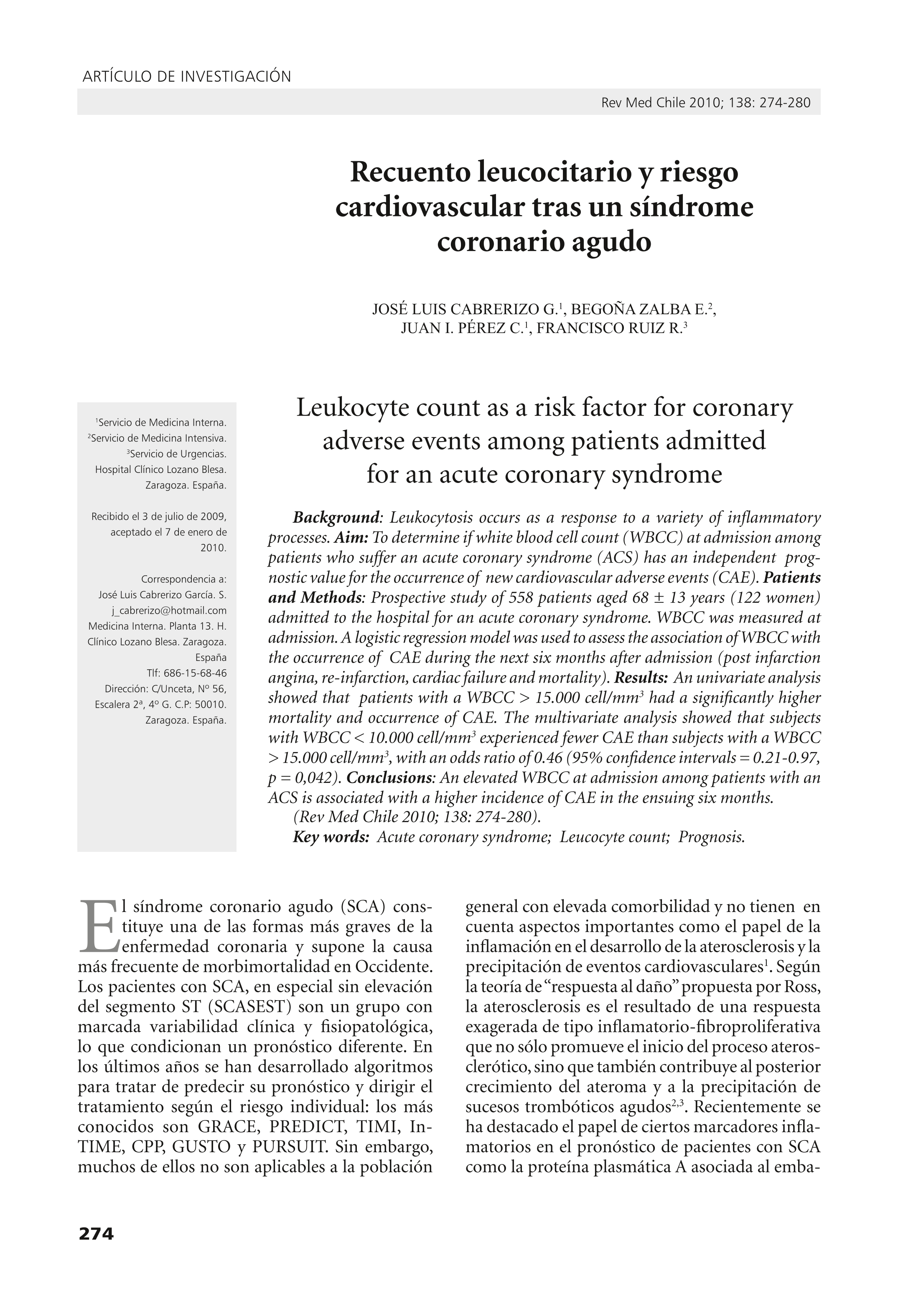
Resumen: Background: Leukocytosis occurs as a response to a variety of infammatory processes. Aim: To determine if white blood cell count (WBCC) at admission among patients who suffer an acute coronary syndrome (ACS) has an independent prog-nostic value for the occurrence of new cardiovascular adverse events (CAE).
Patients and Methods: Prospective study of 558 patients aged 68 ± 13 years (122 women) admitted to the hospital for an acute coronary syndrome. WBCC was measured at admission. A logistic regression model was used to assess the association of WBCC with the occurrence of CAE during the next six months after admission (post infarction angina, re-infarction, cardiac failure and mortality). Results: An univariate analysis showed that patients with a WBCC > 15.000 cell/mm³ had a signifcantly higher mortality and occurrence of CAE. The multivariate analysis showed that subjects with WBCC < 10.000 cell/mm³ experienced fewer CAE than subjects with a WBCC > 15.000 cell/mm³, with an odds ratio of 0.46 (95% confdence intervals = 0.21-0.97, p = 0,042). Conclusions: An elevated WBCC at admission among patients with an ACS is associated with a higher incidence of CAE in the ensuing six months.
Idioma: Español
DOI: 10.4067/S0034-98872010000300003
Año: 2010
Publicado en: REVISTA MEDICA DE CHILE 138, 3 (2010), 274-80
ISSN: 0034-9887
Factor impacto JCR: 0.366 (2010)
Categ. JCR: MEDICINE, GENERAL & INTERNAL rank: 119 / 152 = 0.783 (2010) - Q4 - T3
Tipo y forma: Artículo (Versión definitiva)
Área (Departamento): Area Medicina (Dpto. Medicina, Psiqu. y Derm.)
 Debe reconocer adecuadamente la autoría, proporcionar un enlace a la licencia e indicar si se han realizado cambios. Puede hacerlo de cualquier manera razonable, pero no de una manera que sugiera que tiene el apoyo del licenciador o lo recibe por el uso que hace.
Exportado de SIDERAL (2025-10-17-14:11:37)
Visitas y descargas
Patients and Methods: Prospective study of 558 patients aged 68 ± 13 years (122 women) admitted to the hospital for an acute coronary syndrome. WBCC was measured at admission. A logistic regression model was used to assess the association of WBCC with the occurrence of CAE during the next six months after admission (post infarction angina, re-infarction, cardiac failure and mortality). Results: An univariate analysis showed that patients with a WBCC > 15.000 cell/mm³ had a signifcantly higher mortality and occurrence of CAE. The multivariate analysis showed that subjects with WBCC < 10.000 cell/mm³ experienced fewer CAE than subjects with a WBCC > 15.000 cell/mm³, with an odds ratio of 0.46 (95% confdence intervals = 0.21-0.97, p = 0,042). Conclusions: An elevated WBCC at admission among patients with an ACS is associated with a higher incidence of CAE in the ensuing six months.
Idioma: Español
DOI: 10.4067/S0034-98872010000300003
Año: 2010
Publicado en: REVISTA MEDICA DE CHILE 138, 3 (2010), 274-80
ISSN: 0034-9887
Factor impacto JCR: 0.366 (2010)
Categ. JCR: MEDICINE, GENERAL & INTERNAL rank: 119 / 152 = 0.783 (2010) - Q4 - T3
Tipo y forma: Artículo (Versión definitiva)
Área (Departamento): Area Medicina (Dpto. Medicina, Psiqu. y Derm.)
Debe reconocer adecuadamente la autoría, proporcionar un enlace a la licencia e indicar si se han realizado cambios. Puede hacerlo de cualquier manera razonable, pero no de una manera que sugiera que tiene el apoyo del licenciador o lo recibe por el uso que hace. Exportado de SIDERAL (2025-10-17-14:11:37)
Enlace permanente:
Visitas y descargas
Este artículo se encuentra en las siguientes colecciones:
Artículos > Artículos por área > Medicina
Registro creado el 2025-01-27, última modificación el 2025-10-17