Targeting LDL aggregation decreases atherosclerotic lipid burden in a humanized mouse model of familial hypercholesterolemia: Crucial role of ApoB100 conformational stabilization
Benitez-Amaro, A. ; Garcia, E. ; La Chica Lhoëst, M.T. ; Martínez, A. ; Borràs, C. ; Tondo, M. ; Céspedes, M.V. ; Caruana, P. ; Pepe, A. ; Bochicchio, B. ; Cenarro, A. ; Civeira, F. (Universidad de Zaragoza) ; Prades, R. ; Escola-Gil, J.C. ; Llorente-Cortés, V.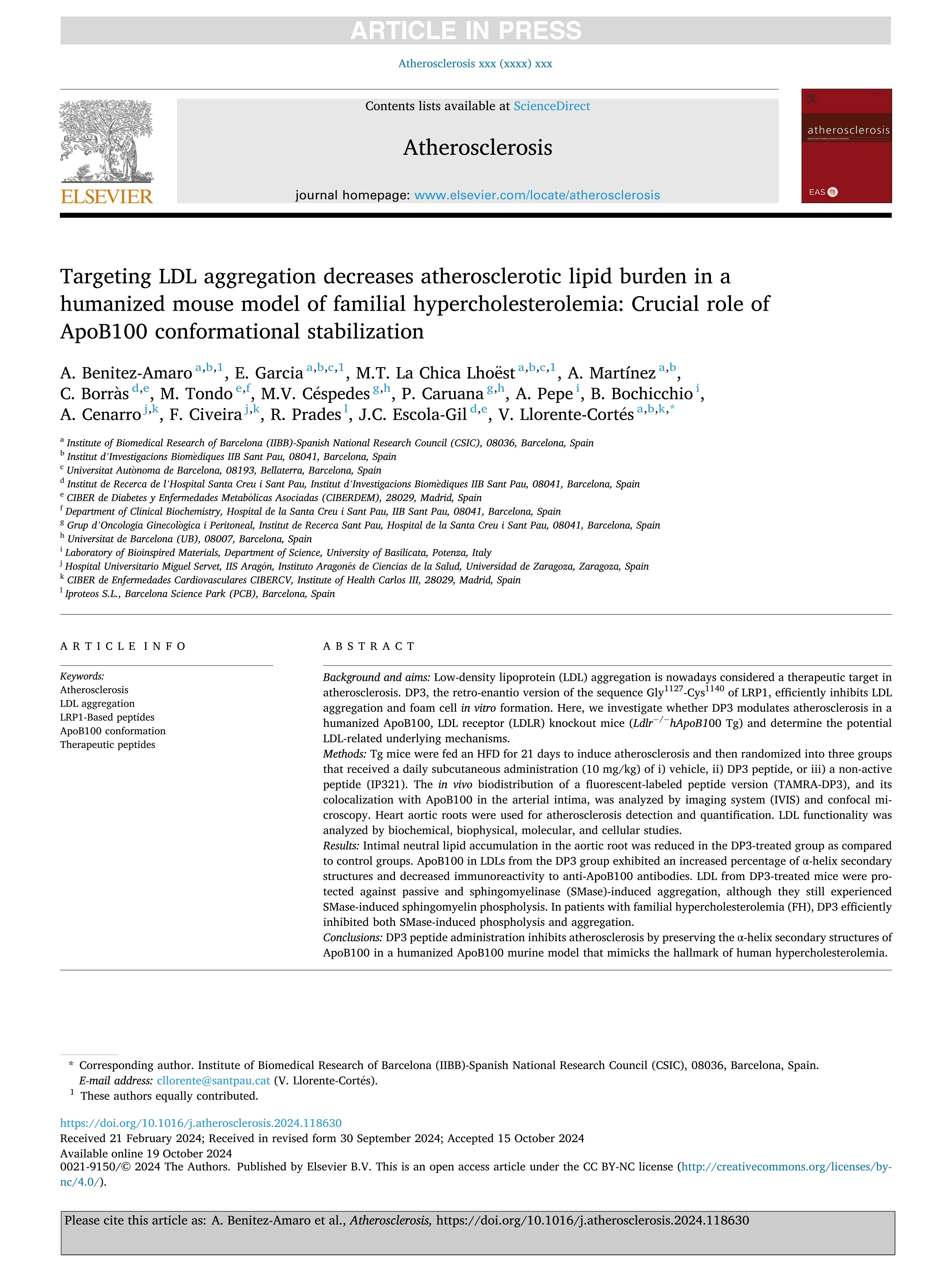
Resumen: Background and aims: Low-density lipoprotein (LDL) aggregation is nowadays considered a therapeutic target in atherosclerosis. DP3, the retro-enantio version of the sequence Gly1127-Cys1140 of LRP1, efficiently inhibits LDL aggregation and foam cell in vitro formation. Here, we investigate whether DP3 modulates atherosclerosis in a humanized ApoB100, LDL receptor (LDLR) knockout mice (Ldlr / hApoB100 Tg) and determine the potential LDL-related underlying mechanisms.
Methods: Tg mice were fed an HFD for 21 days to induce atherosclerosis and then randomized into three groups that received a daily subcutaneous administration (10 mg/kg) of i) vehicle, ii) DP3 peptide, or iii) a non-active peptide (IP321). The in vivo biodistribution of a fluorescent-labeled peptide version (TAMRA-DP3), and its colocalization with ApoB100 in the arterial intima, was analyzed by imaging system (IVIS) and confocal mi-croscopy. Heart aortic roots were used for atherosclerosis detection and quantification. LDL functionality was analyzed by biochemical, biophysical, molecular, and cellular studies.
Results: Intimal neutral lipid accumulation in the aortic root was reduced in the DP3-treated group as compared to control groups. ApoB100 in LDLs from the DP3 group exhibited an increased percentage of α-helix secondary structures and decreased immunoreactivity to anti-ApoB100 antibodies. LDL from DP3-treated mice were pro-tected against passive and sphingomyelinase (SMase)-induced aggregation, although they still experienced SMase-induced sphingomyelin phospholysis. In patients with familial hypercholesterolemia (FH), DP3 efficiently inhibited both SMase-induced phospholysis and aggregation.
Conclusions: DP3 peptide administration inhibits atherosclerosis by preserving the α-helix secondary structures of ApoB100 in a humanized ApoB100 murine model that mimicks the hallmark of human hypercholesterolemia.
Idioma: Inglés
DOI: 10.1016/j.atherosclerosis.2024.118630
Año: 2025
Publicado en: Atherosclerosis 410 (2025), 118630 [17 pp.]
ISSN: 0021-9150
Factor impacto JCR: 5.7 (2024)
Categ. JCR: PERIPHERAL VASCULAR DISEASE rank: 11 / 98 = 0.112 (2024) - Q1 - T1
Categ. JCR: CARDIAC & CARDIOVASCULAR SYSTEMS rank: 38 / 231 = 0.165 (2024) - Q1 - T1
Factor impacto CITESCORE: 9.6 - Cardiology and Cardiovascular Medicine (Q1)
Factor impacto SCIMAGO: 1.762 - Cardiology and Cardiovascular Medicine (Q1)
Financiación: info:eu-repo/grantAgreement/ES/FIS/PI21-01523
Financiación: info:eu-repo/grantAgreement/ES/MCIU/FPU21/01173
Financiación: info:eu-repo/grantAgreement/ES/MCIU/FPU22/01888
Financiación: info:eu-repo/grantAgreement/ES/MINECO/RED2018-102799-T
Tipo y forma: Artículo (Versión definitiva)
Área (Departamento): Area Medicina (Dpto. Medicina, Psiqu. y Derm.)
 Debe reconocer adecuadamente la autoría, proporcionar un enlace a la licencia e indicar si se han realizado cambios. Puede hacerlo de cualquier manera razonable, pero no de una manera que sugiera que tiene el apoyo del licenciador o lo recibe por el uso que hace. No puede utilizar el material para una finalidad comercial.
Exportado de SIDERAL (2026-04-10-13:53:48)
Visitas y descargas
Methods: Tg mice were fed an HFD for 21 days to induce atherosclerosis and then randomized into three groups that received a daily subcutaneous administration (10 mg/kg) of i) vehicle, ii) DP3 peptide, or iii) a non-active peptide (IP321). The in vivo biodistribution of a fluorescent-labeled peptide version (TAMRA-DP3), and its colocalization with ApoB100 in the arterial intima, was analyzed by imaging system (IVIS) and confocal mi-croscopy. Heart aortic roots were used for atherosclerosis detection and quantification. LDL functionality was analyzed by biochemical, biophysical, molecular, and cellular studies.
Results: Intimal neutral lipid accumulation in the aortic root was reduced in the DP3-treated group as compared to control groups. ApoB100 in LDLs from the DP3 group exhibited an increased percentage of α-helix secondary structures and decreased immunoreactivity to anti-ApoB100 antibodies. LDL from DP3-treated mice were pro-tected against passive and sphingomyelinase (SMase)-induced aggregation, although they still experienced SMase-induced sphingomyelin phospholysis. In patients with familial hypercholesterolemia (FH), DP3 efficiently inhibited both SMase-induced phospholysis and aggregation.
Conclusions: DP3 peptide administration inhibits atherosclerosis by preserving the α-helix secondary structures of ApoB100 in a humanized ApoB100 murine model that mimicks the hallmark of human hypercholesterolemia.
Idioma: Inglés
DOI: 10.1016/j.atherosclerosis.2024.118630
Año: 2025
Publicado en: Atherosclerosis 410 (2025), 118630 [17 pp.]
ISSN: 0021-9150
Factor impacto JCR: 5.7 (2024)
Categ. JCR: PERIPHERAL VASCULAR DISEASE rank: 11 / 98 = 0.112 (2024) - Q1 - T1
Categ. JCR: CARDIAC & CARDIOVASCULAR SYSTEMS rank: 38 / 231 = 0.165 (2024) - Q1 - T1
Factor impacto CITESCORE: 9.6 - Cardiology and Cardiovascular Medicine (Q1)
Factor impacto SCIMAGO: 1.762 - Cardiology and Cardiovascular Medicine (Q1)
Financiación: info:eu-repo/grantAgreement/ES/FIS/PI21-01523
Financiación: info:eu-repo/grantAgreement/ES/MCIU/FPU21/01173
Financiación: info:eu-repo/grantAgreement/ES/MCIU/FPU22/01888
Financiación: info:eu-repo/grantAgreement/ES/MINECO/RED2018-102799-T
Tipo y forma: Artículo (Versión definitiva)
Área (Departamento): Area Medicina (Dpto. Medicina, Psiqu. y Derm.)
Debe reconocer adecuadamente la autoría, proporcionar un enlace a la licencia e indicar si se han realizado cambios. Puede hacerlo de cualquier manera razonable, pero no de una manera que sugiera que tiene el apoyo del licenciador o lo recibe por el uso que hace. No puede utilizar el material para una finalidad comercial.Exportado de SIDERAL (2026-04-10-13:53:48)
Enlace permanente:
Visitas y descargas
Este artículo se encuentra en las siguientes colecciones:
Artículos > Artículos por área > Medicina
Registro creado el 2025-02-10, última modificación el 2026-04-10