Dissecting the role of TP53 alterations in del(11q) chronic lymphocytic leukemia
Quijada-Alamo, M. ; Perez-Carretero, C. ; Hernandez-Sanchez, M. ; Rodriguez-Vicente, A.E. ; Herrero, A.B. ; Hernandez-Sanchez, J.M. ; Martin-Izquierdo, M. ; Santos-Minguez, S. ; Del Rey, M. ; Gonzalez, T. ; Rubio-Martinez, A. (Universidad de Zaragoza) ; de Coca, A.G. ; Davila-Valls, J. ; Hernandez-Rivas, J.A. ; Parker, H. ; Strefford, J.C. ; Benito, R. ; Ordonez, J.L. ; Hernandez-Rivas, J.M.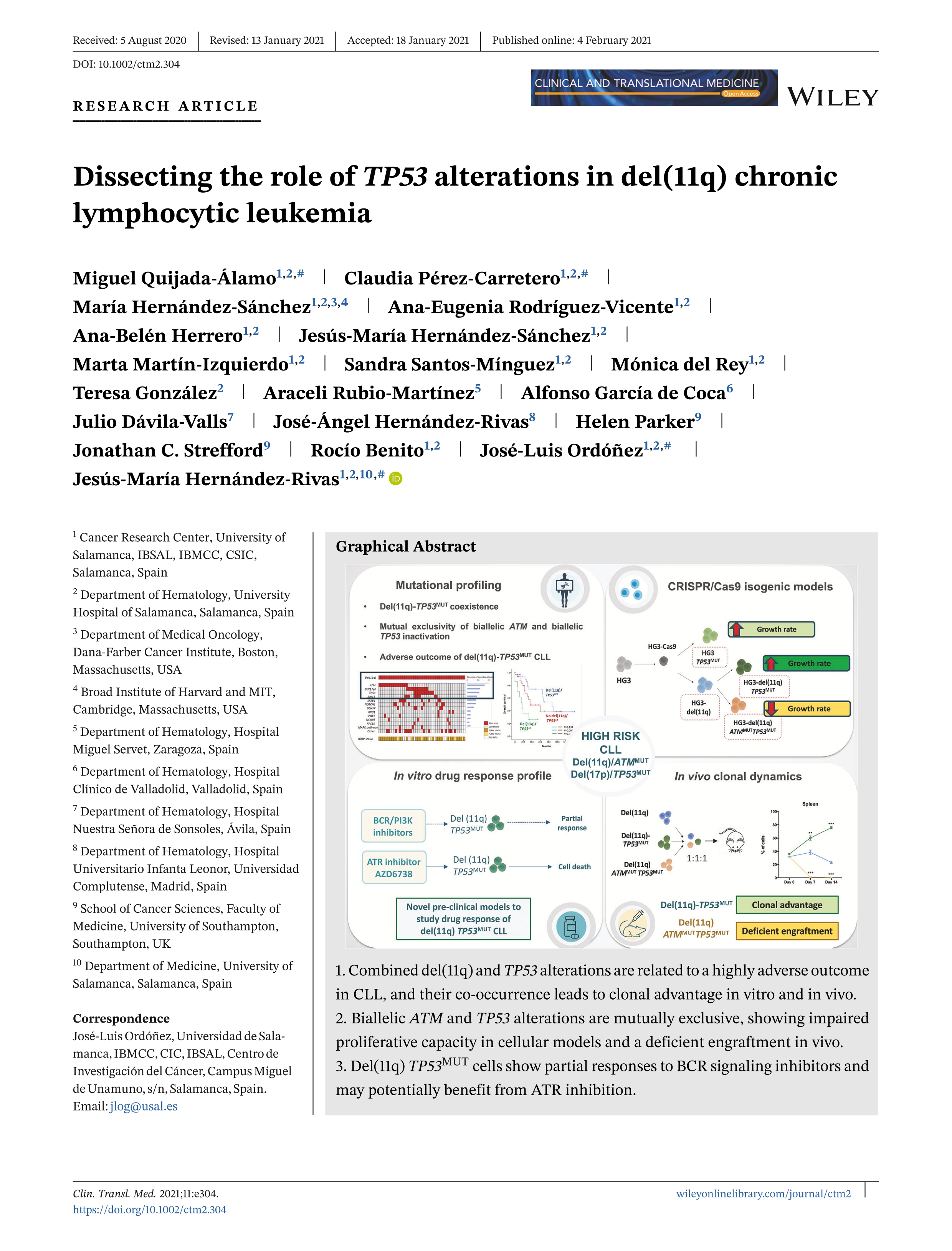
Resumen: Background Several genetic alterations have been identified as driver events in chronic lymphocytic leukemia (CLL) pathogenesis and oncogenic evolution. Concurrent driver alterations usually coexist within the same tumoral clone, but how the cooperation of multiple genomic abnormalities contributes to disease progression remains poorly understood. Specifically, the biological and clinical consequences of concurrent high-risk alterations such as del(11q)/ATM-mutations and del(17p)/TP53-mutations have not been established. Methods We integrated next-generation sequencing (NGS) and clustered regularly interspaced short palindromic repeats (CRISPR)/Cas9 techniques to characterize the in vitro and in vivo effects of concurrent monoallelic or biallelic ATM and/or TP53 alterations in CLL prognosis, clonal evolution, and therapy response. Results Targeted sequencing analysis of the co-occurrence of high-risk alterations in 271 CLLs revealed that biallelic inactivation of both ATM and TP53 was mutually exclusive, whereas monoallelic del(11q) and TP53 alterations significantly co-occurred in a subset of CLL patients with a highly adverse clinical outcome. We determined the biological effects of combined del(11q), ATM and/or TP53 mutations in CRISPR/Cas9-edited CLL cell lines. Our results showed that the combination of monoallelic del(11q) and TP53 mutations in CLL cells led to a clonal advantage in vitro and in in vivo clonal competition experiments, whereas CLL cells harboring biallelic ATM and TP53 loss failed to compete in in vivo xenotransplants. Furthermore, we demonstrated that CLL cell lines harboring del(11q) and TP53 mutations show only partial responses to B cell receptor signaling inhibitors, but may potentially benefit from ATR inhibition. Conclusions Our work highlights that combined monoallelic del(11q) and TP53 alterations coordinately contribute to clonal advantage and shorter overall survival in CLL.
Idioma: Inglés
DOI: 10.1002/ctm2.304
Año: 2021
Publicado en: Clinical and Translational Medicine 11, 2 (2021), e304 [19 pp.]
ISSN: 2001-1326
Factor impacto JCR: 8.554 (2021)
Categ. JCR: ONCOLOGY rank: 41 / 245 = 0.167 (2021) - Q1 - T1
Categ. JCR: MEDICINE, RESEARCH & EXPERIMENTAL rank: 24 / 139 = 0.173 (2021) - Q1 - T1
Factor impacto CITESCORE: 1.3 - Medicine (Q3) - Biochemistry, Genetics and Molecular Biology (Q4)
Factor impacto SCIMAGO: 0.13 - Molecular Medicine (Q4) - Medicine (miscellaneous) (Q4)
Financiación: info:eu-repo/grantAgreement/ES/ISCIII/PI15-01471
Financiación: info:eu-repo/grantAgreement/ES/ISCIII/PI18-01500
Financiación: info:eu-repo/grantAgreement/ES/MINECO/RD12-0036-0069
Tipo y forma: Artículo (Versión definitiva)
Área (Departamento): Área Dermatología (Dpto. Medicina, Psiqu. y Derm.)
 Debe reconocer adecuadamente la autoría, proporcionar un enlace a la licencia e indicar si se han realizado cambios. Puede hacerlo de cualquier manera razonable, pero no de una manera que sugiera que tiene el apoyo del licenciador o lo recibe por el uso que hace.
Exportado de SIDERAL (2025-10-17-14:15:13)
Visitas y descargas
Idioma: Inglés
DOI: 10.1002/ctm2.304
Año: 2021
Publicado en: Clinical and Translational Medicine 11, 2 (2021), e304 [19 pp.]
ISSN: 2001-1326
Factor impacto JCR: 8.554 (2021)
Categ. JCR: ONCOLOGY rank: 41 / 245 = 0.167 (2021) - Q1 - T1
Categ. JCR: MEDICINE, RESEARCH & EXPERIMENTAL rank: 24 / 139 = 0.173 (2021) - Q1 - T1
Factor impacto CITESCORE: 1.3 - Medicine (Q3) - Biochemistry, Genetics and Molecular Biology (Q4)
Factor impacto SCIMAGO: 0.13 - Molecular Medicine (Q4) - Medicine (miscellaneous) (Q4)
Financiación: info:eu-repo/grantAgreement/ES/ISCIII/PI15-01471
Financiación: info:eu-repo/grantAgreement/ES/ISCIII/PI18-01500
Financiación: info:eu-repo/grantAgreement/ES/MINECO/RD12-0036-0069
Tipo y forma: Artículo (Versión definitiva)
Área (Departamento): Área Dermatología (Dpto. Medicina, Psiqu. y Derm.)
Debe reconocer adecuadamente la autoría, proporcionar un enlace a la licencia e indicar si se han realizado cambios. Puede hacerlo de cualquier manera razonable, pero no de una manera que sugiera que tiene el apoyo del licenciador o lo recibe por el uso que hace. Exportado de SIDERAL (2025-10-17-14:15:13)
Enlace permanente:
Visitas y descargas
Este artículo se encuentra en las siguientes colecciones:
Artículos > Artículos por área > Dermatología
Registro creado el 2025-02-21, última modificación el 2025-10-17