A high-resolution flux-matrix model describes the spread of diseases in a spatial network and the effect of mitigation strategies
Le Treut, Guillaume ; Huber, Greg ; Kamb, Mason ; Kawagoe, Kyle ; McGeever, Aaron ; Miller, Jonathan ; Pnini, Reuven ; Veytsman, Boris ; Yllanes, David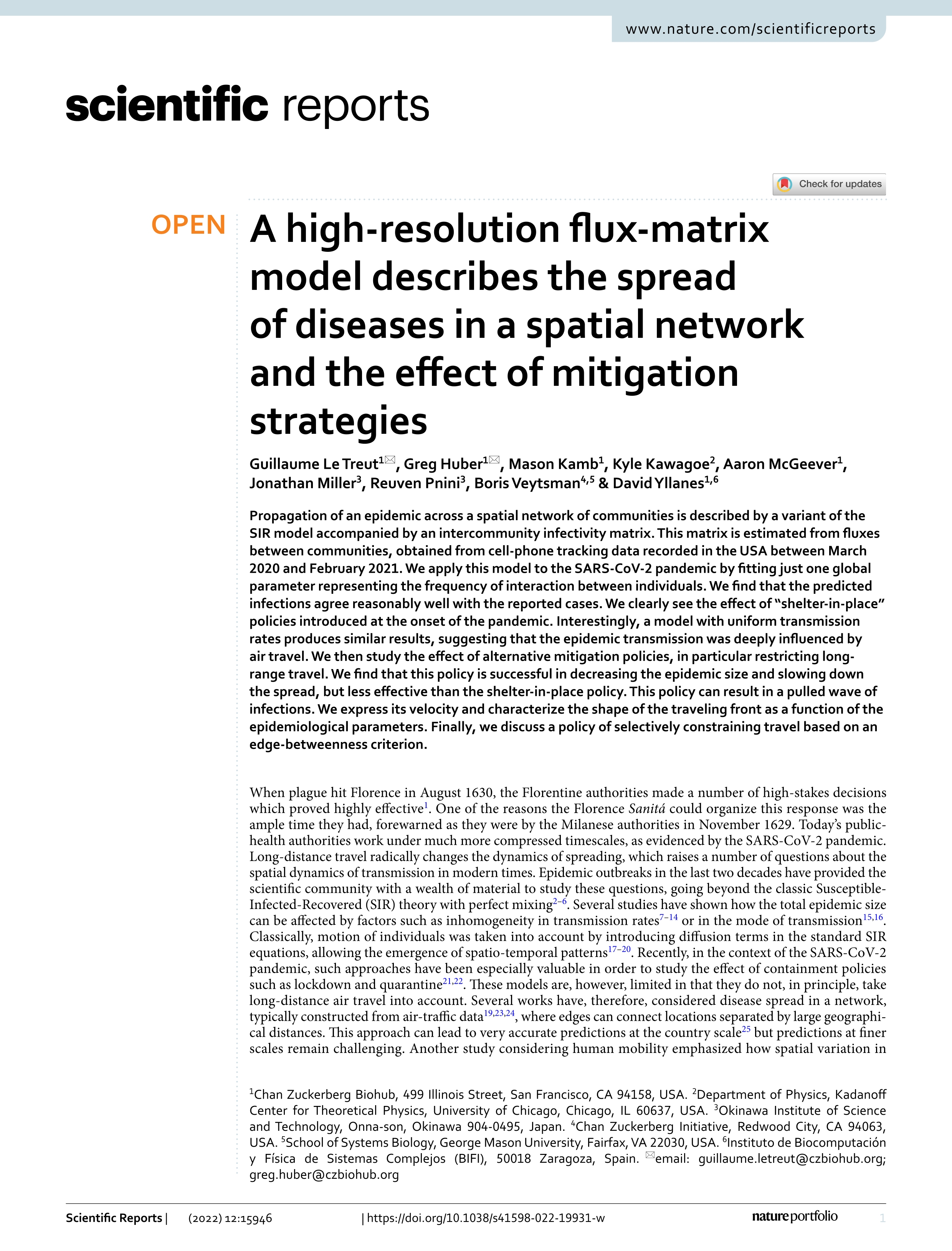
Resumen: Propagation of an epidemic across a spatial network of communities is described by a variant of the SIR model accompanied by an intercommunity infectivity matrix. This matrix is estimated from fluxes between communities, obtained from cell-phone tracking data recorded in the USA between March 2020 and February 2021. We apply this model to the SARS-CoV-2 pandemic by fitting just one global parameter representing the frequency of interaction between individuals. We find that the predicted infections agree reasonably well with the reported cases. We clearly see the effect of “shelter-in-place” policies introduced at the onset of the pandemic. Interestingly, a model with uniform transmission rates produces similar results, suggesting that the epidemic transmission was deeply influenced by air travel. We then study the effect of alternative mitigation policies, in particular restricting long-range travel. We find that this policy is successful in decreasing the epidemic size and slowing down the spread, but less effective than the shelter-in-place policy. This policy can result in a pulled wave of infections. We express its velocity and characterize the shape of the traveling front as a function of the epidemiological parameters. Finally, we discuss a policy of selectively constraining travel based on an edge-betweenness criterion.
Idioma: Inglés
DOI: 10.1038/s41598-022-19931-w
Año: 2022
Publicado en: Scientific reports (Nature Publishing Group) 12 (2022), 15946 [10 pp.]
ISSN: 2045-2322
Factor impacto JCR: 4.6 (2022)
Categ. JCR: MULTIDISCIPLINARY SCIENCES rank: 22 / 73 = 0.301 (2022) - Q2 - T1
Factor impacto CITESCORE: 7.5 - General (Q1)
Factor impacto SCIMAGO: 0.973 - Multidisciplinary (Q1)
Financiación: info:eu-repo/grantAgreement/ES/MINECO-FEDER/PGC2018-094684-B-C21
Tipo y forma: Artículo (Versión definitiva)
 Debe reconocer adecuadamente la autoría, proporcionar un enlace a la licencia e indicar si se han realizado cambios. Puede hacerlo de cualquier manera razonable, pero no de una manera que sugiera que tiene el apoyo del licenciador o lo recibe por el uso que hace.
Exportado de SIDERAL (2025-10-17-14:27:18)
Visitas y descargas
Idioma: Inglés
DOI: 10.1038/s41598-022-19931-w
Año: 2022
Publicado en: Scientific reports (Nature Publishing Group) 12 (2022), 15946 [10 pp.]
ISSN: 2045-2322
Factor impacto JCR: 4.6 (2022)
Categ. JCR: MULTIDISCIPLINARY SCIENCES rank: 22 / 73 = 0.301 (2022) - Q2 - T1
Factor impacto CITESCORE: 7.5 - General (Q1)
Factor impacto SCIMAGO: 0.973 - Multidisciplinary (Q1)
Financiación: info:eu-repo/grantAgreement/ES/MINECO-FEDER/PGC2018-094684-B-C21
Tipo y forma: Artículo (Versión definitiva)
Debe reconocer adecuadamente la autoría, proporcionar un enlace a la licencia e indicar si se han realizado cambios. Puede hacerlo de cualquier manera razonable, pero no de una manera que sugiera que tiene el apoyo del licenciador o lo recibe por el uso que hace. Exportado de SIDERAL (2025-10-17-14:27:18)
Enlace permanente:
Visitas y descargas
Este artículo se encuentra en las siguientes colecciones:
Artículos
Registro creado el 2025-03-21, última modificación el 2025-10-17