Curcuminoid-Based Responsive Surfaces for Fluorescent BF<sub>3</sub> Detection, a Fast and Reversible Approach
Gimeno-Muñoz, Raquel ; Díaz-Torres, Raúl ; Gómez-Coca, Silvia ; Roubeau, Olivier ; Díaz-Cruz, José Manuel ; Aliaga-Alcalde, Núria ; González-Campo, Arántzazu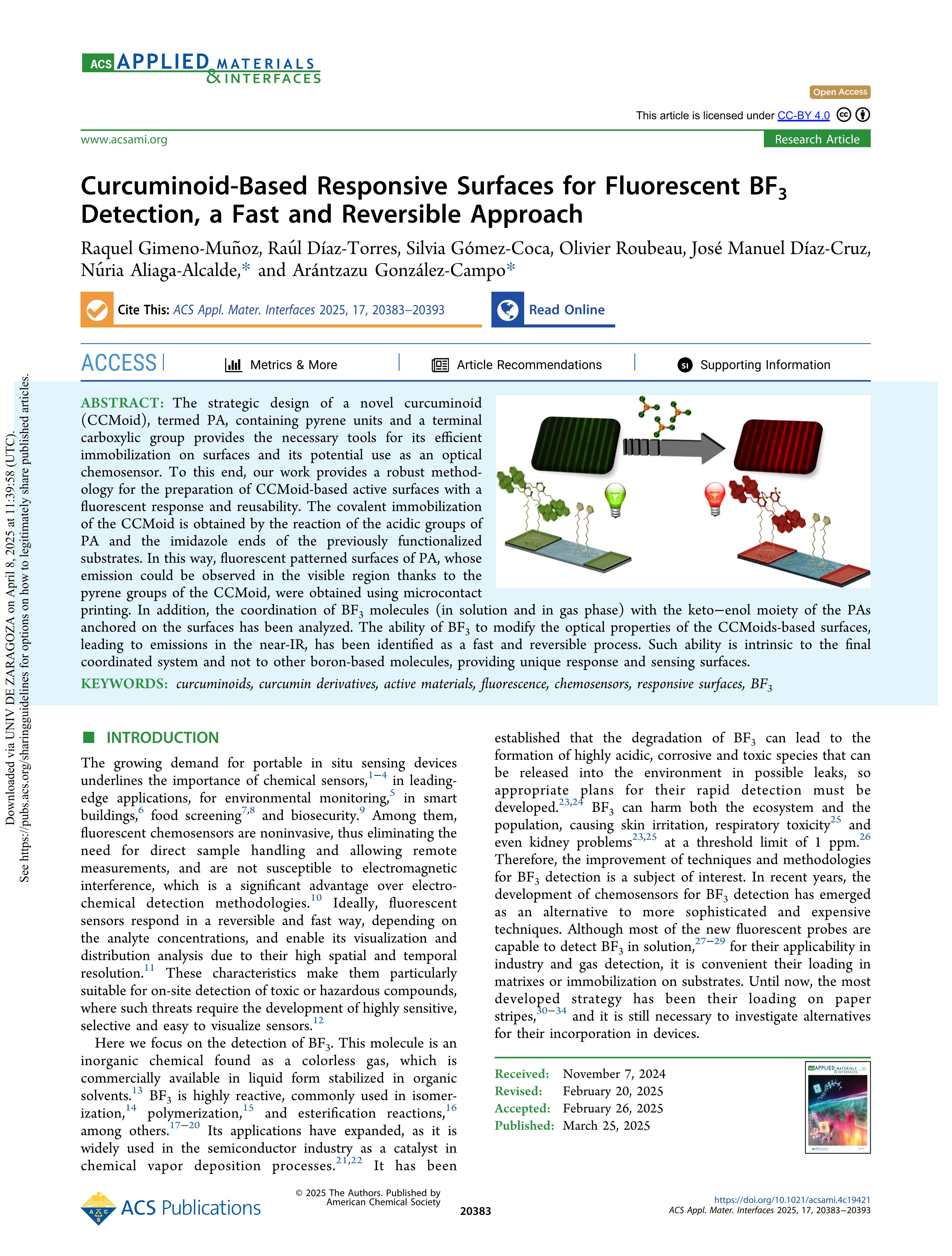
Resumen: The strategic design of a novel curcuminoid (CCMoid), termed PA, containing pyrene units and a terminal carboxylic group provides the necessary tools for its efficient immobilization on surfaces and its potential use as an optical chemosensor. To this end, our work provides a robust methodology for the preparation of CCMoid-based active surfaces with a fluorescent response and reusability. The covalent immobilization of the CCMoid is obtained by the reaction of the acidic groups of PA and the imidazole ends of the previously functionalized substrates. In this way, fluorescent patterned surfaces of PA, whose emission could be observed in the visible region thanks to the pyrene groups of the CCMoid, were obtained using microcontact printing. In addition, the coordination of BF3 molecules (in solution and in gas phase) with the keto–enol moiety of the PAs anchored on the surfaces has been analyzed. The ability of BF3 to modify the optical properties of the CCMoids-based surfaces, leading to emissions in the near-IR, has been identified as a fast and reversible process. Such ability is intrinsic to the final coordinated system and not to other boron-based molecules, providing unique response and sensing surfaces.
Idioma: Inglés
DOI: 10.1021/acsami.4c19421
Año: 2025
Publicado en: ACS applied materials & interfaces 17, 13 (2025), 20383-20393
ISSN: 1944-8244
Financiación: info:eu-repo/grantAgreement/ES/AEI/CEX2023-001263-S
Financiación: info:eu-repo/grantAgreement/ES/MICINN/CEX2021-001202-M
Financiación: info:eu-repo/grantAgreement/ES/MICINN/PID2019-1108794GB-I00
Financiación: info:eu-repo/grantAgreement/ES/MICINN/PID2021-122464NB-I00
Financiación: info:eu-repo/grantAgreement/ES/MICINN/PID2023-151929NB-I00
Tipo y forma: Artículo (Versión definitiva)
 Debe reconocer adecuadamente la autoría, proporcionar un enlace a la licencia e indicar si se han realizado cambios. Puede hacerlo de cualquier manera razonable, pero no de una manera que sugiera que tiene el apoyo del licenciador o lo recibe por el uso que hace.
Exportado de SIDERAL (2025-10-17-14:36:40)
Visitas y descargas
Idioma: Inglés
DOI: 10.1021/acsami.4c19421
Año: 2025
Publicado en: ACS applied materials & interfaces 17, 13 (2025), 20383-20393
ISSN: 1944-8244
Financiación: info:eu-repo/grantAgreement/ES/AEI/CEX2023-001263-S
Financiación: info:eu-repo/grantAgreement/ES/MICINN/CEX2021-001202-M
Financiación: info:eu-repo/grantAgreement/ES/MICINN/PID2019-1108794GB-I00
Financiación: info:eu-repo/grantAgreement/ES/MICINN/PID2021-122464NB-I00
Financiación: info:eu-repo/grantAgreement/ES/MICINN/PID2023-151929NB-I00
Tipo y forma: Artículo (Versión definitiva)
Debe reconocer adecuadamente la autoría, proporcionar un enlace a la licencia e indicar si se han realizado cambios. Puede hacerlo de cualquier manera razonable, pero no de una manera que sugiera que tiene el apoyo del licenciador o lo recibe por el uso que hace. Exportado de SIDERAL (2025-10-17-14:36:40)
Enlace permanente:
Visitas y descargas
Este artículo se encuentra en las siguientes colecciones:
Artículos
Registro creado el 2025-04-10, última modificación el 2025-10-17