Electronic Health Records: A Gateway to AI-Driven Multimorbidity Solutions—A Comprehensive Systematic Review
Ioakeim-Skoufa, Ignatios ; Cebollada-Herrera, Celeste ; Marín-Bárcena, Concepción ; Roque, Vitor ; Roque, Fátima ; Atkins, Kerry ; Hernández-Rodríguez, Miguel Ángel ; Aza-Pascual-Salcedo, Mercedes ; Fanlo-Villacampa, Ana (Universidad de Zaragoza) ; Coelho, Helena ; Lasala-Aza, Carmen ; Ledesma-Calvo, Rubén ; Gimeno-Miguel, Antonio ; Vicente-Romero, Jorge (Universidad de Zaragoza)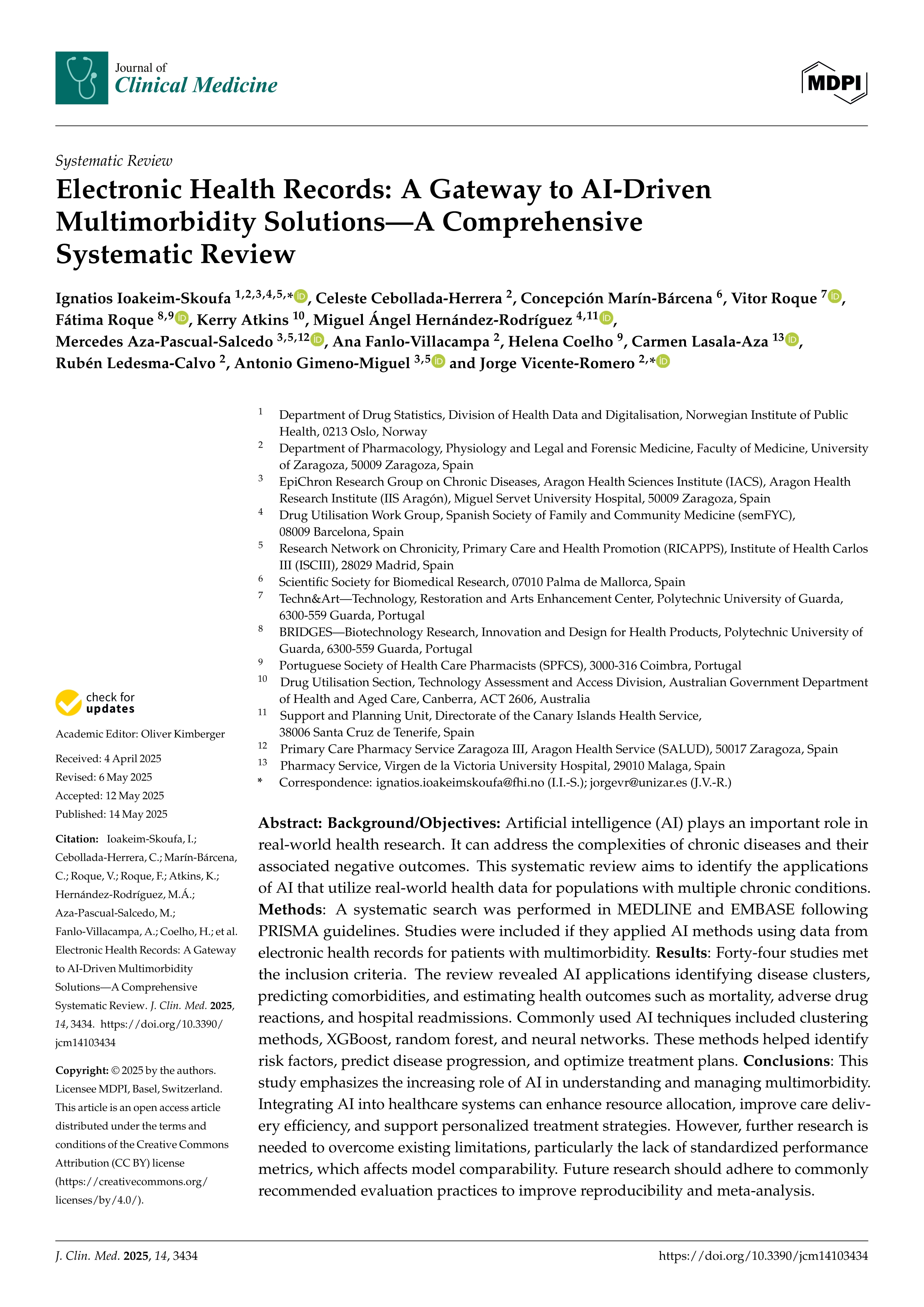
Resumen: Background/Objectives: Artificial intelligence (AI) plays an important role in real-world health research. It can address the complexities of chronic diseases and their associated negative outcomes. This systematic review aims to identify the applications of AI that utilize real-world health data for populations with multiple chronic conditions. Methods: A systematic search was performed in MEDLINE and EMBASE following PRISMA guidelines. Studies were included if they applied AI methods using data from electronic health records for patients with multimorbidity. Results: Forty-four studies met the inclusion criteria. The review revealed AI applications identifying disease clusters, predicting comorbidities, and estimating health outcomes such as mortality, adverse drug reactions, and hospital readmissions. Commonly used AI techniques included clustering methods, XGBoost, random forest, and neural networks. These methods helped identify risk factors, predict disease progression, and optimize treatment plans. Conclusions: This study emphasizes the increasing role of AI in understanding and managing multimorbidity. Integrating AI into healthcare systems can enhance resource allocation, improve care delivery efficiency, and support personalized treatment strategies. However, further research is needed to overcome existing limitations, particularly the lack of standardized performance metrics, which affects model comparability. Future research should adhere to commonly recommended evaluation practices to improve reproducibility and meta-analysis.
Idioma: Inglés
DOI: 10.3390/jcm14103434
Año: 2025
Publicado en: Journal of Clinical Medicine 14, 10 (2025), 3434 [23 pp.]
ISSN: 2077-0383
Financiación: info:eu-repo/grantAgreement/ES/DGA-FEDER/B01-23R
Financiación: info:eu-repo/grantAgreement/ES/ISCIII/RD24-0005-0013
Financiación: info:eu-repo/grantAgreement/ES/ISCIII-RICAPPS/RD21-0016-0019
Tipo y forma: Artículo (Versión definitiva)
Área (Departamento): Área Farmacología (Dpto. Farmac.Fisiol.y Med.L.F.)
 Debe reconocer adecuadamente la autoría, proporcionar un enlace a la licencia e indicar si se han realizado cambios. Puede hacerlo de cualquier manera razonable, pero no de una manera que sugiera que tiene el apoyo del licenciador o lo recibe por el uso que hace.
Exportado de SIDERAL (2025-10-17-14:11:50)
Visitas y descargas
Idioma: Inglés
DOI: 10.3390/jcm14103434
Año: 2025
Publicado en: Journal of Clinical Medicine 14, 10 (2025), 3434 [23 pp.]
ISSN: 2077-0383
Financiación: info:eu-repo/grantAgreement/ES/DGA-FEDER/B01-23R
Financiación: info:eu-repo/grantAgreement/ES/ISCIII/RD24-0005-0013
Financiación: info:eu-repo/grantAgreement/ES/ISCIII-RICAPPS/RD21-0016-0019
Tipo y forma: Artículo (Versión definitiva)
Área (Departamento): Área Farmacología (Dpto. Farmac.Fisiol.y Med.L.F.)
Debe reconocer adecuadamente la autoría, proporcionar un enlace a la licencia e indicar si se han realizado cambios. Puede hacerlo de cualquier manera razonable, pero no de una manera que sugiera que tiene el apoyo del licenciador o lo recibe por el uso que hace. Exportado de SIDERAL (2025-10-17-14:11:50)
Enlace permanente:
Visitas y descargas
Este artículo se encuentra en las siguientes colecciones:
Artículos > Artículos por área > Farmacología
Registro creado el 2025-05-20, última modificación el 2025-10-17