Dissecting the Essential Role of Anomeric ß-Triflates in Glycosylation Reactions
Santana, A.G. ; Montalvillo-Jiménez, L. ; Díaz-Casado, L. ; Corzana, F. ; Merino, P. (Universidad de Zaragoza) ; Cañada, F.J. ; Jiménez-Osés, G. ; Jiménez-Barbero, J. ; Gómez, A.M. ; Asensio, J.L.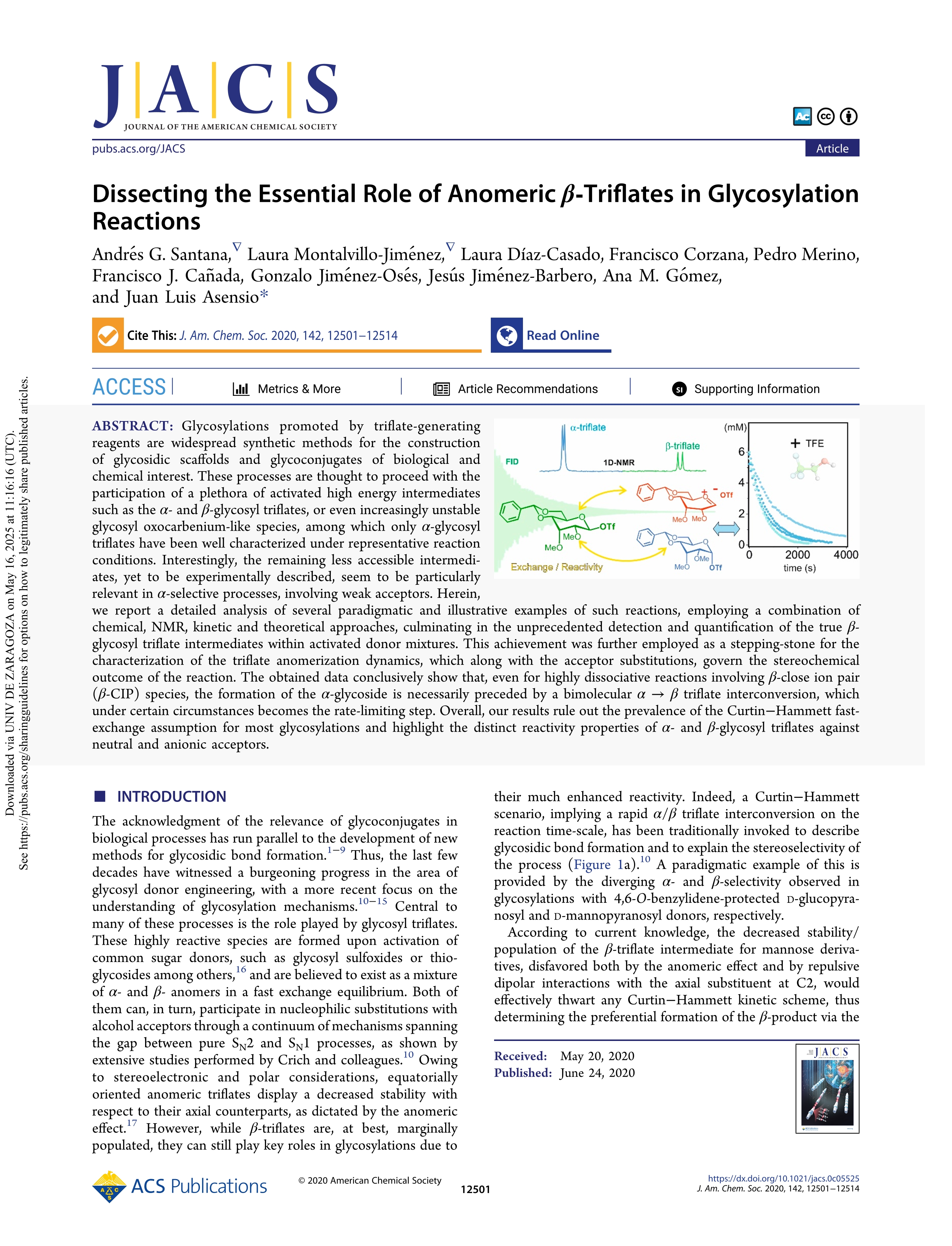
Resumen: Glycosylations promoted by triflate-generating reagents are widespread synthetic methods for the construction of glycosidic scaffolds and glycoconjugates of biological and chemical interest. These processes are thought to proceed with the participation of a plethora of activated high energy intermediates such as the a- and ß-glycosyl triflates, or even increasingly unstable glycosyl oxocarbenium-like species, among which only a-glycosyl triflates have been well characterized under representative reaction conditions. Interestingly, the remaining less accessible intermediates, yet to be experimentally described, seem to be particularly relevant in a-selective processes, involving weak acceptors. Herein, we report a detailed analysis of several paradigmatic and illustrative examples of such reactions, employing a combination of chemical, NMR, kinetic and theoretical approaches, culminating in the unprecedented detection and quantification of the true ß-glycosyl triflate intermediates within activated donor mixtures. This achievement was further employed as a stepping-stone for the characterization of the triflate anomerization dynamics, which along with the acceptor substitutions, govern the stereochemical outcome of the reaction. The obtained data conclusively show that, even for highly dissociative reactions involving ß-close ion pair (ß-CIP) species, the formation of the a-glycoside is necessarily preceded by a bimolecular a ¿ ß triflate interconversion, which under certain circumstances becomes the rate-limiting step. Overall, our results rule out the prevalence of the Curtin-Hammett fast-exchange assumption for most glycosylations and highlight the distinct reactivity properties of a- and ß-glycosyl triflates against neutral and anionic acceptors.
Idioma: Inglés
DOI: 10.1021/jacs.0c05525
Año: 2020
Publicado en: Journal of the American Chemical Society 142, 28 (2020), 12501-12514
ISSN: 0002-7863
Factor impacto JCR: 15.419 (2020)
Categ. JCR: CHEMISTRY, MULTIDISCIPLINARY rank: 15 / 178 = 0.084 (2020) - Q1 - T1
Factor impacto SCIMAGO: 7.115 - Biochemistry (Q1) - Colloid and Surface Chemistry (Q1) - Chemistry (miscellaneous) (Q1) - Catalysis (Q1)
Tipo y forma: Artículo (Versión definitiva)
Área (Departamento): Área Química Orgánica (Dpto. Química Orgánica)
 Debe reconocer adecuadamente la autoría, proporcionar un enlace a la licencia e indicar si se han realizado cambios. Puede hacerlo de cualquier manera razonable, pero no de una manera que sugiera que tiene el apoyo del licenciador o lo recibe por el uso que hace.
Exportado de SIDERAL (2025-10-17-14:14:48)
Visitas y descargas
Idioma: Inglés
DOI: 10.1021/jacs.0c05525
Año: 2020
Publicado en: Journal of the American Chemical Society 142, 28 (2020), 12501-12514
ISSN: 0002-7863
Factor impacto JCR: 15.419 (2020)
Categ. JCR: CHEMISTRY, MULTIDISCIPLINARY rank: 15 / 178 = 0.084 (2020) - Q1 - T1
Factor impacto SCIMAGO: 7.115 - Biochemistry (Q1) - Colloid and Surface Chemistry (Q1) - Chemistry (miscellaneous) (Q1) - Catalysis (Q1)
Tipo y forma: Artículo (Versión definitiva)
Área (Departamento): Área Química Orgánica (Dpto. Química Orgánica)
Debe reconocer adecuadamente la autoría, proporcionar un enlace a la licencia e indicar si se han realizado cambios. Puede hacerlo de cualquier manera razonable, pero no de una manera que sugiera que tiene el apoyo del licenciador o lo recibe por el uso que hace. Exportado de SIDERAL (2025-10-17-14:14:48)
Enlace permanente:
Visitas y descargas
Este artículo se encuentra en las siguientes colecciones:
Artículos > Artículos por área > Química Orgánica
Registro creado el 2025-05-20, última modificación el 2025-10-17