Predictive validity of the SAD PERSONS and NO HOPE scales in a sample of suicide cases
Sanz-Gómez, Sergio ; De La Vega-Sánchez, Diego ; Alacreu-Crespo, Adrián (Universidad de Zaragoza) ; Ordoñez-Carrasco, Jorge Luis (Universidad de Zaragoza) ; Perea-González, María Isabel ; Castell-Navarro, Aida ; Guija, Julio ; Giner, Lucas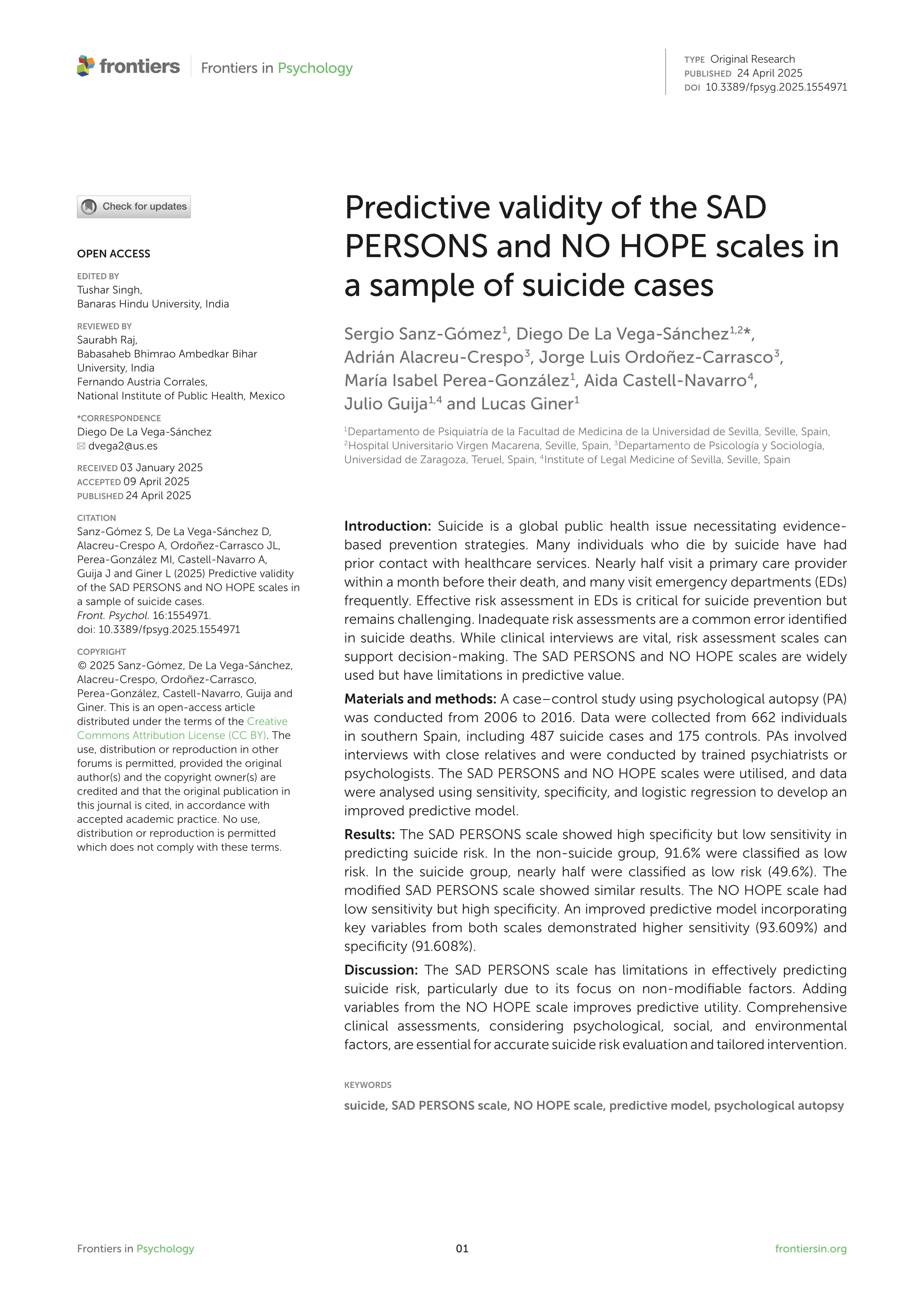
Resumen: Introduction: Suicide is a global public health issue necessitating evidence-based prevention strategies. Many individuals who die by suicide have had prior contact with healthcare services. Nearly half visit a primary care provider within a month before their death, and many visit emergency departments (EDs) frequently. Effective risk assessment in EDs is critical for suicide prevention but remains challenging. Inadequate risk assessments are a common error identified in suicide deaths. While clinical interviews are vital, risk assessment scales can support decision-making. The SAD PERSONS and NO HOPE scales are widely used but have limitations in predictive value.
Materials and methods: A case–control study using psychological autopsy (PA) was conducted from 2006 to 2016. Data were collected from 662 individuals in southern Spain, including 487 suicide cases and 175 controls. PAs involved interviews with close relatives and were conducted by trained psychiatrists or psychologists. The SAD PERSONS and NO HOPE scales were utilised, and data were analysed using sensitivity, specificity, and logistic regression to develop an improved predictive model.
Results: The SAD PERSONS scale showed high specificity but low sensitivity in predicting suicide risk. In the non-suicide group, 91.6% were classified as low risk. In the suicide group, nearly half were classified as low risk (49.6%). The modified SAD PERSONS scale showed similar results. The NO HOPE scale had low sensitivity but high specificity. An improved predictive model incorporating key variables from both scales demonstrated higher sensitivity (93.609%) and specificity (91.608%).
Discussion: The SAD PERSONS scale has limitations in effectively predicting suicide risk, particularly due to its focus on non-modifiable factors. Adding variables from the NO HOPE scale improves predictive utility. Comprehensive clinical assessments, considering psychological, social, and environmental factors, are essential for accurate suicide risk evaluation and tailored intervention.
Idioma: Inglés
DOI: 10.3389/fpsyg.2025.1554971
Año: 2025
Publicado en: Frontiers in Psychology 16 (2025), [7 pp.]
ISSN: 1664-1078
Tipo y forma: Artículo (Versión definitiva)
Área (Departamento): Área Metod.Ciencias Comportam. (Dpto. Psicología y Sociología)
Área (Departamento): Área Person.Eval.Trat.Psicoló. (Dpto. Psicología y Sociología)
 Debe reconocer adecuadamente la autoría, proporcionar un enlace a la licencia e indicar si se han realizado cambios. Puede hacerlo de cualquier manera razonable, pero no de una manera que sugiera que tiene el apoyo del licenciador o lo recibe por el uso que hace.
Exportado de SIDERAL (2025-10-17-14:18:57)
Visitas y descargas
Materials and methods: A case–control study using psychological autopsy (PA) was conducted from 2006 to 2016. Data were collected from 662 individuals in southern Spain, including 487 suicide cases and 175 controls. PAs involved interviews with close relatives and were conducted by trained psychiatrists or psychologists. The SAD PERSONS and NO HOPE scales were utilised, and data were analysed using sensitivity, specificity, and logistic regression to develop an improved predictive model.
Results: The SAD PERSONS scale showed high specificity but low sensitivity in predicting suicide risk. In the non-suicide group, 91.6% were classified as low risk. In the suicide group, nearly half were classified as low risk (49.6%). The modified SAD PERSONS scale showed similar results. The NO HOPE scale had low sensitivity but high specificity. An improved predictive model incorporating key variables from both scales demonstrated higher sensitivity (93.609%) and specificity (91.608%).
Discussion: The SAD PERSONS scale has limitations in effectively predicting suicide risk, particularly due to its focus on non-modifiable factors. Adding variables from the NO HOPE scale improves predictive utility. Comprehensive clinical assessments, considering psychological, social, and environmental factors, are essential for accurate suicide risk evaluation and tailored intervention.
Idioma: Inglés
DOI: 10.3389/fpsyg.2025.1554971
Año: 2025
Publicado en: Frontiers in Psychology 16 (2025), [7 pp.]
ISSN: 1664-1078
Tipo y forma: Artículo (Versión definitiva)
Área (Departamento): Área Metod.Ciencias Comportam. (Dpto. Psicología y Sociología)
Área (Departamento): Área Person.Eval.Trat.Psicoló. (Dpto. Psicología y Sociología)
Debe reconocer adecuadamente la autoría, proporcionar un enlace a la licencia e indicar si se han realizado cambios. Puede hacerlo de cualquier manera razonable, pero no de una manera que sugiera que tiene el apoyo del licenciador o lo recibe por el uso que hace. Exportado de SIDERAL (2025-10-17-14:18:57)
Enlace permanente:
Visitas y descargas
Este artículo se encuentra en las siguientes colecciones:
Artículos > Artículos por área > Personalidad,Evaluación y Tratamiento Psicológicos
Artículos > Artículos por área > Metod. de las Ciencias del Comportamiento
Registro creado el 2025-05-30, última modificación el 2025-10-17