Who closes first? The interaction of market structure and fall in demand in bank branch closures
Martín-Oliver, Alfredo ; Sákovics, József ; Salas-Fumás, Vicente (Universidad de Zaragoza)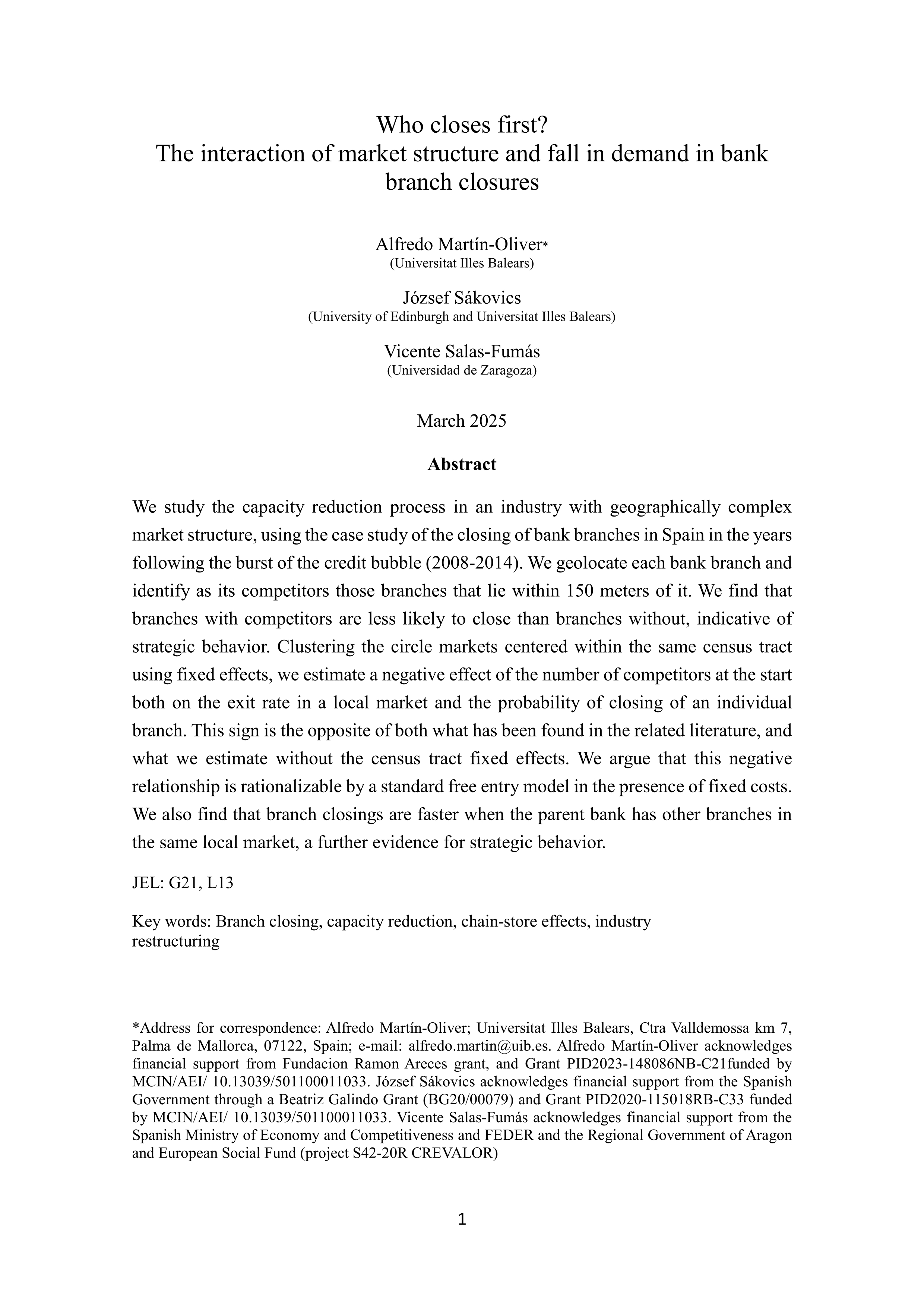
Resumen: We study the capacity reduction process in an industry with geographically complex market structure, using the case study of the closing of bank branches in Spain in the years following the burst of the credit bubble (2008–14). We geolocate each bank branch and identify as its competitors those branches that lie within 150 metres of it. We find that branches with competitors are less likely to close than branches without, indicative of strategic behaviour. Clustering the circle markets centred within the same census tract using fixed effects, we estimate a negative effect of the number of competitors at the start on both the exit rate in a local market and the probability of closing of an individual branch. This sign is the opposite of both what has been found in the related literature, and what we estimate without the census tract fixed effects. We argue that this negative relationship is rationalizable by a standard free entry model in the presence of fixed costs. We also find that branch closings are faster when the parent bank has other branches in the same local market, which is further evidence for strategic behaviour.
Idioma: Inglés
DOI: 10.1111/ecca.12579
Año: 2025
Publicado en: ECONOMICA (2025), 701-728
ISSN: 0013-0427
Tipo y forma: Artículo (PostPrint)
Área (Departamento): Área Organización de Empresas (Dpto. Direcc.Organiza.Empresas)
 Derechos reservados por el editor de la revista
Exportado de SIDERAL (2025-10-17-14:18:58)
Visitas y descargas
Idioma: Inglés
DOI: 10.1111/ecca.12579
Año: 2025
Publicado en: ECONOMICA (2025), 701-728
ISSN: 0013-0427
Tipo y forma: Artículo (PostPrint)
Área (Departamento): Área Organización de Empresas (Dpto. Direcc.Organiza.Empresas)
Derechos reservados por el editor de la revistaExportado de SIDERAL (2025-10-17-14:18:58)
Enlace permanente:
Visitas y descargas
Este artículo se encuentra en las siguientes colecciones:
Artículos > Artículos por área > Organización de Empresas
Registro creado el 2025-06-12, última modificación el 2025-10-17