What Shapes Quality of Life in Youth? A Multidimensional Approach from Lifestyle to Residential Context—Cor-School Study
Pano-Rodriguez, Alvaro ; Aixa-Requena, Saül ; Beltran-Garrido, Jose Vicente ; Batalla-Gavaldà, Abraham ; Hernández-González, Vicenç ; Conesa-Milian, Enric ; López-Laval, Isaac (Universidad de Zaragoza) ; Reverter-Masia, Joaquin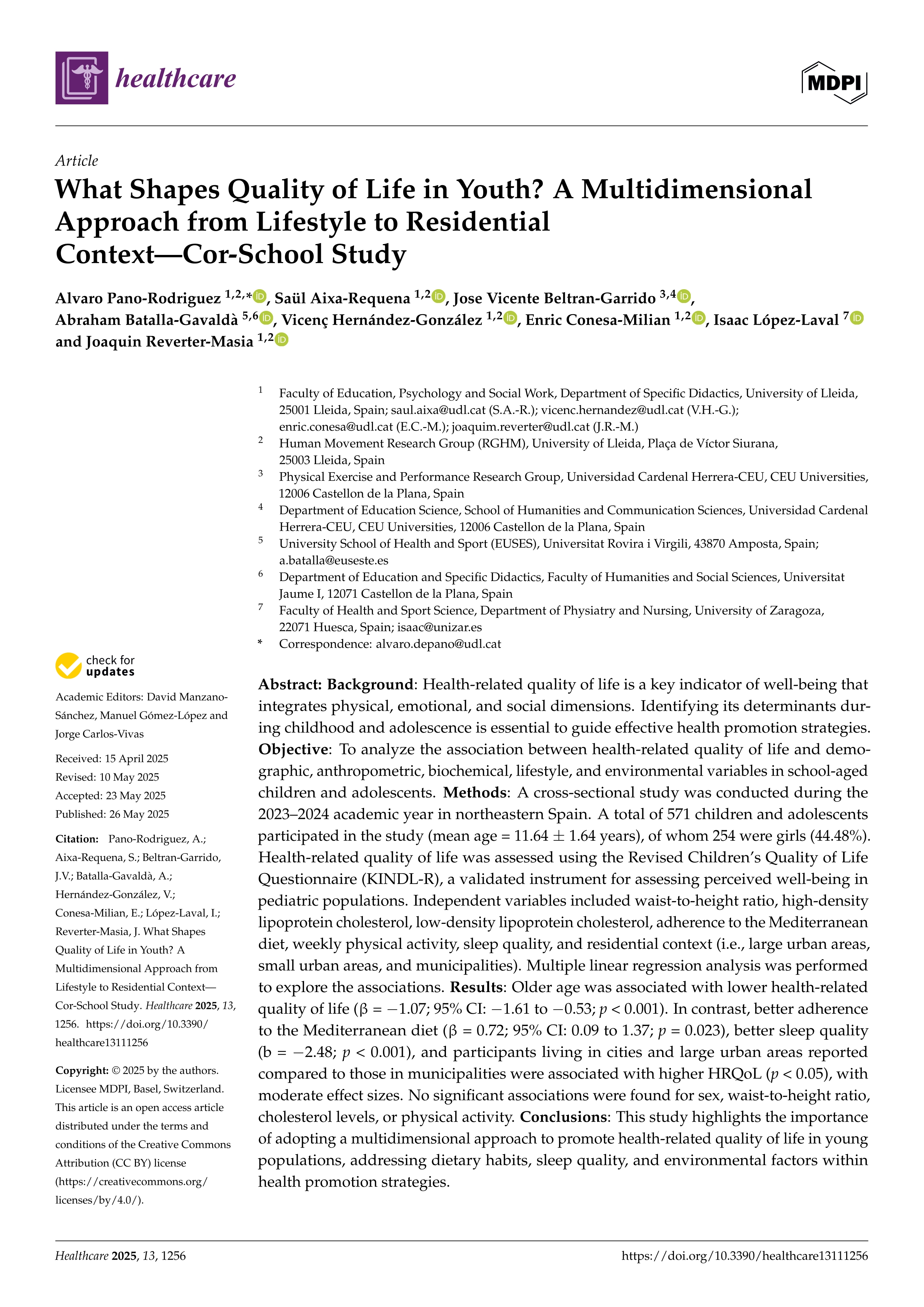
Resumen: Background: Health-related quality of life is a key indicator of well-being that integrates physical, emotional, and social dimensions. Identifying its determinants during childhood and adolescence is essential to guide effective health promotion strategies. Objective: To analyze the association between health-related quality of life and demographic, anthropometric, biochemical, lifestyle, and environmental variables in school-aged children and adolescents. Methods: A cross-sectional study was conducted during the 2023–2024 academic year in northeastern Spain. A total of 571 children and adolescents participated in the study (mean age = 11.64 ± 1.64 years), of whom 254 were girls (44.48%). Health-related quality of life was assessed using the Revised Children’s Quality of Life Questionnaire (KINDL-R), a validated instrument for assessing perceived well-being in pediatric populations. Independent variables included waist-to-height ratio, high-density lipoprotein cholesterol, low-density lipoprotein cholesterol, adherence to the Mediterranean diet, weekly physical activity, sleep quality, and residential context (i.e., large urban areas, small urban areas, and municipalities). Multiple linear regression analysis was performed to explore the associations. Results: Older age was associated with lower health-related quality of life (β = −1.07; 95% CI: −1.61 to −0.53; p < 0.001). In contrast, better adherence to the Mediterranean diet (β = 0.72; 95% CI: 0.09 to 1.37; p = 0.023), better sleep quality (b = −2.48; p < 0.001), and participants living in cities and large urban areas reported compared to those in municipalities were associated with higher HRQoL (p < 0.05), with moderate effect sizes. No significant associations were found for sex, waist-to-height ratio, cholesterol levels, or physical activity. Conclusions: This study highlights the importance of adopting a multidimensional approach to promote health-related quality of life in young populations, addressing dietary habits, sleep quality, and environmental factors within health promotion strategies.
Idioma: Inglés
DOI: 10.3390/healthcare13111256
Año: 2025
Publicado en: Healthcare (Switzerland) 13, 11 (2025), 1256 [14 pp.]
ISSN: 2227-9032
Financiación: info:eu-repo/grantAgreement/ES/AEI/PID2020-117932RB-I00
Tipo y forma: Artículo (Versión definitiva)
Área (Departamento): Área Educación Física y Depor. (Dpto. Fisiatría y Enfermería)
 Debe reconocer adecuadamente la autoría, proporcionar un enlace a la licencia e indicar si se han realizado cambios. Puede hacerlo de cualquier manera razonable, pero no de una manera que sugiera que tiene el apoyo del licenciador o lo recibe por el uso que hace.
Exportado de SIDERAL (2025-10-17-14:25:00)
Visitas y descargas
Idioma: Inglés
DOI: 10.3390/healthcare13111256
Año: 2025
Publicado en: Healthcare (Switzerland) 13, 11 (2025), 1256 [14 pp.]
ISSN: 2227-9032
Financiación: info:eu-repo/grantAgreement/ES/AEI/PID2020-117932RB-I00
Tipo y forma: Artículo (Versión definitiva)
Área (Departamento): Área Educación Física y Depor. (Dpto. Fisiatría y Enfermería)
Debe reconocer adecuadamente la autoría, proporcionar un enlace a la licencia e indicar si se han realizado cambios. Puede hacerlo de cualquier manera razonable, pero no de una manera que sugiera que tiene el apoyo del licenciador o lo recibe por el uso que hace. Exportado de SIDERAL (2025-10-17-14:25:00)
Enlace permanente:
Visitas y descargas
Este artículo se encuentra en las siguientes colecciones:
Artículos > Artículos por área > Educación Física y Deportiva
Registro creado el 2025-06-19, última modificación el 2025-10-17