Adherence to a healthy lifestyle behavior composite score and cardiometabolic risk factors in Spanish children from the CORALS cohort
Garcidueñas-Fimbres, Tany E. ; Gómez-Martínez, Carlos ; Pascual-Compte, Maria ; Jurado-Castro, Jose Manuel ; Leis, Rosaura ; Moreno, Luis A. (Universidad de Zaragoza) ; Navas-Carretero, Santiago ; Codoñer-Franch, Pilar ; Echeverria, Ana Moreira ; Pastor-Villaescusa, Belén ; López-Rubio, Alicia ; García, Sara Moroño ; De Miguel-Etayo, Pilar (Universidad de Zaragoza) ; Martínez, J. Alfredo ; Aguayo, Inmaculada Velasco ; Vázquez-Cobela, Rocío ; Escribano, Joaquín ; Miguel-Berges, María Luisa ; De La Torre-Aguilar, María José ; Gil-Campos, Mercedes ; Salas-Salvadó, Jordi ; Babio, Nancy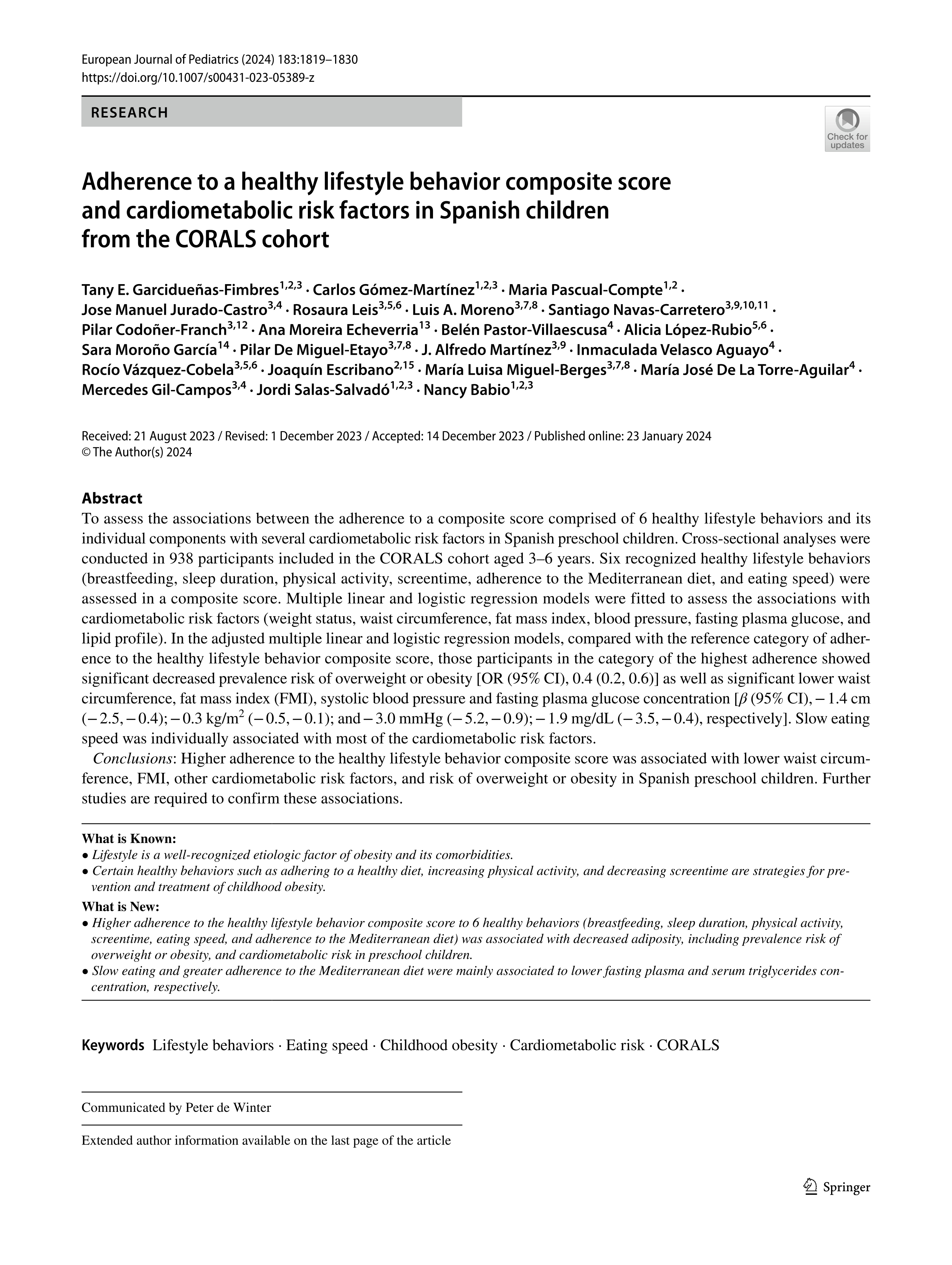
Resumen: To assess the associations between the adherence to a composite score comprised of 6 healthy lifestyle behaviors and its individual components with several cardiometabolic risk factors in Spanish preschool children. Cross-sectional analyses were conducted in 938 participants included in the CORALS cohort aged 3–6 years. Six recognized healthy lifestyle behaviors (breastfeeding, sleep duration, physical activity, screentime, adherence to the Mediterranean diet, and eating speed) were assessed in a composite score. Multiple linear and logistic regression models were fitted to assess the associations with cardiometabolic risk factors (weight status, waist circumference, fat mass index, blood pressure, fasting plasma glucose, and lipid profile). In the adjusted multiple linear and logistic regression models, compared with the reference category of adherence to the healthy lifestyle behavior composite score, those participants in the category of the highest adherence showed significant decreased prevalence risk of overweight or obesity [OR (95% CI), 0.4 (0.2, 0.6)] as well as significant lower waist circumference, fat mass index (FMI), systolic blood pressure and fasting plasma glucose concentration [β (95% CI), − 1.4 cm (− 2.5, − 0.4); − 0.3 kg/m2 (− 0.5, − 0.1); and − 3.0 mmHg (− 5.2, − 0.9); − 1.9 mg/dL (− 3.5, − 0.4), respectively]. Slow eating speed was individually associated with most of the cardiometabolic risk factors. Conclusions: Higher adherence to the healthy lifestyle behavior composite score was associated with lower waist circumference, FMI, other cardiometabolic risk factors, and risk of overweight or obesity in Spanish preschool children. Further studies are required to confirm these associations.
To assess the associations between the adherence to a composite score comprised of 6 healthy lifestyle behaviors and its individual components with several cardiometabolic risk factors in Spanish preschool children. Cross-sectional analyses were conducted in 938 participants included in the CORALS cohort aged 3–6 years. Six recognized healthy lifestyle behaviors (breastfeeding, sleep duration, physical activity, screentime, adherence to the Mediterranean diet, and eating speed) were assessed in a composite score. Multiple linear and logistic regression models were fitted to assess the associations with cardiometabolic risk factors (weight status, waist circumference, fat mass index, blood pressure, fasting plasma glucose, and lipid profile). In the adjusted multiple linear and logistic regression models, compared with the reference category of adherence to the healthy lifestyle behavior composite score, those participants in the category of the highest adherence showed significant decreased prevalence risk of overweight or obesity [OR (95% CI), 0.4 (0.2, 0.6)] as well as significant lower waist circumference, fat mass index (FMI), systolic blood pressure and fasting plasma glucose concentration [β (95% CI), − 1.4 cm (− 2.5, − 0.4); − 0.3 kg/m2 (− 0.5, − 0.1); and − 3.0 mmHg (− 5.2, − 0.9); − 1.9 mg/dL (− 3.5, − 0.4), respectively]. Slow eating speed was individually associated with most of the cardiometabolic risk factors.
Conclusions: Higher adherence to the healthy lifestyle behavior composite score was associated with lower waist circumference, FMI, other cardiometabolic risk factors, and risk of overweight or obesity in Spanish preschool children. Further studies are required to confirm these associations.
Idioma: Inglés
DOI: 10.1007/s00431-023-05389-z
Año: 2024
Publicado en: European Journal of Pediatrics 183, 4 (2024), 1819-1830
ISSN: 0340-6199
Factor impacto JCR: 2.6 (2024)
Categ. JCR: PEDIATRICS rank: 37 / 191 = 0.194 (2024) - Q1 - T1
Factor impacto CITESCORE: 5.9 - Pediatrics, Perinatology and Child Health (Q1)
Factor impacto SCIMAGO: 0.934 - Pediatrics, Perinatology and Child Health (Q1)
Tipo y forma: Artículo (Versión definitiva)
Área (Departamento): Área Enfermería (Dpto. Fisiatría y Enfermería)
Área (Departamento): Área Medic.Prevent.Salud Públ. (Dpto. Microb.Ped.Radio.Sal.Pú.)
 Debe reconocer adecuadamente la autoría, proporcionar un enlace a la licencia e indicar si se han realizado cambios. Puede hacerlo de cualquier manera razonable, pero no de una manera que sugiera que tiene el apoyo del licenciador o lo recibe por el uso que hace.
Exportado de SIDERAL (2026-02-17-20:18:16)
Visitas y descargas
To assess the associations between the adherence to a composite score comprised of 6 healthy lifestyle behaviors and its individual components with several cardiometabolic risk factors in Spanish preschool children. Cross-sectional analyses were conducted in 938 participants included in the CORALS cohort aged 3–6 years. Six recognized healthy lifestyle behaviors (breastfeeding, sleep duration, physical activity, screentime, adherence to the Mediterranean diet, and eating speed) were assessed in a composite score. Multiple linear and logistic regression models were fitted to assess the associations with cardiometabolic risk factors (weight status, waist circumference, fat mass index, blood pressure, fasting plasma glucose, and lipid profile). In the adjusted multiple linear and logistic regression models, compared with the reference category of adherence to the healthy lifestyle behavior composite score, those participants in the category of the highest adherence showed significant decreased prevalence risk of overweight or obesity [OR (95% CI), 0.4 (0.2, 0.6)] as well as significant lower waist circumference, fat mass index (FMI), systolic blood pressure and fasting plasma glucose concentration [β (95% CI), − 1.4 cm (− 2.5, − 0.4); − 0.3 kg/m2 (− 0.5, − 0.1); and − 3.0 mmHg (− 5.2, − 0.9); − 1.9 mg/dL (− 3.5, − 0.4), respectively]. Slow eating speed was individually associated with most of the cardiometabolic risk factors.
Conclusions: Higher adherence to the healthy lifestyle behavior composite score was associated with lower waist circumference, FMI, other cardiometabolic risk factors, and risk of overweight or obesity in Spanish preschool children. Further studies are required to confirm these associations.
Idioma: Inglés
DOI: 10.1007/s00431-023-05389-z
Año: 2024
Publicado en: European Journal of Pediatrics 183, 4 (2024), 1819-1830
ISSN: 0340-6199
Factor impacto JCR: 2.6 (2024)
Categ. JCR: PEDIATRICS rank: 37 / 191 = 0.194 (2024) - Q1 - T1
Factor impacto CITESCORE: 5.9 - Pediatrics, Perinatology and Child Health (Q1)
Factor impacto SCIMAGO: 0.934 - Pediatrics, Perinatology and Child Health (Q1)
Tipo y forma: Artículo (Versión definitiva)
Área (Departamento): Área Enfermería (Dpto. Fisiatría y Enfermería)
Área (Departamento): Área Medic.Prevent.Salud Públ. (Dpto. Microb.Ped.Radio.Sal.Pú.)
Debe reconocer adecuadamente la autoría, proporcionar un enlace a la licencia e indicar si se han realizado cambios. Puede hacerlo de cualquier manera razonable, pero no de una manera que sugiera que tiene el apoyo del licenciador o lo recibe por el uso que hace. Exportado de SIDERAL (2026-02-17-20:18:16)
Enlace permanente:
Visitas y descargas
Este artículo se encuentra en las siguientes colecciones:
Artículos > Artículos por área > Medicina Preventiva y Salud Pública
Artículos > Artículos por área > Enfermería
Registro creado el 2025-07-02, última modificación el 2026-02-17