Self-Perceived Fitness in Young Athletes: Associations with Anthropometric Markers and Lipid Profile as Cardiometabolic Risk Factors—COR-SCHOOL Study
Pano-Rodriguez, Alvaro ; Aixa-Requena, Saül ; Batalla-Gavaldà, Abraham ; Beltran-Garrido, Jose Vicente ; López-Laval, Isaac (Universidad de Zaragoza) ; Hernández-González, Vicenç ; Jové-Deltell, Carme ; Conesa-Milian, Enric ; Reverter-Masia, Joaquin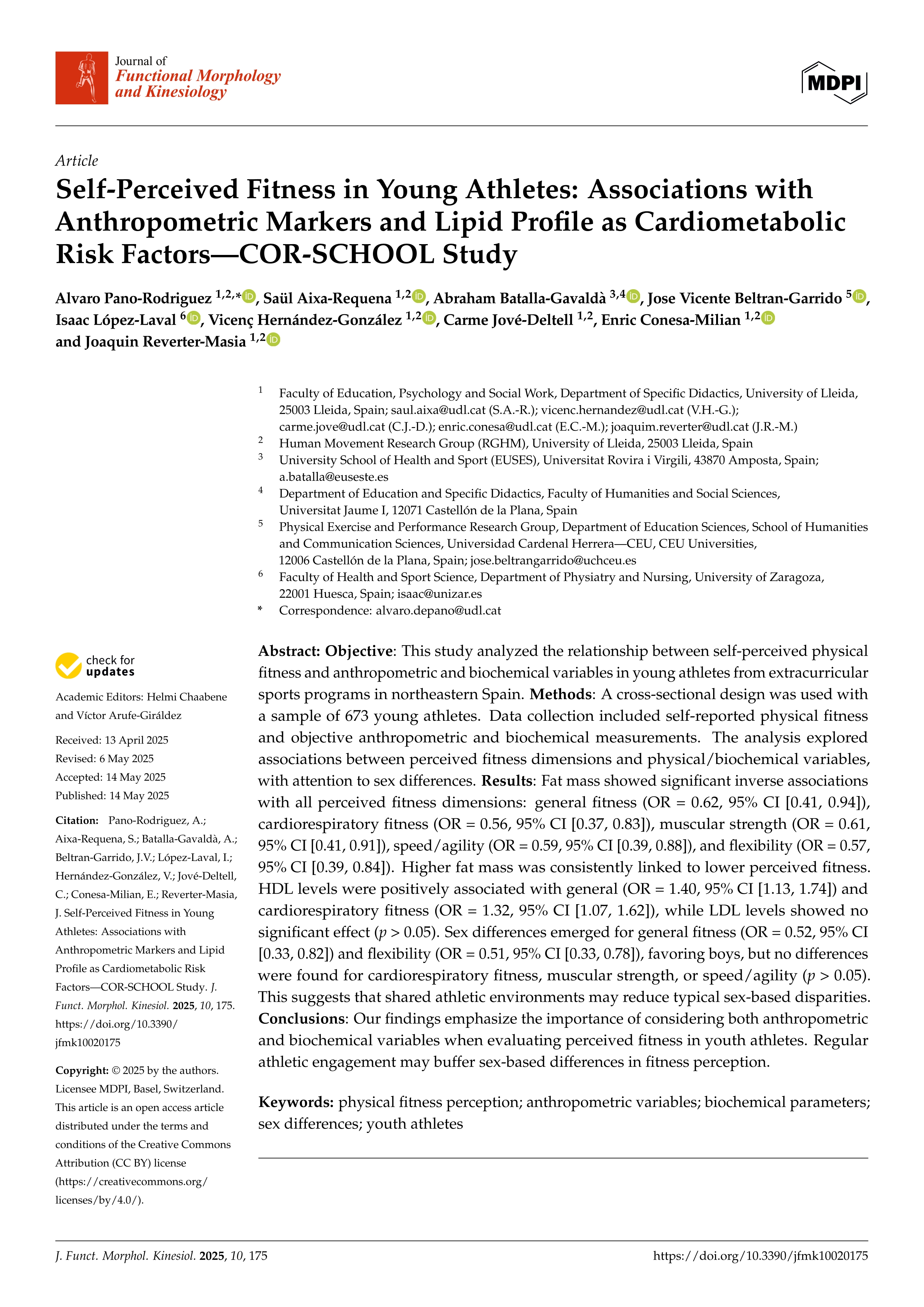
Resumen: Objective: This study analyzed the relationship between self-perceived physical fitness and anthropometric and biochemical variables in young athletes from extracurricular sports programs in northeastern Spain. Methods: A cross-sectional design was used with a sample of 673 young athletes. Data collection included self-reported physical fitness and objective anthropometric and biochemical measurements. The analysis explored associations between perceived fitness dimensions and physical/biochemical variables, with attention to sex differences. Results: Fat mass showed significant inverse associations with all perceived fitness dimensions: general fitness (OR = 0.62, 95% CI [0.41, 0.94]), cardiorespiratory fitness (OR = 0.56, 95% CI [0.37, 0.83]), muscular strength (OR = 0.61, 95% CI [0.41, 0.91]), speed/agility (OR = 0.59, 95% CI [0.39, 0.88]), and flexibility (OR = 0.57, 95% CI [0.39, 0.84]). Higher fat mass was consistently linked to lower perceived fitness. HDL levels were positively associated with general (OR = 1.40, 95% CI [1.13, 1.74]) and cardiorespiratory fitness (OR = 1.32, 95% CI [1.07, 1.62]), while LDL levels showed no significant effect (p > 0.05). Sex differences emerged for general fitness (OR = 0.52, 95% CI [0.33, 0.82]) and flexibility (OR = 0.51, 95% CI [0.33, 0.78]), favoring boys, but no differences were found for cardiorespiratory fitness, muscular strength, or speed/agility (p > 0.05). This suggests that shared athletic environments may reduce typical sex-based disparities. Conclusions: Our findings emphasize the importance of considering both anthropometric and biochemical variables when evaluating perceived fitness in youth athletes. Regular athletic engagement may buffer sex-based differences in fitness perception.
Idioma: Inglés
DOI: 10.3390/jfmk10020175
Año: 2025
Publicado en: Journal of Functional Morphology and Kinesiology 10, 2 (2025), 175
ISSN: 2411-5142
Financiación: info:eu-repo/grantAgreement/ES/AEI/PID2020-117932RB-I00
Tipo y forma: Artículo (Versión definitiva)
Área (Departamento): Área Educación Física y Depor. (Dpto. Fisiatría y Enfermería)
 Debe reconocer adecuadamente la autoría, proporcionar un enlace a la licencia e indicar si se han realizado cambios. Puede hacerlo de cualquier manera razonable, pero no de una manera que sugiera que tiene el apoyo del licenciador o lo recibe por el uso que hace.
Exportado de SIDERAL (2025-10-17-14:20:49)
Visitas y descargas
Idioma: Inglés
DOI: 10.3390/jfmk10020175
Año: 2025
Publicado en: Journal of Functional Morphology and Kinesiology 10, 2 (2025), 175
ISSN: 2411-5142
Financiación: info:eu-repo/grantAgreement/ES/AEI/PID2020-117932RB-I00
Tipo y forma: Artículo (Versión definitiva)
Área (Departamento): Área Educación Física y Depor. (Dpto. Fisiatría y Enfermería)
Debe reconocer adecuadamente la autoría, proporcionar un enlace a la licencia e indicar si se han realizado cambios. Puede hacerlo de cualquier manera razonable, pero no de una manera que sugiera que tiene el apoyo del licenciador o lo recibe por el uso que hace. Exportado de SIDERAL (2025-10-17-14:20:49)
Enlace permanente:
Visitas y descargas
Este artículo se encuentra en las siguientes colecciones:
Artículos > Artículos por área > Educación Física y Deportiva
Registro creado el 2025-07-10, última modificación el 2025-10-17