Rational design of EV-Mimicking nanoparticles with polarity-based recognition potential for advanced nanocarrier development
Rosso, Giada ; Van Veen, Stijn M.A. ; Sancho-Albero, María (Universidad de Zaragoza) ; Tamboia, Giulia ; Empereur-Mot, Charly ; Perego, Claudio ; Kuipers, Marije E. ; Dumontel, Bianca ; Ajó, Alessandro ; Nolte-’t Hoen, Esther N. ; Pavan, Giovanni M. ; Cola, Luisa De ; Albertazzi, Lorenzo ; Cauda, Valentina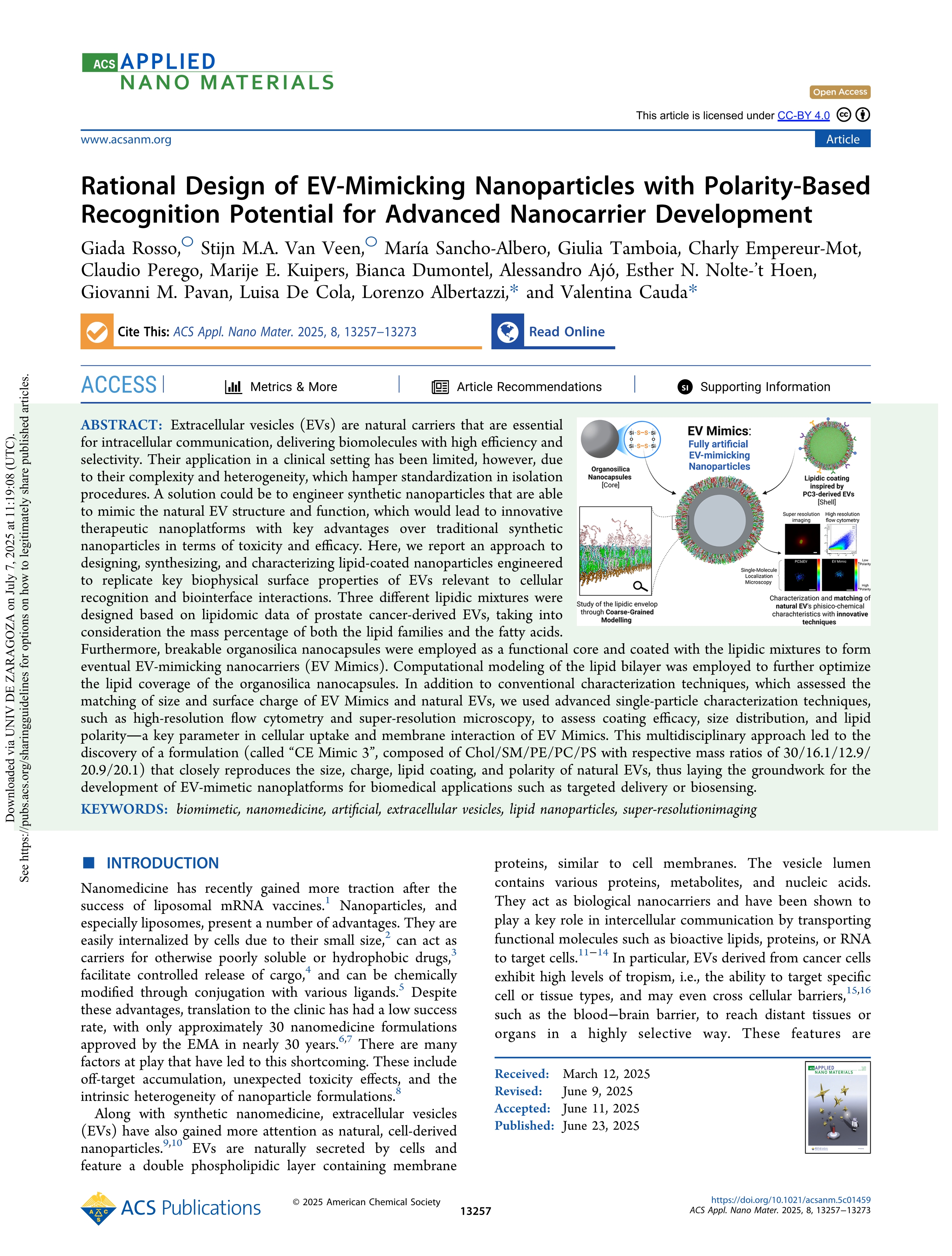
Resumen: Extracellular vesicles (EVs) are natural carriers that are essential for intracellular communication, delivering biomolecules with high efficiency and selectivity. Their application in a clinical setting has been limited, however, due to their complexity and heterogeneity, which hamper standardization in isolation procedures. A solution could be to engineer synthetic nanoparticles that are able to mimic the natural EV structure and function, which would lead to innovative therapeutic nanoplatforms with key advantages over traditional synthetic nanoparticles in terms of toxicity and efficacy. Here, we report an approach to designing, synthesizing, and characterizing lipid-coated nanoparticles engineered to replicate key biophysical surface properties of EVs relevant to cellular recognition and biointerface interactions. Three different lipidic mixtures were designed based on lipidomic data of prostate cancer-derived EVs, taking into consideration the mass percentage of both the lipid families and the fatty acids. Furthermore, breakable organosilica nanocapsules were employed as a functional core and coated with the lipidic mixtures to form eventual EV-mimicking nanocarriers (EV Mimics). Computational modeling of the lipid bilayer was employed to further optimize the lipid coverage of the organosilica nanocapsules. In addition to conventional characterization techniques, which assessed the matching of size and surface charge of EV Mimics and natural EVs, we used advanced single-particle characterization techniques, such as high-resolution flow cytometry and super-resolution microscopy, to assess coating efficacy, size distribution, and lipid polarity─a key parameter in cellular uptake and membrane interaction of EV Mimics. This multidisciplinary approach led to the discovery of a formulation (called “CE Mimic 3”, composed of Chol/SM/PE/PC/PS with respective mass ratios of 30/16.1/12.9/20.9/20.1) that closely reproduces the size, charge, lipid coating, and polarity of natural EVs, thus laying the groundwork for the development of EV-mimetic nanoplatforms for biomedical applications such as targeted delivery or biosensing.
Idioma: Inglés
DOI: 10.1021/acsanm.5c01459
Año: 2025
Publicado en: ACS APPLIED NANO MATERIALS 8, 26 (2025), 13257-13273
ISSN: 2574-0970
Tipo y forma: Artículo (Versión definitiva)
Área (Departamento): Área Ingeniería Química (Dpto. Ing.Quím.Tecnol.Med.Amb.)
 Debe reconocer adecuadamente la autoría, proporcionar un enlace a la licencia e indicar si se han realizado cambios. Puede hacerlo de cualquier manera razonable, pero no de una manera que sugiera que tiene el apoyo del licenciador o lo recibe por el uso que hace.
Exportado de SIDERAL (2025-10-17-14:33:10)
Visitas y descargas
Idioma: Inglés
DOI: 10.1021/acsanm.5c01459
Año: 2025
Publicado en: ACS APPLIED NANO MATERIALS 8, 26 (2025), 13257-13273
ISSN: 2574-0970
Tipo y forma: Artículo (Versión definitiva)
Área (Departamento): Área Ingeniería Química (Dpto. Ing.Quím.Tecnol.Med.Amb.)
Debe reconocer adecuadamente la autoría, proporcionar un enlace a la licencia e indicar si se han realizado cambios. Puede hacerlo de cualquier manera razonable, pero no de una manera que sugiera que tiene el apoyo del licenciador o lo recibe por el uso que hace. Exportado de SIDERAL (2025-10-17-14:33:10)
Enlace permanente:
Visitas y descargas
Este artículo se encuentra en las siguientes colecciones:
Artículos > Artículos por área > Ingeniería Química
Registro creado el 2025-07-10, última modificación el 2025-10-17