Serum-Based Detection of Pancreatic and Ovarian Cancer via a Nanoparticle-Enhanced Fluorescence Array and Machine Learning
Morcuende-Ventura, Violeta ; Sánchez-Gracia, Oscar ; Abian-Franco, Natalia ; Jiménez-Pardo, Isabel ; Herrer, Lucía ; Castillo-Vallés, Martín ; Lancelot, Alexandre ; Falcó-Martí, F. Javier (Universidad de Zaragoza) ; Hermoso-Durán, Sonia ; Pazo-Cid, Roberto (Universidad de Zaragoza) ; Lanas, Ángel (Universidad de Zaragoza) ; Velazquez-Campoy, Adrián (Universidad de Zaragoza) ; Sierra, Teresa ; Abian, Olga (Universidad de Zaragoza)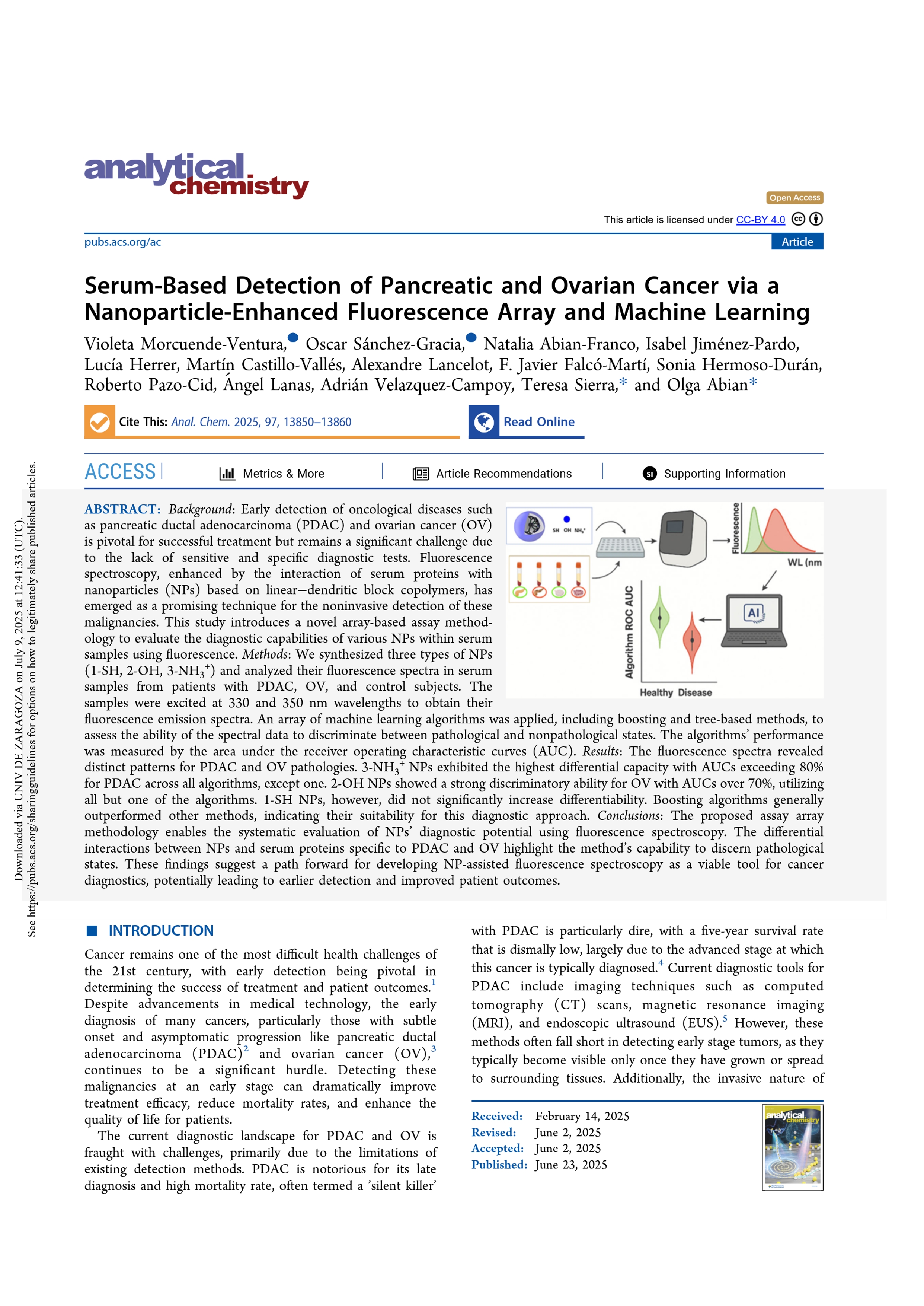
Resumen: Early detection of oncological diseases such as pancreatic ductal adenocarcinoma (PDAC) and ovarian cancer (OV) is pivotal for successful treatment but remains a significant challenge due to the lack of sensitive and specific diagnostic tests. Fluorescence spectroscopy, enhanced by the interaction of serum proteins with nanoparticles (NPs) based on linear–dendritic block copolymers, has emerged as a promising technique for the noninvasive detection of these malignancies. This study introduces a novel array-based assay methodology to evaluate the diagnostic capabilities of various NPs within serum samples using fluorescence. Methods: We synthesized three types of NPs (1-SH, 2-OH, 3-NH3+) and analyzed their fluorescence spectra in serum samples from patients with PDAC, OV, and control subjects. The samples were excited at 330 and 350 nm wavelengths to obtain their fluorescence emission spectra. An array of machine learning algorithms was applied, including boosting and tree-based methods, to assess the ability of the spectral data to discriminate between pathological and nonpathological states. The algorithms’ performance was measured by the area under the receiver operating characteristic curves (AUC). Results: The fluorescence spectra revealed distinct patterns for PDAC and OV pathologies. 3-NH3+ NPs exhibited the highest differential capacity with AUCs exceeding 80% for PDAC across all algorithms, except one. 2-OH NPs showed a strong discriminatory ability for OV with AUCs over 70%, utilizing all but one of the algorithms. 1-SH NPs, however, did not significantly increase differentiability. Boosting algorithms generally outperformed other methods, indicating their suitability for this diagnostic approach. Conclusions: The proposed assay array methodology enables the systematic evaluation of NPs’ diagnostic potential using fluorescence spectroscopy. The differential interactions between NPs and serum proteins specific to PDAC and OV highlight the method’s capability to discern pathological states. These findings suggest a path forward for developing NP-assisted fluorescence spectroscopy as a viable tool for cancer diagnostics, potentially leading to earlier detection and improved patient outcomes.
Idioma: Inglés
DOI: 10.1021/acs.analchem.5c00974
Año: 2025
Publicado en: ANALYTICAL CHEMISTRY 97 (2025), 11 pp.
ISSN: 0003-2700
Financiación: info:eu-repo/grantAgreement/ES/AEI/PID2021-127296OB-I00
Financiación: info:eu-repo/grantAgreement/ES/DGA/B08-24R
Financiación: info:eu-repo/grantAgreement/ES/DGA/E47-23R
Financiación: info:eu-repo/grantAgreement/ES/ISCIII-ERDF-ESF/PI18-00349-Investing in your future
Financiación: info:eu-repo/grantAgreement/ES/ISCIII-ERDF-ESF/PI21-00394
Financiación: info:eu-repo/grantAgreement/ES/ISCIII-FIS/FI19-00146
Financiación: info:eu-repo/grantAgreement/ES/MICINN/CEX2023-001286-S
Financiación: info:eu-repo/grantAgreement/ES/MICINN/PID2021-126132NB-I00
Tipo y forma: Artículo (Versión definitiva)
Área (Departamento): Area Medicina (Dpto. Medicina, Psiqu. y Derm.)
Área (Departamento): Área Bioquímica y Biolog.Mole. (Dpto. Bioq.Biolog.Mol. Celular)
 Debe reconocer adecuadamente la autoría, proporcionar un enlace a la licencia e indicar si se han realizado cambios. Puede hacerlo de cualquier manera razonable, pero no de una manera que sugiera que tiene el apoyo del licenciador o lo recibe por el uso que hace.
Exportado de SIDERAL (2025-10-17-14:36:43)
Visitas y descargas
Idioma: Inglés
DOI: 10.1021/acs.analchem.5c00974
Año: 2025
Publicado en: ANALYTICAL CHEMISTRY 97 (2025), 11 pp.
ISSN: 0003-2700
Financiación: info:eu-repo/grantAgreement/ES/AEI/PID2021-127296OB-I00
Financiación: info:eu-repo/grantAgreement/ES/DGA/B08-24R
Financiación: info:eu-repo/grantAgreement/ES/DGA/E47-23R
Financiación: info:eu-repo/grantAgreement/ES/ISCIII-ERDF-ESF/PI18-00349-Investing in your future
Financiación: info:eu-repo/grantAgreement/ES/ISCIII-ERDF-ESF/PI21-00394
Financiación: info:eu-repo/grantAgreement/ES/ISCIII-FIS/FI19-00146
Financiación: info:eu-repo/grantAgreement/ES/MICINN/CEX2023-001286-S
Financiación: info:eu-repo/grantAgreement/ES/MICINN/PID2021-126132NB-I00
Tipo y forma: Artículo (Versión definitiva)
Área (Departamento): Area Medicina (Dpto. Medicina, Psiqu. y Derm.)
Área (Departamento): Área Bioquímica y Biolog.Mole. (Dpto. Bioq.Biolog.Mol. Celular)
Debe reconocer adecuadamente la autoría, proporcionar un enlace a la licencia e indicar si se han realizado cambios. Puede hacerlo de cualquier manera razonable, pero no de una manera que sugiera que tiene el apoyo del licenciador o lo recibe por el uso que hace. Exportado de SIDERAL (2025-10-17-14:36:43)
Enlace permanente:
Visitas y descargas
Este artículo se encuentra en las siguientes colecciones:
Artículos > Artículos por área > Bioquímica y Biología Molecular
Artículos > Artículos por área > Medicina
Registro creado el 2025-07-10, última modificación el 2025-10-17