Analysis of young students' perception of loneliness: a cross-sectional study
Hernández-Díaz, Rogelio ; Navarro-Vásquez, Lucas ; Aguilar-Latorre, Alejandra (Universidad de Zaragoza) ; Méndez-López, Fátima (Universidad de Zaragoza) ; Gascón-Santos, Santiago (Universidad de Zaragoza) ; Magallón-Botaya, Rosa (Universidad de Zaragoza)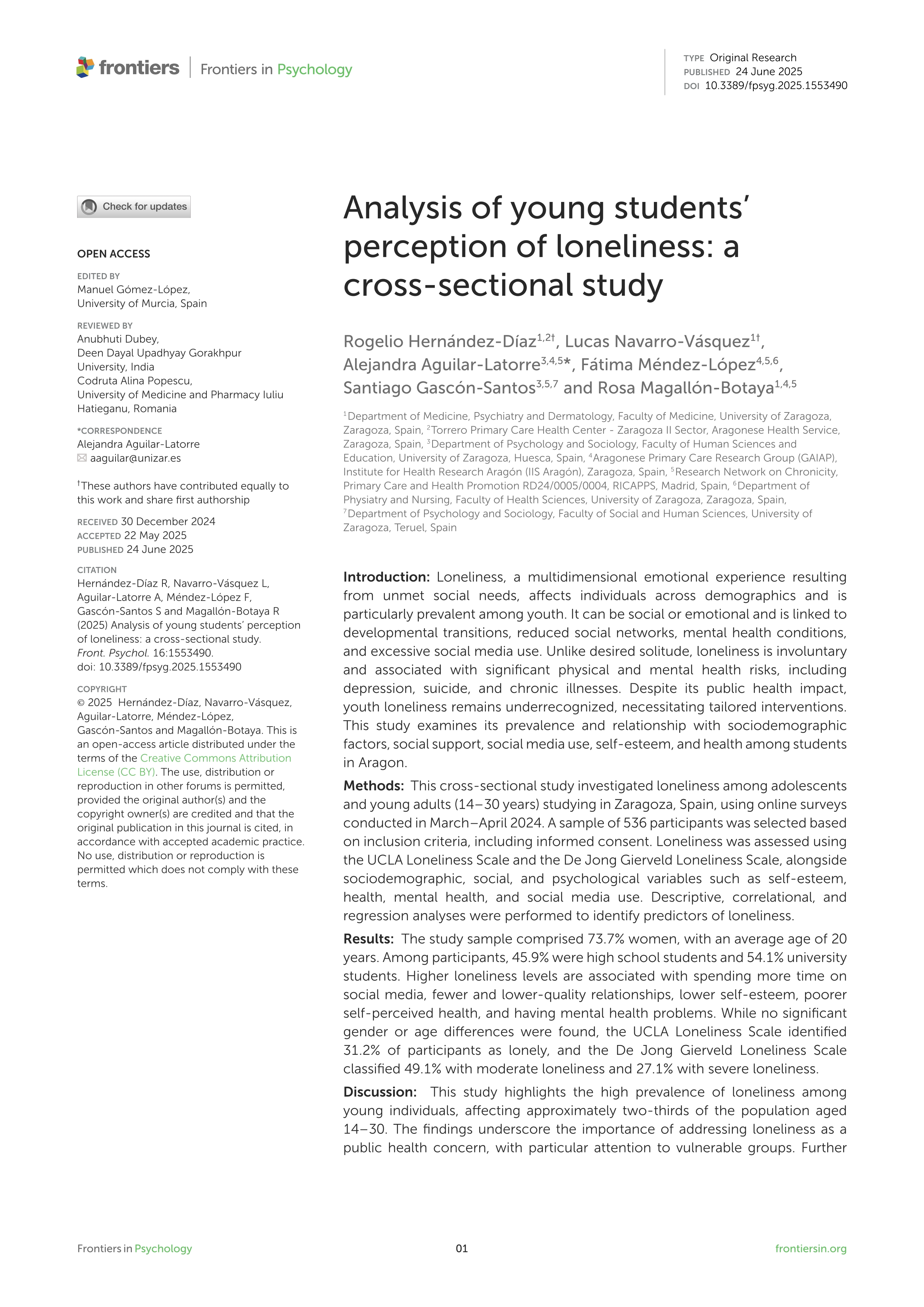
Resumen: Introduction
Loneliness, a multidimensional emotional experience resulting from unmet social needs, affects individuals across demographics and is particularly prevalent among youth. It can be social or emotional and is linked to developmental transitions, reduced social networks, mental health conditions, and excessive social media use. Unlike desired solitude, loneliness is involuntary and associated with significant physical and mental health risks, including depression, suicide, and chronic illnesses. Despite its public health impact, youth loneliness remains underrecognized, necessitating tailored interventions. This study examines its prevalence and relationship with sociodemographic factors, social support, social media use, self-esteem, and health among students in Aragon.
Methods
This cross-sectional study investigated loneliness among adolescents and young adults (14–30 years) studying in Zaragoza, Spain, using online surveys conducted in March–April 2024. A sample of 536 participants was selected based on inclusion criteria, including informed consent. Loneliness was assessed using the UCLA Loneliness Scale and the De Jong Gierveld Loneliness Scale, alongside sociodemographic, social, and psychological variables such as self-esteem, health, mental health, and social media use. Descriptive, correlational, and regression analyses were performed to identify predictors of loneliness.
Results
The study sample comprised 73.7% women, with an average age of 20 years. Among participants, 45.9% were high school students and 54.1% university students. Higher loneliness levels are associated with spending more time on social media, fewer and lower-quality relationships, lower self-esteem, poorer self-perceived health, and having mental health problems. While no significant gender or age differences were found, the UCLA Loneliness Scale identified 31.2% of participants as lonely, and the De Jong Gierveld Loneliness Scale classified 49.1% with moderate loneliness and 27.1% with severe loneliness.
Discussion
This study highlights the high prevalence of loneliness among young individuals, affecting approximately two-thirds of the population aged 14–30. The findings underscore the importance of addressing loneliness as a public health concern, with particular attention to vulnerable groups. Further research is needed to develop effective prevention, detection, and intervention strategies tailored to youth, which could be implemented through Primary Care and educational institutions.
Idioma: Inglés
DOI: 10.3389/fpsyg.2025.1553490
Año: 2025
Publicado en: Frontiers in Psychology 16 (2025), 1553490 [12 pp.]
ISSN: 1664-1078
Financiación: info:eu-repo/grantAgreement/ES/DGA/B21-23R-GAIAP
Financiación: info:eu-repo/grantAgreement/ES/ISCIII/RD24-0005/0004
Tipo y forma: Artículo (Versión definitiva)
Área (Departamento): Área Enfermería (Dpto. Fisiatría y Enfermería)
Área (Departamento): Area Medicina (Dpto. Medicina, Psiqu. y Derm.)
Área (Departamento): Área Psicolog.Evolut.Educac (Dpto. Psicología y Sociología)
Área (Departamento): Área Person.Eval.Trat.Psicoló. (Dpto. Psicología y Sociología)
 Debe reconocer adecuadamente la autoría, proporcionar un enlace a la licencia e indicar si se han realizado cambios. Puede hacerlo de cualquier manera razonable, pero no de una manera que sugiera que tiene el apoyo del licenciador o lo recibe por el uso que hace.
Exportado de SIDERAL (2025-10-17-14:18:40)
Visitas y descargas
Loneliness, a multidimensional emotional experience resulting from unmet social needs, affects individuals across demographics and is particularly prevalent among youth. It can be social or emotional and is linked to developmental transitions, reduced social networks, mental health conditions, and excessive social media use. Unlike desired solitude, loneliness is involuntary and associated with significant physical and mental health risks, including depression, suicide, and chronic illnesses. Despite its public health impact, youth loneliness remains underrecognized, necessitating tailored interventions. This study examines its prevalence and relationship with sociodemographic factors, social support, social media use, self-esteem, and health among students in Aragon.
Methods
This cross-sectional study investigated loneliness among adolescents and young adults (14–30 years) studying in Zaragoza, Spain, using online surveys conducted in March–April 2024. A sample of 536 participants was selected based on inclusion criteria, including informed consent. Loneliness was assessed using the UCLA Loneliness Scale and the De Jong Gierveld Loneliness Scale, alongside sociodemographic, social, and psychological variables such as self-esteem, health, mental health, and social media use. Descriptive, correlational, and regression analyses were performed to identify predictors of loneliness.
Results
The study sample comprised 73.7% women, with an average age of 20 years. Among participants, 45.9% were high school students and 54.1% university students. Higher loneliness levels are associated with spending more time on social media, fewer and lower-quality relationships, lower self-esteem, poorer self-perceived health, and having mental health problems. While no significant gender or age differences were found, the UCLA Loneliness Scale identified 31.2% of participants as lonely, and the De Jong Gierveld Loneliness Scale classified 49.1% with moderate loneliness and 27.1% with severe loneliness.
Discussion
This study highlights the high prevalence of loneliness among young individuals, affecting approximately two-thirds of the population aged 14–30. The findings underscore the importance of addressing loneliness as a public health concern, with particular attention to vulnerable groups. Further research is needed to develop effective prevention, detection, and intervention strategies tailored to youth, which could be implemented through Primary Care and educational institutions.
Idioma: Inglés
DOI: 10.3389/fpsyg.2025.1553490
Año: 2025
Publicado en: Frontiers in Psychology 16 (2025), 1553490 [12 pp.]
ISSN: 1664-1078
Financiación: info:eu-repo/grantAgreement/ES/DGA/B21-23R-GAIAP
Financiación: info:eu-repo/grantAgreement/ES/ISCIII/RD24-0005/0004
Tipo y forma: Artículo (Versión definitiva)
Área (Departamento): Área Enfermería (Dpto. Fisiatría y Enfermería)
Área (Departamento): Area Medicina (Dpto. Medicina, Psiqu. y Derm.)
Área (Departamento): Área Psicolog.Evolut.Educac (Dpto. Psicología y Sociología)
Área (Departamento): Área Person.Eval.Trat.Psicoló. (Dpto. Psicología y Sociología)
Debe reconocer adecuadamente la autoría, proporcionar un enlace a la licencia e indicar si se han realizado cambios. Puede hacerlo de cualquier manera razonable, pero no de una manera que sugiera que tiene el apoyo del licenciador o lo recibe por el uso que hace. Exportado de SIDERAL (2025-10-17-14:18:40)
Enlace permanente:
Visitas y descargas
Este artículo se encuentra en las siguientes colecciones:
Artículos > Artículos por área > Personalidad,Evaluación y Tratamiento Psicológicos
Artículos > Artículos por área > Psicología Evolutiva y de la Educación
Artículos > Artículos por área > Enfermería
Artículos > Artículos por área > Medicina
Registro creado el 2025-08-26, última modificación el 2025-10-17