Unsupervised clustering of biochemical markers reveals health profiles associated with function and survival in active aging
González-Martos, Raquel ; Galeano, Javier ; Ramirez-Castillejo, Carmen ; Gusi, Narcis ; Gesteiro, Eva ; Vicente-Rodriguez, German (Universidad de Zaragoza) ; Ara, Ignacio ; Guadalupe-Grau, Amelia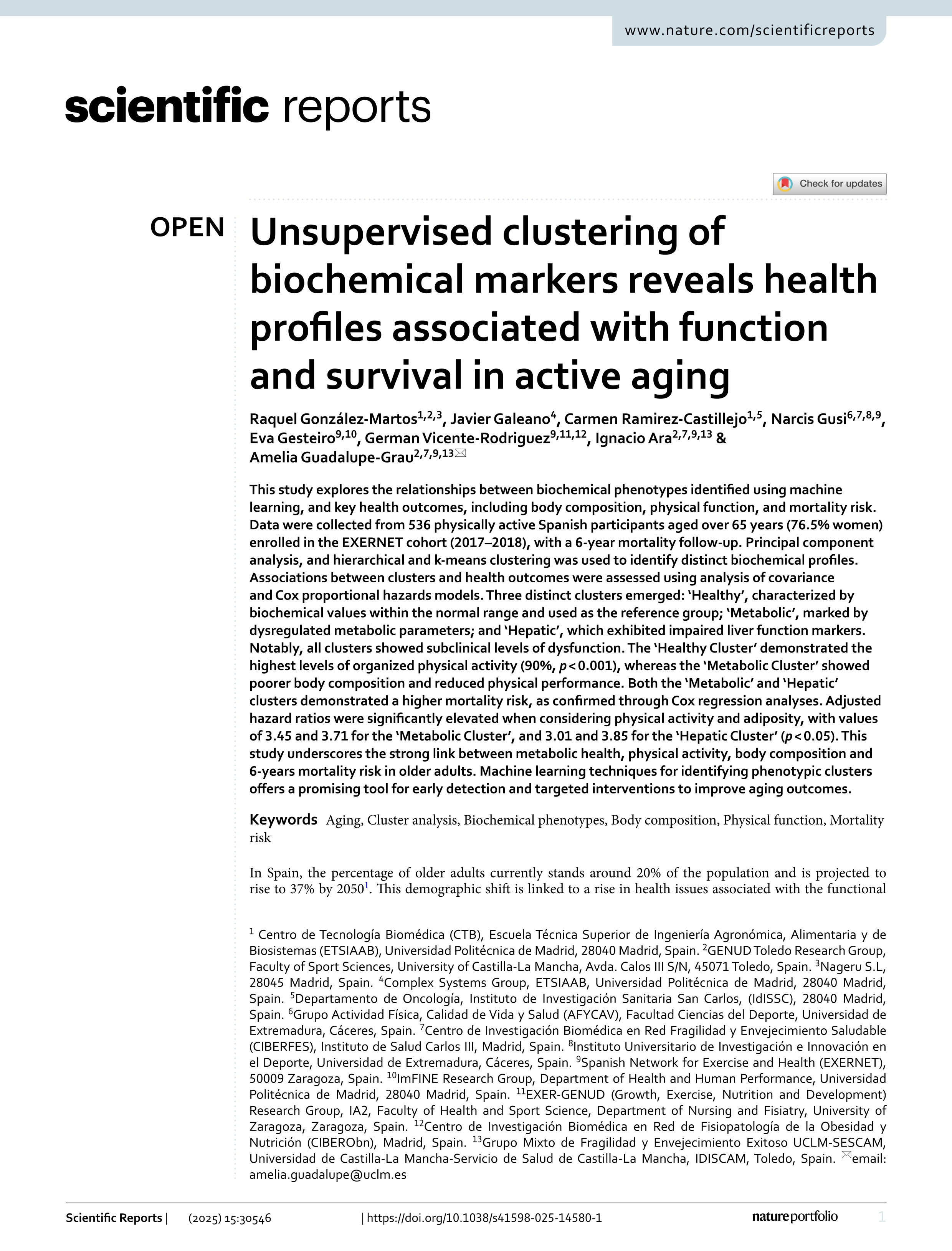

Resumen: This study explores the relationships between biochemical phenotypes identified using machine learning, and key health outcomes, including body composition, physical function, and mortality risk. Data were collected from 536 physically active Spanish participants aged over 65 years (76.5% women) enrolled in the EXERNET cohort (2017–2018), with a 6-year mortality follow-up. Principal component analysis, and hierarchical and k-means clustering was used to identify distinct biochemical profiles. Associations between clusters and health outcomes were assessed using analysis of covariance and Cox proportional hazards models. Three distinct clusters emerged: ‘Healthy’, characterized by biochemical values within the normal range and used as the reference group; ‘Metabolic’, marked by dysregulated metabolic parameters; and ‘Hepatic’, which exhibited impaired liver function markers. Notably, all clusters showed subclinical levels of dysfunction. The ‘Healthy Cluster’ demonstrated the highest levels of organized physical activity (90%, p < 0.001), whereas the ‘Metabolic Cluster’ showed poorer body composition and reduced physical performance. Both the ‘Metabolic’ and ‘Hepatic’ clusters demonstrated a higher mortality risk, as confirmed through Cox regression analyses. Adjusted hazard ratios were significantly elevated when considering physical activity and adiposity, with values of 3.45 and 3.71 for the ‘Metabolic Cluster’, and 3.01 and 3.85 for the ‘Hepatic Cluster’ (p < 0.05). This study underscores the strong link between metabolic health, physical activity, body composition and 6-years mortality risk in older adults. Machine learning techniques for identifying phenotypic clusters offers a promising tool for early detection and targeted interventions to improve aging outcomes.
Idioma: Inglés
DOI: 10.1038/s41598-025-14580-1
Año: 2025
Publicado en: Scientific reports (Nature Publishing Group) 15, 1 (2025), [12 pp.]
ISSN: 2045-2322
Financiación: info:eu-repo/grantAgreement/ES/AEI/RED2022-134800-T
Financiación: info:eu-repo/grantAgreement/EC/FP7/305483/EU/Utility of omic-based biomarkers in characterizing older individuals at risk for frailty, its progression to disability and general consequences to health and well-being - The FRAILOMIC Initiative/FRAILOMIC
Financiación: info:eu-repo/grantAgreement/ES/MECD/EXERNET-DEP2005-00046
Financiación: info:eu-repo/grantAgreement/ES/MECD/09-UPB-19
Financiación: info:eu-repo/grantAgreement/ES/MECD/27-UPB-21
Financiación: info:eu-repo/grantAgreement/ES/MECD/29-UPB-22
Financiación: info:eu-repo/grantAgreement/ES/MECD/45-UPB-20
Financiación: info:eu-repo/grantAgreement/ES/MECD/5-UPB-23
Tipo y forma: Artículo (Versión definitiva)
Área (Departamento): Área Educación Física y Depor. (Dpto. Fisiatría y Enfermería)
 Debe reconocer adecuadamente la autoría, proporcionar un enlace a la licencia e indicar si se han realizado cambios. Puede hacerlo de cualquier manera razonable, pero no de una manera que sugiera que tiene el apoyo del licenciador o lo recibe por el uso que hace. No puede utilizar el material para una finalidad comercial. Si remezcla, transforma o crea a partir del material, no puede difundir el material modificado.
Exportado de SIDERAL (2025-10-17-14:37:22)
Visitas y descargas
Idioma: Inglés
DOI: 10.1038/s41598-025-14580-1
Año: 2025
Publicado en: Scientific reports (Nature Publishing Group) 15, 1 (2025), [12 pp.]
ISSN: 2045-2322
Financiación: info:eu-repo/grantAgreement/ES/AEI/RED2022-134800-T
Financiación: info:eu-repo/grantAgreement/EC/FP7/305483/EU/Utility of omic-based biomarkers in characterizing older individuals at risk for frailty, its progression to disability and general consequences to health and well-being - The FRAILOMIC Initiative/FRAILOMIC
Financiación: info:eu-repo/grantAgreement/ES/MECD/EXERNET-DEP2005-00046
Financiación: info:eu-repo/grantAgreement/ES/MECD/09-UPB-19
Financiación: info:eu-repo/grantAgreement/ES/MECD/27-UPB-21
Financiación: info:eu-repo/grantAgreement/ES/MECD/29-UPB-22
Financiación: info:eu-repo/grantAgreement/ES/MECD/45-UPB-20
Financiación: info:eu-repo/grantAgreement/ES/MECD/5-UPB-23
Tipo y forma: Artículo (Versión definitiva)
Área (Departamento): Área Educación Física y Depor. (Dpto. Fisiatría y Enfermería)
Debe reconocer adecuadamente la autoría, proporcionar un enlace a la licencia e indicar si se han realizado cambios. Puede hacerlo de cualquier manera razonable, pero no de una manera que sugiera que tiene el apoyo del licenciador o lo recibe por el uso que hace. No puede utilizar el material para una finalidad comercial. Si remezcla, transforma o crea a partir del material, no puede difundir el material modificado.Exportado de SIDERAL (2025-10-17-14:37:22)
Enlace permanente:
Visitas y descargas
Este artículo se encuentra en las siguientes colecciones:
Artículos > Artículos por área > Educación Física y Deportiva
Registro creado el 2025-08-29, última modificación el 2025-10-17