Editorial: Integrating computational modeling and organoid technology for enhanced biological research
García-Aznar, J. M. (Universidad de Zaragoza) ; McEvoy, E. ; Verbruggen, S. W. ; Van Liedekerke, P.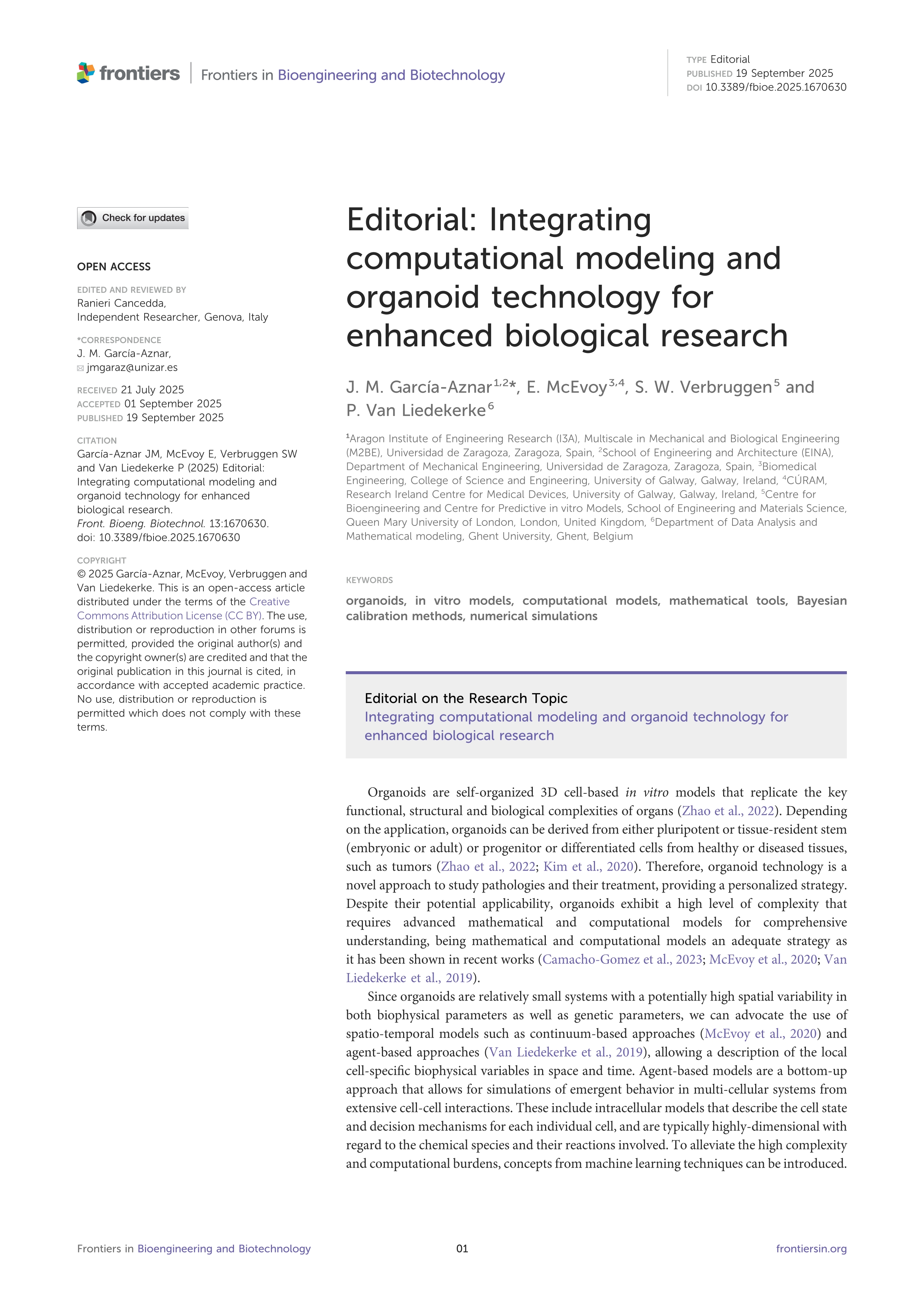
Resumen: Organoids are self-organized 3D cell-based in vitro models that replicate the key functional, structural and biological complexities of organs (Zhao et al., 2022). Depending on the application, organoids can be derived from either pluripotent or tissue-resident stem (embryonic or adult) or progenitor or differentiated cells from healthy or diseased tissues, such as tumors (Zhao et al., 2022; Kim et al., 2020). Therefore, organoid technology is a novel approach to study pathologies and their treatment, providing a personalized strategy. Despite their potential applicability, organoids exhibit a high level of complexity that requires advanced mathematical and computational models for comprehensive understanding, being mathematical and computational models an adequate strategy as it has been shown in recent works (Camacho-Gomez et al., 2023; McEvoy et al., 2020; Van Liedekerke et al., 2019)...
Idioma: Inglés
DOI: 10.3389/fbioe.2025.1670630
Año: 2025
Publicado en: Frontiers in Bioengineering and Biotechnology 13 (2025), 1670630 [2 pp.]
ISSN: 2296-4185
Tipo y forma: (Versión definitiva)
Área (Departamento): Área Mec.Med.Cont. y Teor.Est. (Dpto. Ingeniería Mecánica)
 Debe reconocer adecuadamente la autoría, proporcionar un enlace a la licencia e indicar si se han realizado cambios. Puede hacerlo de cualquier manera razonable, pero no de una manera que sugiera que tiene el apoyo del licenciador o lo recibe por el uso que hace.
Exportado de SIDERAL (2025-10-24-16:56:28)
Visitas y descargas
Idioma: Inglés
DOI: 10.3389/fbioe.2025.1670630
Año: 2025
Publicado en: Frontiers in Bioengineering and Biotechnology 13 (2025), 1670630 [2 pp.]
ISSN: 2296-4185
Tipo y forma: (Versión definitiva)
Área (Departamento): Área Mec.Med.Cont. y Teor.Est. (Dpto. Ingeniería Mecánica)
Debe reconocer adecuadamente la autoría, proporcionar un enlace a la licencia e indicar si se han realizado cambios. Puede hacerlo de cualquier manera razonable, pero no de una manera que sugiera que tiene el apoyo del licenciador o lo recibe por el uso que hace. Exportado de SIDERAL (2025-10-24-16:56:28)
Enlace permanente:
Visitas y descargas
Este artículo se encuentra en las siguientes colecciones:
Artículos > Artículos por área > Mec. de Medios Contínuos y Teor. de Estructuras
Registro creado el 2025-10-24, última modificación el 2025-10-24